

More news on this day
Thousands of passengers remained trapped in terminals at Dubai International Airport on March 1 as more than 1,100 flights were cancelled and scores delayed across the Middle East, after sweeping airspace closures linked to escalating U.S.-Israel tensions with Iran threw one of the world’s busiest aviation corridors into disarray.
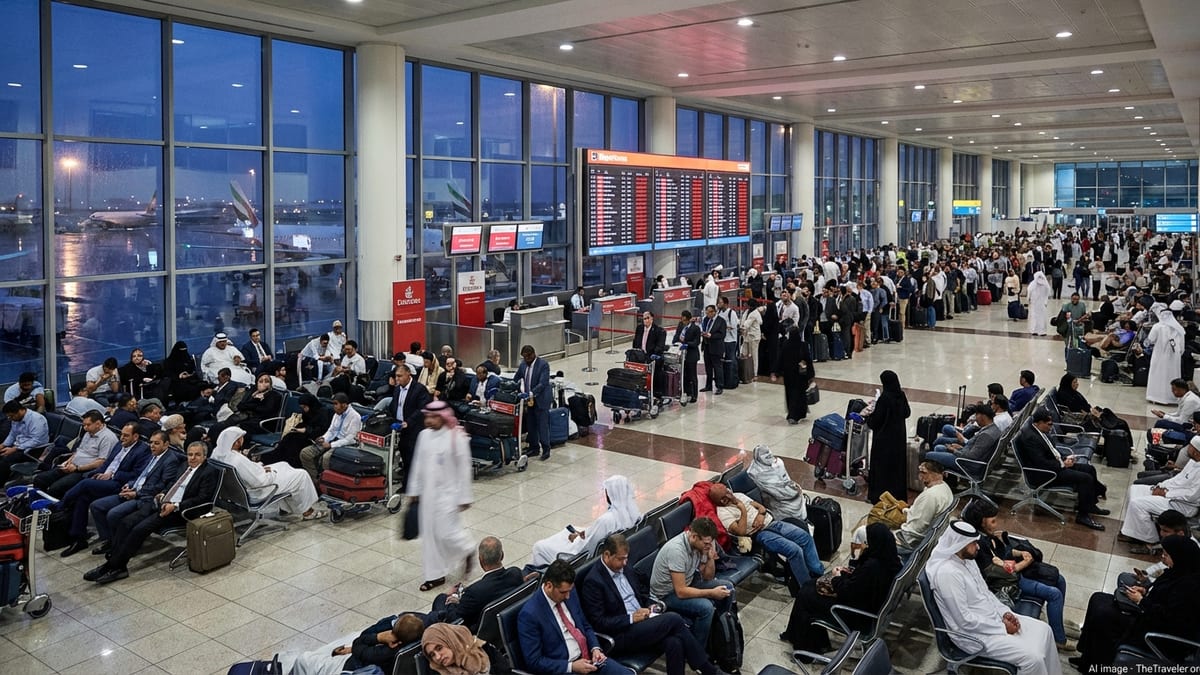
Dubai International Brought to a Standstill
Dubai International Airport, the globe’s largest hub for international passengers, has effectively gone offline following regional airspace shutdowns and reported missile strikes connected to the latest flare-up between the United States, Israel and Iran. Airport authorities suspended all operations at both Dubai International and Al Maktoum International on February 28, instructing travellers not to come to the terminals and to contact airlines directly for rebooking or refunds.
Over a two day period around 1,121 flights were cancelled and at least 117 delayed at Dubai alone, according to airport and industry estimates, with long haul carriers scrambling to divert aircraft already en route. Crowded departure halls quickly turned into makeshift waiting areas as passengers stretched out on the floor beside trolleys stacked with luggage, while food outlets and restrooms struggled to cope with the surge.
Emirates, which relies on Dubai as its central hub, halted the bulk of its schedule, effectively freezing the flow of tens of thousands of connecting travellers who normally pass through the city each day on routes linking Europe, Asia, Africa and Australasia. Regional low cost operator Flydubai has also grounded services, adding to the backlog of stranded passengers that airline analysts say could take days, if not longer, to clear once airspace begins to reopen.
Ripple Effects in Doha, Cairo and Tel Aviv
The shutdown in the United Arab Emirates has rippled across neighbouring hubs, with Qatar Airways suspending all flights to and from Doha after Qatari airspace was closed as a precaution. Hamad International Airport, usually one of the most reliable connecting points between Europe and Asia, has been reduced to a sea of waiting travellers as aircraft are parked at remote stands and check in counters sit idle.
In Cairo, where Egyptian airspace remains technically open but key regional corridors are blocked, airlines have been consolidating services and diverting flights that would normally overfly Iran, Iraq or the Gulf. Passengers arriving from Europe report holding patterns and last minute route changes, while onward connections to Gulf destinations are cancelled with little clarity on when they might resume.
Tel Aviv’s Ben Gurion Airport has also seen operations curtailed amid missile alerts and official warnings for airlines to avoid Israeli and adjacent skies. Carriers serving the city, including some European and U.S. airlines, have suspended or rerouted services, forcing passengers to seek scarce seats on alternative routes through Athens, Larnaca or Istanbul, many of which themselves face congestion from rerouted long haul traffic.
Multiple Airlines, One Intertwined Crisis
Beyond Emirates and Flydubai, a wide roster of carriers has been swept into the disruption as airspace over Iran, Israel, Iraq, Kuwait, Bahrain, Qatar and parts of the UAE has been closed or heavily restricted. Gulf heavyweight Qatar Airways has grounded much of its network, while regional and South Asian operators such as Flynas, Airblue and SpiceJet have been forced to cancel or reroute flights that rely on the Gulf as a primary transit point.
Qatar Airways, Etihad Airways and other network carriers serving Abu Dhabi, Doha and Dubai collectively move tens of thousands of people each day between continents using the Gulf as a bridge. With that bridge suddenly severed, passengers bound between Europe and India, Southeast Asia, Australia and East Africa have found themselves stranded on every leg of their journey, from origin airports in London, Frankfurt and Toronto to transit hubs in Doha, Dubai and Cairo.
Analysts warn that the knock on effects are likely to be felt well beyond the Middle East in the days ahead. With aircraft and crew out of position, airlines are cancelling rotations as far away as North America and East Asia, while others are adding unplanned technical stops in cities such as Riyadh or Jeddah to refuel on longer detours skirting closed airspace. The consequence is a patchwork of irregular operations that makes planning almost impossible for travellers and carriers alike.
Passengers Face Uncertainty and Mounting Costs
Inside terminals from Dubai to Doha, scenes on March 1 were marked by long queues at airline desks and information boards dominated by the word “cancelled.” Families slept on benches and carpets near departure gates as they waited for updates, with many reporting that they had received only limited communication from airlines struggling to keep pace with rapidly shifting military and regulatory conditions.
Travel insurers and consumer advocates say passengers should expect extended delays before normal schedules can be restored. With regional airspace still restricted and the risk of further military action not fully dismissed, aviation authorities are moving cautiously. Airlines are issuing travel waivers, allowing customers to rebook without change fees or to request refunds, but in many cases alternative flights are days away due to a lack of available seats and aircraft.
The financial toll on travellers is growing alongside the operational strain on airlines. Hotel rooms near major airports quickly sold out once suspensions were announced, pushing some stranded passengers to seek accommodation far from terminals or to remain airside. Food and incidental costs are mounting, especially for those without comprehensive travel insurance, while some budget carriers have provided only limited vouchers in line with their standard disruption policies.
Global Aviation Confronts a Strategic Chokepoint
The crisis has underscored the degree to which global aviation depends on a relatively narrow corridor of Middle Eastern airspace for flights linking Europe with Asia and Australasia. Dubai alone handled more than 90 million passengers last year and was projected to edge toward 100 million in 2026, with Emirates and Flydubai funneling much of that traffic through tightly scheduled banked connections.
With multiple Gulf and Levant airspaces now partially or fully closed, many airlines have shifted to longer routes over Saudi Arabia or further south, adding hours to flight times and significantly increasing fuel burn and crew duty costs. Industry experts say these expenses are likely to filter through to higher ticket prices if the disruption endures, compounding the impact on travellers already facing rebookings and cancellations.
Regulators and airline safety departments are closely monitoring the security situation following U.S.-Israeli strikes on Iranian targets and subsequent Iranian retaliatory attacks. While there is hope that airspace can reopen in stages as military risks are reassessed, officials caution that any renewed exchange of fire or missile threats could prompt fresh closures with little warning. For now, passengers heading anywhere near the region are being urged to check their flight status repeatedly and prepare for last minute changes to even the most well planned itineraries.