

More news on this day
Air travel across the Middle East was plunged into sudden chaos on February 28 after coordinated US and Israeli strikes on Iran prompted a cascade of airspace closures, mass flight cancellations and emergency rerouting across one of the world’s busiest aviation corridors.
Airspace Closures Ripple Across the Gulf and Beyond
Within hours of the strikes on Iran in the early hours of Saturday, aviation maps showed large parts of regional skies abruptly clearing as civil authorities shut or restricted airspace over Iran, Iraq, Kuwait, Israel and Bahrain, with additional partial closures across the Gulf. Safety notices from regulators cited the heightened risk to civil aircraft due to ongoing military operations and the possibility of further retaliatory action.
Iran’s civil aviation authority moved to effectively close its national airspace to most commercial traffic until further notice, while Israel and several Gulf states, including Qatar and the United Arab Emirates, temporarily halted civilian movements. Regional hubs that normally act as bridges between Europe, Asia and Africa suddenly found themselves cut off or operating at sharply reduced capacity, forcing airlines to scramble for alternative routings or cancel flights outright.
Preliminary data from aviation analytics firm Cirium indicated that on Saturday alone nearly 40 percent of flights to Israel and close to 7 percent of services to the wider region were cancelled, a figure that is expected to shift as airlines continue to adjust schedules. Industry analysts warn that even a short period of closures can create lingering knock-on effects, as aircraft and crew end up in the wrong locations and complex long-haul networks take days to be fully rebalanced.
Major Hubs Disrupted: Dubai, Doha and Abu Dhabi Hit Hard
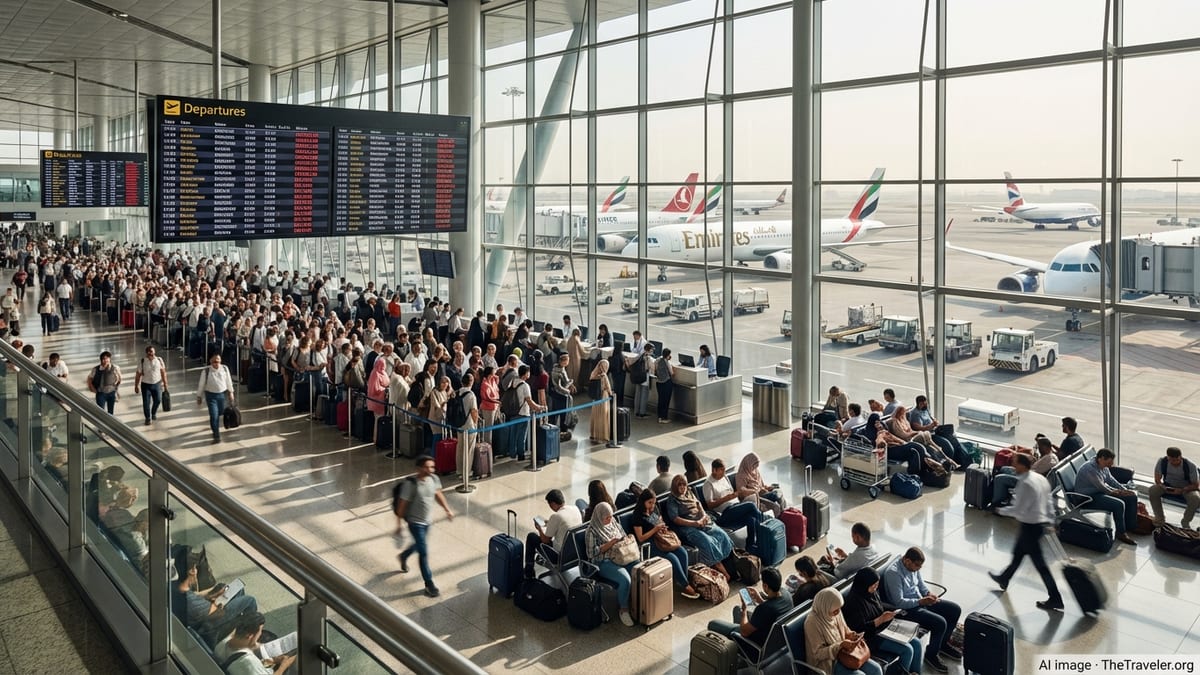
Nowhere is the disruption more visible than in the Gulf’s giant transit hubs. Dubai International Airport, which normally ranks among the world’s busiest for international passengers, suspended all departures and arrivals on Saturday after the UAE announced a partial and temporary closure of its airspace. Operations were also halted at Dubai World Central, the emirate’s secondary airport, bringing traffic in one of the key nodes of global aviation to a standstill.
Home carrier Emirates said it had suspended all operations to and from Dubai for the duration of the closures, while sister low-cost airline flydubai also grounded services. Abu Dhabi’s Zayed International Airport reported widespread delays, diversions and cancellations, with Etihad Airways suspending departures from the Emirati capital until at least Sunday afternoon local time and warning that inbound services prior to that window would be cancelled.
In Qatar, authorities temporarily closed national airspace as a precaution amid reports of explosions near Doha, which hosts a major United States military base. Qatar Airways confirmed it had halted flights to and from Doha while the restrictions remain in place, cautioning passengers that even once operations resume, they should expect significant delays and an extended period of schedule instability as the carrier works through the backlog.
Which Airlines and Routes Are Most Affected
The impact of the strikes and subsequent airspace shutdowns is being felt most acutely by airlines that rely on Middle Eastern hubs as transit points between Europe and Asia. Gulf carriers including Emirates, Etihad, Qatar Airways, flydubai and Air Arabia have either suspended operations entirely for specific windows or cancelled swathes of services to and from affected cities across the region.
European and Asian airlines have also moved quickly to adjust. Lufthansa has halted flights to Tel Aviv, Beirut and Oman until early March and suspended Dubai operations for at least the weekend, while Air France and KLM have cancelled services to Tel Aviv and Beirut and rerouted long-haul flights to avoid Iranian, Iraqi and neighboring conflict-zone airspace. Low-cost operator Wizz Air has frozen flights to Israel, Dubai, Abu Dhabi and Amman until at least March 7, and carriers such as Virgin Atlantic and Turkish Airlines are diverting around certain countries or suspending specific routes outright.
In South Asia, Indian airlines including Air India and IndiGo have cancelled or diverted flights touching the Middle East, particularly services to Tel Aviv and key Gulf destinations, citing operational and safety concerns. Japan Airlines has scrapped at least one rotation between Tokyo and Doha. For many of these carriers, the challenge is not only whether a destination remains open but whether a safe and commercially viable routing exists that avoids closed airspace and still allows aircraft to operate within crew duty limits and fuel constraints.
What Travelers Flying Through the Region Should Do
For passengers with imminent trips involving the Middle East, the picture is fluid and subject to rapid change throughout the weekend and into next week. Airlines are urging customers not to travel to the airport without first checking their flight status on official channels and monitoring mobile or email alerts, as some services are being cancelled only hours before departure or diverted mid-flight to alternative airports.
Travel agents and airline call centers are reporting heavy demand from stranded passengers attempting to rebook, particularly those using Gulf hubs as connection points between Europe and Asia or between North America and the Indian subcontinent. In many cases, re-routing now involves significant detours over Central Asia or Africa to avoid closed skies, extending flight times by several hours and requiring additional fuel stops.
Most carriers have introduced short-term flexible policies, allowing free rebooking or refunds for itineraries touching affected airports over the coming days, though specific rules vary by airline and fare type. Travelers are being advised to consider postponing non-essential journeys through the region, to hold off on booking new itineraries involving Middle Eastern hubs until the situation clarifies, and to ensure any new tickets include clear flexibility or change options.
Safety, Insurance and How Long Disruptions Could Last
Regulators and safety agencies in Europe and beyond have issued conflict-zone advisories for parts of the Middle East, warning of elevated risks to civil aircraft in airspace where military operations and missile activity are ongoing. While commercial jets maintain substantial safety margins and airlines conduct their own risk assessments, the combination of active hostilities and the presence of military assets across multiple states has led many operators to err on the side of caution.
Travel insurance coverage is another point of concern. Policies differ widely on what is classified as a war-related event and how flight cancellations, diversions or trip curtailments are handled. Industry experts recommend that passengers review the wording of their policies and, where possible, contact insurers directly to clarify coverage in light of the recent strikes and airspace closures. Some premium products may cover additional accommodation and re-routing costs, while more basic plans may exclude disruptions linked to armed conflict.
How long the current chaos will last depends largely on the pace of diplomatic efforts and any further military escalation. Aviation analysts suggest that if airspace restrictions are eased within days, airlines can gradually restore schedules, albeit with lingering delays as aircraft and crew are repositioned. A more prolonged closure of Iranian and neighboring skies, however, would force carriers to bake longer routings, higher fuel burn and increased insurance costs into their operations, potentially leading to reduced frequencies and higher fares on some long-haul markets that rely on Middle East transit corridors.