

More news on this day
Global aviation is reeling as escalating conflict involving Iran, Israel and the United States triggers sweeping airspace closures and missile attacks across the Middle East, pushing flight cancellations to nearly 23 percent and grinding key Gulf hubs in the United Arab Emirates, Qatar and Saudi Arabia to a near standstill.
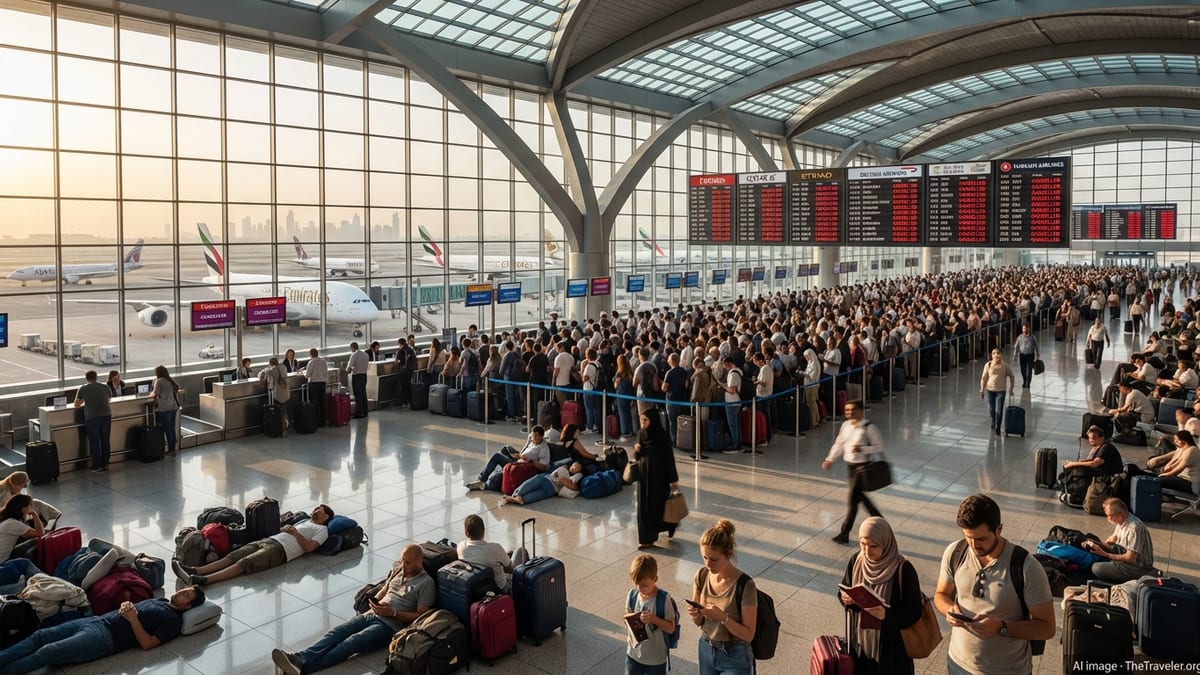
Airspace Closures Drive Record Flight Cancellations
According to data from aviation analytics firms, the Middle East has experienced one of its sharpest and fastest spikes in operational disruption since the pandemic. On Saturday, February 28, 966 of 4,218 scheduled arrivals into Middle Eastern destinations were cancelled, representing 22.9 percent of inbound flights. When outbound services are added, total cancellations across the region are estimated to exceed 1,800 flights within a 24 hour window.
Authorities in Iran, Israel, Iraq, Jordan, Lebanon, Qatar, Bahrain, Kuwait and the United Arab Emirates moved to close or severely restrict their airspace after joint United States and Israeli strikes on Iran and subsequent retaliatory attacks. The closures have effectively severed some of the world’s busiest east west corridors, forcing airlines to ground aircraft, divert routes and strand passengers across multiple continents.
By Sunday March 1, cancellations remained elevated, with at least 716 of 4,329 scheduled arrivals into the wider region already scrubbed and analysts warning that the figures are likely to climb further as airlines progressively update schedules to reflect the fluid security situation.
Gulf Mega Hubs Fall Silent as Missiles Target Airports
Dubai International Airport, normally one of the busiest international hubs on the planet, has all but fallen silent after the United Arab Emirates temporarily and partially closed its skies. Airport authorities in Dubai and at the newer Al Maktoum International have suspended operations until further notice as risk assessments continue in the wake of Iranian missile and drone barrages across the Gulf.
Neighbouring hubs in Abu Dhabi and Doha have also been hit by cascading shutdowns. Qatar’s civil aviation authority temporarily closed national airspace, prompting Qatar Airways to halt regular passenger services while operating only limited special flights to move stranded travellers when security conditions permit. Bahrain, Kuwait and Oman have likewise imposed restrictions, with Bahrain confirming that its air defence systems intercepted dozens of missiles and drones aimed at critical infrastructure including its international airport.
Iranian strikes have not been confined to military targets, with debris and shrapnel reported near civilian areas and hotel districts in Gulf cities. In the UAE, local reports describe damage and injuries linked to drone and missile interceptions near airport zones, reinforcing airline risk assessments that routine commercial operations are currently untenable.
Saudi Arabia, Israel and Iran at the Heart of a Regional Shock
While Gulf hubs have drawn global attention, the disruption stretches from the eastern Mediterranean to the Strait of Hormuz. Israel has closed its airspace to civilian traffic as part of wartime protocols, grounding a large proportion of flights to and from Tel Aviv. Iran, at the epicentre of the confrontation, swiftly shut its skies to commercial aviation until further notice as strikes intensified.
Saudi Arabia, traditionally a crucial overflight bridge between Europe, Asia and Africa, has seen hundreds of services disrupted as airlines avoid conflict zones and navigate shifting notices to air missions. Though its airports have not experienced the same level of direct damage reported elsewhere, the kingdom’s role as an alternate overflight corridor has been complicated by the evolving military picture and by congestion on remaining viable routes.
The ripple effects extend beyond the immediate combatants. Carriers serving Egypt, Jordan and other neighbouring states have cancelled or rerouted services as flight planners work to avoid missile trajectories and restricted zones. Analysts warn that the concentration of long haul traffic through a relatively narrow geographic band has left global aviation acutely exposed to regional shocks of this kind.
Airlines Ground Fleets and Reroute Around a Fragmented Sky
Major Middle Eastern airlines, including Emirates, Etihad Airways and Qatar Airways, have suspended the bulk of their scheduled operations through the affected hubs, operating only selective repatriation or repositioning flights under enhanced security protocols. Regional operators such as flydubai and Saudia have cancelled dozens of services, while EgyptAir, Turkish Airlines and a growing list of Asian and European carriers have imposed sweeping curbs on routes that either serve the Middle East directly or rely on its airspace.
Indian carriers are among those heavily exposed. Air India and IndiGo have extended suspensions of flights to the United Arab Emirates, Saudi Arabia, Qatar and Israel through at least March 2, and have also cancelled or curtailed selected Europe bound services that ordinarily cross Middle Eastern airspace. Additional cancellations were announced for March 3 by other Asian airlines, including the suspension of flights to Abu Dhabi, Doha, Jeddah, Kuwait and Riyadh by some low cost operators as a precautionary measure.
Beyond outright cancellations, thousands of flights worldwide have been delayed as airlines scramble to design longer detours around closed skies. Alternative routings over the Caucasus, Central Asia and North Africa are adding significant flight time and fuel burn, squeezing already thin margins at a moment when oil prices are rising on fears of broader energy supply disruption.
Stranded Travellers, Soaring Costs and Uncertain Timelines
For passengers, the numbers translate into chaotic scenes at airports and in transit hotels from the Gulf to Europe and Asia. Hundreds of thousands of travellers have been stranded or diverted after midair route changes forced aircraft to land at secondary airports far from their intended destinations. With operations at many primary hubs suspended, rebooking options are limited and in some cases non existent in the short term.
Travel industry sources report surging demand for private jet evacuations from Gulf cities, with charter rates spiralling into the hundreds of thousands of dollars for last minute long haul departures. Some expatriates and business travellers have resorted to long overland journeys to reach functioning airports in less affected parts of the region.
Tour operators and corporate travel managers are racing to update advisories and reroute itineraries. Many governments have issued or upgraded travel warnings for countries across the Middle East, urging citizens to defer non essential trips and, in some cases, to shelter in place until organised evacuation plans are finalised. Insurers and airlines are bracing for a wave of claims as travellers seek refunds, compensation and alternative arrangements.
For now, industry analysts caution that any recovery in regional air connectivity hinges on security assessments and political decisions rather than purely operational factors. While some officials have expressed hope that closures will be short lived, the breadth of airspace restrictions, the direct targeting and near misses at major airports, and the strategic importance of Gulf hubs to global traffic mean that even a limited extension of the current crisis could reshape long haul flight patterns well beyond the Middle East in the weeks ahead.