

More news on this day
Europe’s aviation safety regulator has warned of a “high risk” to civilian flights across much of the Middle East and Persian Gulf, prompting widespread rerouting, cancellations and fresh uncertainty for tourism-dependent hubs from Dubai to Doha as the Iran war ripples through global air travel.
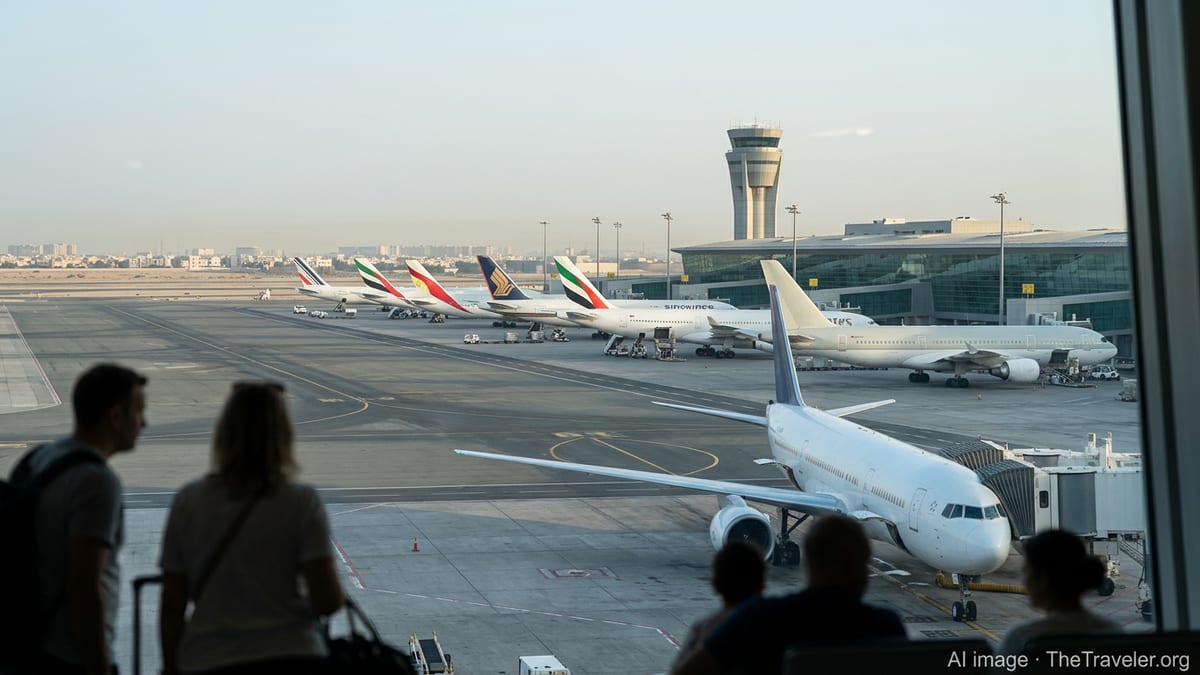
EASA Raises the Alarm Over Conflict Zone Airspace
The European Union Aviation Safety Agency has issued an urgent Conflict Zone Information Bulletin covering the Middle East and Persian Gulf, advising airlines that large swaths of regional airspace now pose a high risk to civilian operations. The move follows joint strikes by the United States and Israel on Iran on 28 February 2026 and subsequent missile and drone attacks across the region, which have sharply increased the likelihood of miscalculation involving civil aircraft.
The latest bulletin, identified by aviation authorities as CZIB 2026-03 and updated in early March, urges operators to avoid the airspaces of Bahrain, Iran, Iraq, Israel, Jordan, Kuwait, Lebanon, Oman, Qatar, Saudi Arabia, the United Arab Emirates and surrounding international waters where military activity has intensified. National regulators in Europe have echoed the guidance, issuing notices to airmen that restrict or prohibit overflights without a documented risk assessment.
EASA’s conflict zone bulletins do not themselves close airspace, but they carry significant weight for European carriers and insurers. Airlines operating under EU oversight are expected to treat the new guidance as a baseline for their own operational risk analysis, and many have reacted by suspending routes outright or shifting to lengthy detours around the region.
The bulletin builds on earlier, narrower advisories for the airspace of Iran, Iraq, Israel, Jordan and Lebanon that were in place through 2025. Whereas those notices focused on specific flight levels and routes, the latest warning reflects a more systemic crisis that stretches from the eastern Mediterranean to the Strait of Hormuz and beyond.
Route Closures, Detours and Operational Strain
Within days of the escalation, major international airlines began trimming or suspending services to the Middle East and rerouting long haul flights that normally depend on Gulf hubs. European and Asian carriers have temporarily halted services to cities such as Tehran, Baghdad and Tel Aviv, while flights to Doha, Dubai and Abu Dhabi have been cut back or re-timed as authorities imposed partial closures and tight slot controls.
Flight tracking data and airline statements show transcontinental services between Europe and South or Southeast Asia now skirting far to the south, through the Arabian Sea and Indian Ocean, or pushing north via Central Asia to avoid the high-risk airspace corridor. These detours add up to two hours to some journeys, pushing aircraft toward fuel limits, complicating crew duty schedules and squeezing fleet availability at a time of strong demand.
Airports that marketed themselves as seamless global connectors are facing particular pressure. Hamad International in Doha and Dubai International, among the world’s busiest transfer hubs, have both experienced temporary suspensions of movements and abrupt schedule changes as operators waited for clearer guidance from regulators and militaries. Airlines based in the Gulf have launched limited relief and repatriation flights, but their usual wave structures remain heavily disrupted.
Operationally, carriers are dealing not only with closed corridors but also with degraded navigation environments. Reports of GPS jamming and spoofing around conflict zones have led some operators to bring back additional inertial navigation procedures and old-fashioned contingency planning, further slowing traffic and increasing cockpit workload on already stressful routes.
Tourism Destinations Confront a Sudden Shock
The EASA warning lands at a sensitive time for Middle Eastern tourism. Gulf countries such as the United Arab Emirates, Qatar and Saudi Arabia have spent heavily to position themselves as stopover and holiday destinations, banking on reliable air connectivity to sustain new resorts, cultural districts and mega-events. The current airspace restrictions are eroding that foundation in real time.
Travel agents report a wave of cancellations and deferrals for leisure trips to Dubai, Abu Dhabi and coastal resorts along the Gulf, as well as for pilgrimage and heritage tourism in Jordan and Saudi Arabia. Even destinations that remain technically open to visitors are seeing demand evaporate as travelers weigh fast-changing advisories, images of missile launches and the possibility of being stranded due to sudden airport closures.
The impact extends beyond headline hubs. Smaller destinations that rely on one or two key routes via Gulf connectors are vulnerable when those links vanish. Popular Indian Ocean and East African beach destinations, which depend heavily on one-stop itineraries through Doha or Dubai, are experiencing softer bookings and last-minute re-routings as airlines cobble together alternative paths that avoid the conflict corridor.
In Europe and Asia, tourism boards are also adjusting their messaging. Some are quietly promoting routings via alternative hubs in Istanbul, Cairo or Central Asia, while cautioning visitors to build extra time into connections and to pay close attention to airline and government alerts in the days leading up to departure.
Price Pressures and Insurance Complications for Airlines
Economic consequences from the EASA risk warning are already feeding through to ticket prices and airline balance sheets. Longer routings mean higher fuel burn, additional crew costs and greater exposure to delay compensation regimes. Airlines that cannot viably detour certain routes have simply cut frequencies, reducing capacity and pushing up fares in remaining markets.
Insurance is another pressure point. War-risk underwriters tend to re-price coverage rapidly in response to conflict zone advisories, and a broad bulletin covering much of the Middle East can sharply increase premiums for any airline seeking to operate there, even on limited humanitarian or repatriation services. Some carriers may find that the incremental insurance and security costs cancel out the commercial benefit of maintaining a skeleton schedule.
For passengers, the result is a patchwork of refund and rebooking policies that can change from week to week. While many airlines initially offered free date and route changes for itineraries touching the affected region, those waivers are now tightening as operators gain more clarity about which corridors will remain closed and which can be served safely with detours.
Corporate travel planners are revising risk thresholds as well. Companies that once allowed staff to transit Gulf hubs en route to Asia or Africa are increasingly routing employees via Europe, North America or alternative Asian gateways, accepting higher costs and longer journeys in exchange for reduced exposure to a volatile airspace environment.
What Travelers Should Do Now
For individual travelers, the EASA warning does not mean an automatic ban on flying to or through the Middle East, but it does change the calculus. Analysts expect weeks, and possibly months, of intermittent disruptions as military operations evolve and regulators adjust their risk assessments. That uncertainty argues for flexibility and close monitoring rather than last-minute improvisation at the airport.
Experts recommend that passengers with existing tickets touching the region check their itineraries daily in the run-up to departure and keep contact details updated in airline profiles and booking records. Where possible, choosing routings that avoid known conflict zone airspace, even if slightly longer or more expensive, can reduce the risk of cancellations or extended diversions.
Travel insurance with explicit coverage for war-related disruptions and missed connections is becoming more important, though policies vary in how they treat government advisories and conflict zone bulletins. Travelers are being urged to scrutinize the fine print and, if needed, to speak directly with insurers about what happens if their flight is rerouted or scrubbed due to changing EASA or national authority guidance.
For now, industry observers say, the Middle East’s role as a seamless global crossroads has been visibly dented. Whether it rebounds quickly will depend not only on the course of the Iran war, but also on how fast regulators such as EASA feel comfortable lifting their risk warnings and restoring the confidence of airlines, insurers and the millions of travelers who cross the region’s skies each year.