

More news on this day
Air travel across the Middle East has been plunged into chaos after joint US-Israel strikes on Iran triggered sweeping airspace closures from the Gulf to the Levant, grounding flights, stranding passengers at major hubs and forcing airlines worldwide to tear up carefully planned routes between Europe, Asia and Africa.
Airspace Closures Sweep Across the Region
Within hours of the strikes on Iran, at least eight states including Iran, Israel, Qatar, Bahrain, Kuwait and the United Arab Emirates moved to shut their skies to civilian traffic, citing security risks from ongoing missile exchanges and potential retaliatory attacks. Aviation authorities in Iraq and Jordan also imposed sweeping restrictions, while Syria partially closed its southern airspace near the Israeli border, creating an unprecedented no-fly belt across much of the Middle East.
In the Gulf, the UAE announced a partial and temporary closure of its airspace, but the impact was effectively total for international passengers. Flights at Dubai International Airport, one of the world’s busiest long haul hubs, and at Al Maktoum International were suspended until further notice, while operations at Abu Dhabi’s Zayed International were sharply curtailed. Qatar, Bahrain and Kuwait followed with their own closures, leaving air traffic controllers across the region working to clear skies and divert aircraft already en route.
Regional officials said the emergency measures were based on intensive risk assessments and coordination with international partners as missile interceptions and debris were reported over several countries. Authorities stressed that airspace safety and national sovereignty were the priority, warning that restrictions would remain in place as long as the threat to civil aviation remained high.
Hubs in the UAE, Qatar and Saudi Arabia Paralyzed
The closures have hit the Gulf’s giant transfer hubs particularly hard, sending shock waves through global aviation. Emirates, based in Dubai, suspended all operations to and from its home base after the UAE airspace decision, while low cost carrier flydubai and regional player Air Arabia also halted large parts of their schedules. Abu Dhabi Airports warned of widespread delays, diversions and cancellations at Zayed International as aircraft were turned back to origin or rerouted far from usual corridors.
In Qatar, Doha’s Hamad International Airport, another key bridge between Europe and Asia, saw Qatar Airways suspend flights as the country’s civil aviation authority closed national airspace. Bahrain’s civil aviation department, managing a smaller but strategically vital hub, told passengers to expect diversions and cancellations as both its own skies and those of neighboring states shut down.
Saudi Arabia, which has stayed technically open as a southern detour corridor, has cancelled flights on its flag carrier Saudia to multiple regional destinations including Abu Dhabi, Dubai, Doha, Kuwait and Bahrain. Analysts say Saudi controllers are now managing intense volumes of rerouted long haul services skirting the conflict zone, increasing workload and forcing airlines to build in extra flight time and fuel.
Thousands of Flights Disrupted and Travellers Stranded
Data from aviation analytics firms show that roughly one in four flights scheduled to land in Middle Eastern countries on Saturday was cancelled, with total cancellations including outbound services topping 1,800 in a single day. Hundreds more flights have been delayed or forced onto lengthy detours, while cancellations have continued into Sunday as airlines reassess risk and await clearer guidance from regulators and militaries.
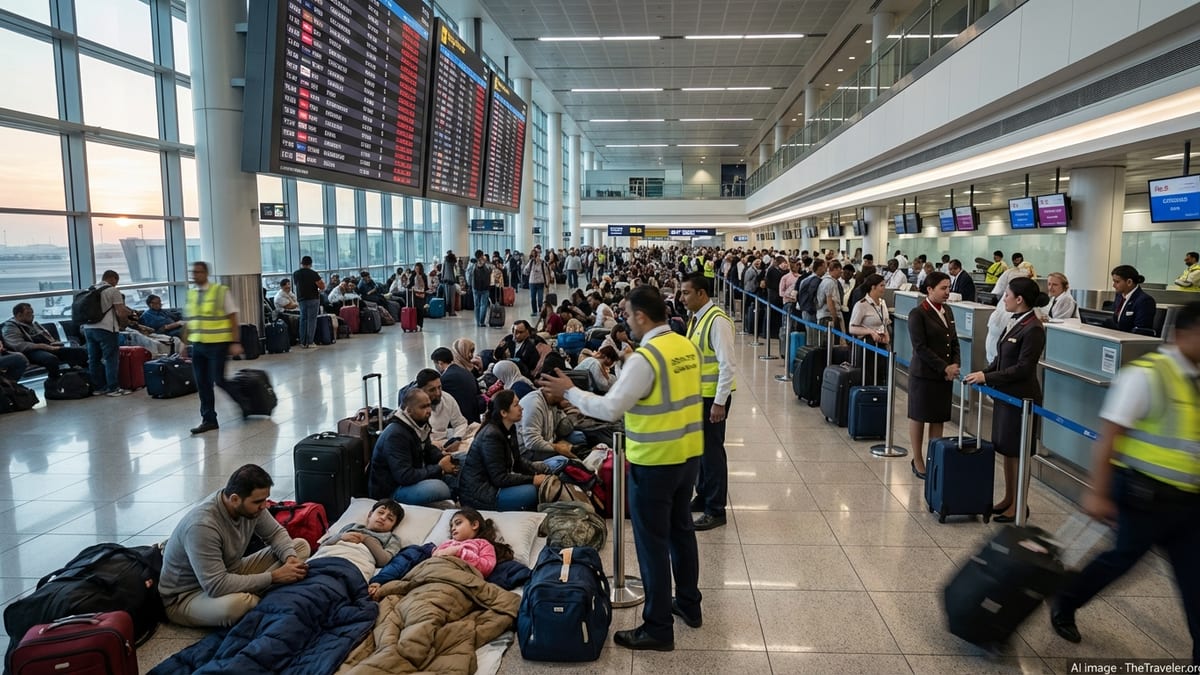
At airports from Dubai and Abu Dhabi to Doha, Beirut and beyond, tens of thousands of passengers have found themselves marooned in transit. Travellers reported sleeping on terminal floors, queuing for hours at rebooking desks and struggling to secure hotel rooms as capacity in nearby cities quickly filled. Some governments, including the UAE, said they were covering meals, accommodation and rebooking costs for stranded passengers caught in the disruption at their airports.
The crisis has spread far beyond the region. Airports in Europe and Asia, including major gateways that host flights to Gulf hubs, have reported waves of cancellations and last minute aircraft swaps. Airlines serving the Middle East from North America have pulled services or diverted them via longer southern routes, adding hours to journeys and complicating crew scheduling and aircraft rotations across global fleets.
Global Airlines Reroute and Suspend Middle East Operations
Flag carriers across Europe, Asia and North America have responded with sweeping adjustments to their networks. Many have temporarily suspended flights to Israel, Qatar, Kuwait and the UAE, while others have halted services to Lebanon, Jordan and Iraq amid warnings from safety regulators about the high risk to civil aviation in conflict-affected airspace. Several airlines have also extended earlier suspensions to Tel Aviv that were introduced during previous rounds of regional tension.
For other long haul operators, the priority has been rerouting around the expanding no fly zones. Carriers that once crossed Iran, Iraq and the Gulf on the most direct tracks between Europe and Asia are now planning paths that sweep south over Saudi Arabia, or in some cases west over Egypt and the eastern Mediterranean. These longer routings demand more fuel, tighten payload margins and erode already thin profit margins on competitive intercontinental routes.
Industry analysts warn that the cost pressures will soon reach passengers. Airlines may absorb the initial spike in fuel burn and crew costs, but if airspace closures persist, higher fares on Europe Asia itineraries that relied on Middle East connections are widely expected. The closures will also cut overflight fee revenues for states that have sealed their skies, removing a lucrative income stream at a time when they are simultaneously facing security and economic shocks.
How Long Could the Disruptions Last?
Aviation safety bodies in Europe and elsewhere have issued fresh conflict zone bulletins covering large parts of the Middle East, advising airlines to avoid affected skies due to the risk from missiles, drones and military intercepts. Experts say any reopening is likely to be gradual and heavily conditioned on military developments, including further US and Israeli operations and Iran’s capacity or intent to launch additional attacks on regional targets.
Security analysts note that partial reopenings are possible once clear deconfliction channels are in place and militaries share more precise information on their flight paths and engagement rules. Even then, some carriers may choose to avoid the region entirely, remembering previous incidents in which civilian aircraft were downed over conflict zones in other parts of the world. Risk tolerance will vary by airline and by national regulator, potentially leading to a patchwork of routing decisions even after official restrictions ease.
For now, travellers with upcoming itineraries touching the Middle East are being urged to monitor airline alerts closely, keep contact details updated and be prepared for last minute changes. Industry observers say that as long as the confrontation between the United States, Israel and Iran remains live, the Middle East’s role as a seamless global transit crossroads has been fundamentally disrupted, with ripple effects that will be felt across the world’s air routes for days and possibly weeks to come.