

More news on this day
Air travelers across the Middle East are facing steep fare increases and mounting flight disruptions as soaring jet fuel costs, driven by the widening conflict around Iran and the Strait of Hormuz, ripple through one of the world’s most vital aviation corridors.
Get the latest news straight to your inbox!
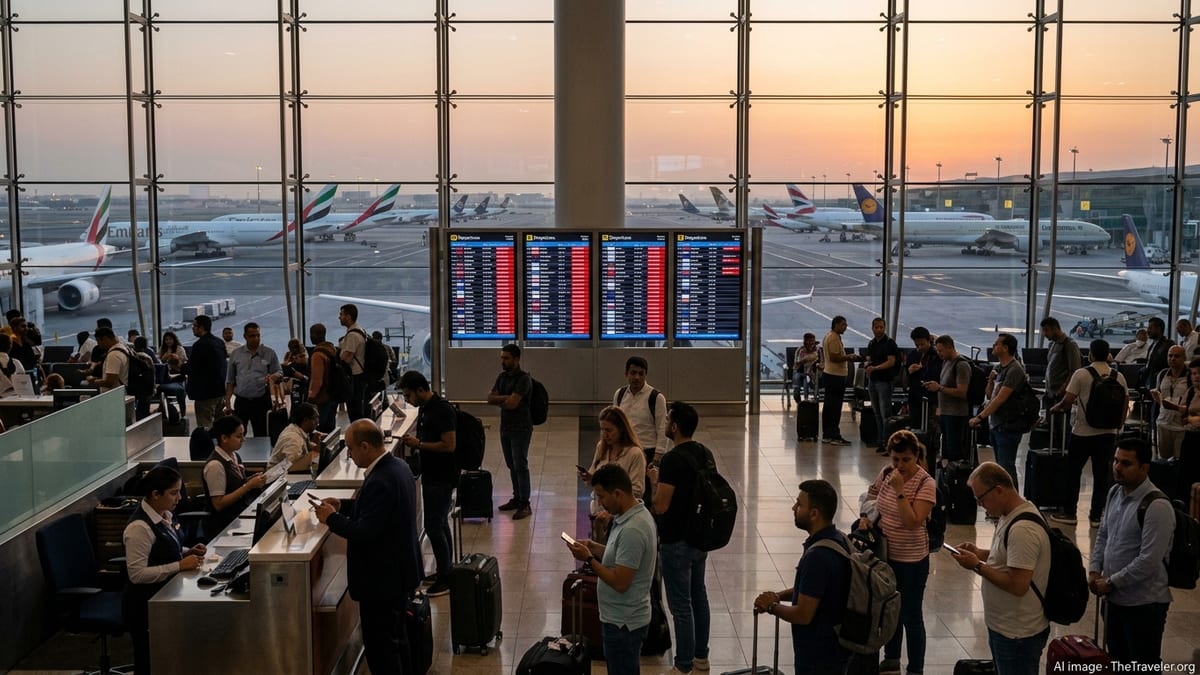
Jet Fuel Spike Pushes Regional Fares Sharply Higher
Published analyses of the 2026 Iran war and the related Strait of Hormuz crisis indicate that roughly one fifth of global oil supplies moving through the chokepoint have been disrupted, sending Brent crude prices from around 70 dollars to well above 110 dollars per barrel within days. Industry commentary notes that the shock has fed directly into jet fuel markets, where costs have jumped even faster than crude benchmarks.
Recent reporting from aviation and business outlets describes jet fuel as one of airlines’ largest expenses, frequently representing a quarter or more of operating costs. As prices spike, carriers are moving quickly to preserve margins by raising base fares, adding fuel surcharges, or quietly withdrawing the lowest promotional tickets from sale on Middle East routes.
According to coverage of remarks by the head of the International Air Transport Association, airlines are now anticipating global ticket price increases in the high single digits, with some European reporting pointing to projected rises of around 8 to 9 percent as fuel costs surge. One Spanish business daily recently highlighted that jet fuel prices have climbed more than 100 percent since the beginning of the year, a reversal from earlier IATA forecasts that had assumed relatively stable energy markets.
Travel trade publications add that higher oil prices linked to the Middle East conflict are expected to push airfares higher worldwide, not only on routes touching the region. Analysts cited in those reports note that when demand remains solid, airlines often pass higher fuel costs on to passengers through surcharges and fewer discounted seats, meaning budget travelers are likely to feel the squeeze first.
Airspace Closures Trigger Cancellations and Rerouting
The sharp rise in fuel costs is compounded by unprecedented operational disruption. A detailed summary of the economic impact of the 2026 Iran war notes that Bahrain, Iraq, Israel, Kuwait, Qatar, Syria, and the United Arab Emirates have all closed or severely restricted their airspace following recent attacks, forcing airlines to cancel flights outright or undertake long detours that further increase fuel burn.
Earlier conflict episodes in the region offer a preview of the current pattern. In mid 2025, news coverage from financial and regional outlets documented how major Gulf and European carriers temporarily halted services to Tel Aviv, Tehran, Amman, Beirut, and multiple Iraqi airports after Israel and Iran exchanged strikes. Some UAE airlines suspended flights to Iran, Iraq, Jordan, Lebanon, Syria, and Israel, citing airspace restrictions and security concerns, while European groups such as Lufthansa paused routes to several Middle Eastern destinations for weeks.
Security-focused situation reports from 2025 described extensive no fly zones forming over Iraq, Syria, Lebanon, Jordan, and parts of the Eastern Mediterranean, leading to widespread cancellations and diversions. With the newer escalation now centered on Iran and the Strait of Hormuz, analysts warn that a similar but broader pattern is emerging, affecting not only point to point links within the Middle East but also long haul connections between Europe, Asia, and Africa that traditionally overfly the region.
Industry commentary in international business media notes that avoiding conflict zones can significantly lengthen flight times as aircraft route around closed airspace. Longer flying times demand more fuel and place additional strain on crew duty limits, which can in turn force further cancellations when staff reach regulatory working hour caps.
Global Airlines Trim Middle East Capacity
Publicly available information compiled by international news organizations and reference sources shows that a growing list of global airlines has reduced or suspended services to the Middle East in response to the latest fighting. Carriers from India, Bangladesh, Europe, and East Asia have announced temporary halts on flights to major hubs in the Gulf and Levant or have suspended overflights of Iranian and neighboring airspace.
Aviation reporting from mid 2025, when tensions also spiked, detailed similar steps. Airlines such as Air India diverted or turned back flights that normally cross Iranian airspace, while European operators curtailed services to Jordan, Lebanon, and Israel for extended periods. British and Scandinavian carriers also adjusted schedules or introduced temporary price increases to offset higher fuel bills and operational uncertainty on routes touching the region.
Current coverage from Asia focused media highlights that airlines in the Asia Pacific, including Qantas, Air India, and Cathay Pacific, have already raised fares or imposed new fuel surcharges tied directly to the war in the Middle East and higher aviation turbine fuel prices. Analysts quoted in those reports say that more carriers are likely to follow if elevated fuel and insurance costs persist.
Industry outlooks from financial news platforms suggest that while global passenger demand remains resilient, especially for leisure and visiting family travel, the combination of route suspensions, higher costs, and capacity constraints could limit growth plans for airlines that had been counting on Middle Eastern hubs as key connectors between continents.
Travelers Face Rising Costs, Reduced Options, and Safety Warnings
For travelers, the immediate impact is visible in higher ticket prices, fewer available seats, and increased uncertainty when planning itineraries that pass through the region. Travel specialists interviewed in trade coverage recommend booking earlier than usual, as airlines remove the cheapest fare classes and reduce schedules, leaving less room for last minute bargains or flexible rebooking.
Reports from international security and travel risk consultancies describe a patchwork of airport operations across the Middle East, with some hubs functioning normally and others subject to sudden closures or curfews depending on the security situation. Airports in Lebanon, Iraq, Jordan, Israel, and parts of the Gulf have all experienced temporary shutdowns or significant disruption during previous escalation phases, and current assessments caution that similar interruptions remain a real possibility.
Public travel advisories issued in recent weeks underscore the seriousness of the situation. One widely covered notice from the United States government urged its citizens to leave a broad swath of Middle Eastern countries, citing serious safety risks associated with the conflict involving Iran and Israel. Such advisories can influence both demand and airline decision making, as carriers weigh commercial opportunities against evolving risk profiles.
Travel industry analysts say that while some passengers may simply postpone or reroute their trips away from the Middle East, others who need to travel for family or business reasons may have little choice but to accept higher costs and longer journeys. With no clear timeline for de escalation, observers expect elevated fares, selective cancellations, and complex routings to remain a defining feature of air travel to, from, and across the Middle East in the months ahead.