

More news on this day
As missile and drone strikes ripple across the Gulf, shuttering key hubs from Dubai to Doha and forcing mass rerouting of global traffic, the latest Middle East crisis is revealing just how fragile the region’s air travel systems remain when confronted with fast-moving conflict.
Get the latest news straight to your inbox!
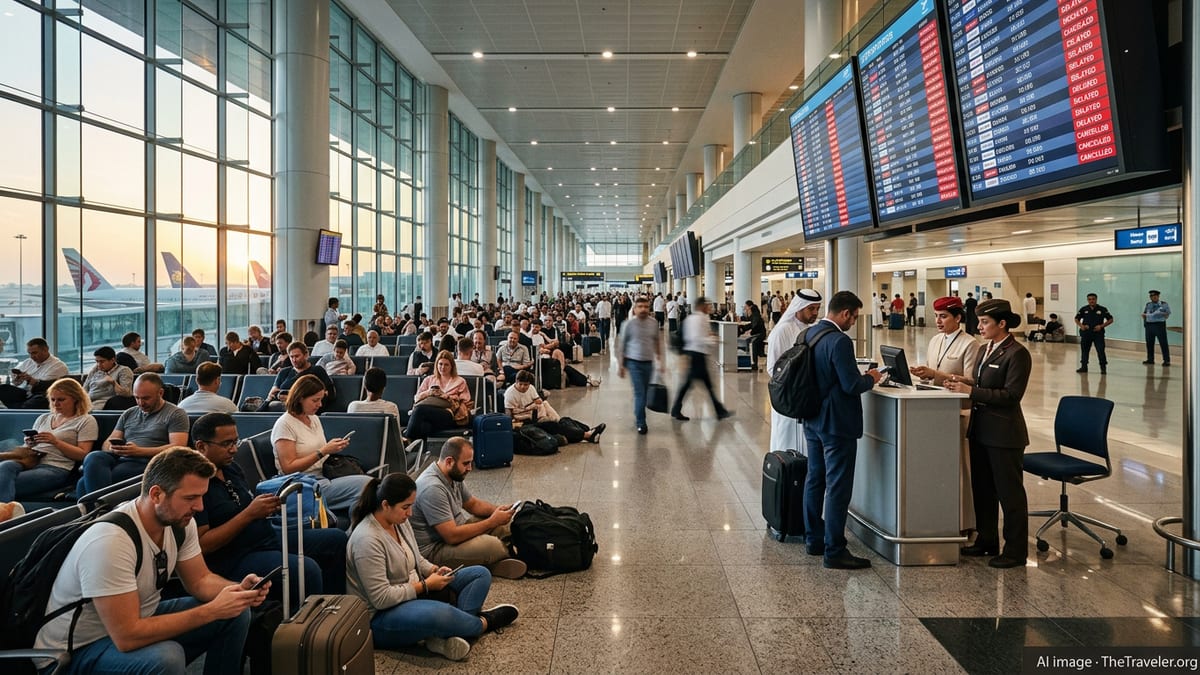
Airports Under Fire and Networks at a Standstill
In recent days, a wave of Iranian missile and drone attacks linked to the broader 2026 Iran war has disrupted operations at some of the world’s most important aviation hubs. Publicly available information shows that Dubai International, the world’s busiest international airport, temporarily suspended flights after a drone strike ignited a fuel facility, while additional incidents were reported near airports in Bahrain, Qatar and Saudi Arabia. Airspace closures or severe restrictions across multiple Gulf states have cascaded across global schedules, pushing airlines into emergency holding patterns and last-minute diversions.
Travel advisories compiled by security and logistics firms indicate that commercial flights into Abu Dhabi, Doha and parts of Saudi Arabia were halted or sharply curtailed in early March, with some carriers operating only limited repatriation or emergency services. Dubai’s brief closure alone sent shockwaves through long-haul networks that rely on the city as a connecting hub between Europe, Asia, Africa and Australasia. For many travelers, journeys that once required a single, overnight connection suddenly stretched into multi-stop odysseys or were cancelled altogether.
While airports and airlines have activated contingency plans, the speed and geographic spread of the strikes have tested the limits of existing systems. The picture emerging from published coverage is one of fragmented responses: partial shutdowns, rapidly changing no-fly zones and inconsistent communication timelines that have left passengers and corporate travel planners scrambling.
From Reroutes to Gridlock: The Operational Fallout
Operationally, the crisis is forcing airlines to redraw flight paths on the fly. With segments of Gulf airspace restricted, long-haul services between Europe and Asia are being rerouted over alternative corridors, adding flight time and fuel burn. Freight and logistics updates from major forwarders describe reduced schedules, suspended routes and longer block times into and out of Dubai, Abu Dhabi, Doha and other regional gateways. What began as a regional security emergency is now reshaping traffic patterns far beyond the Middle East.
This rerouting carries a heavy cost. Aviation analysts cited in recent travel and business coverage estimate that every additional hour of flying can add thousands of dollars in operating expenses, a burden magnified on widebody long-haul sectors. Fuel price spikes linked to attacks on regional oil infrastructure are compounding the pressure. For carriers already operating on thin margins, prolonged detours threaten to erase profits for the season and may push fares higher ahead of the busy summer period.
Capacity constraints are tightening as well. Industry briefings suggest that a significant share of global air cargo lift is tied to Gulf carriers and corridors. With some aircraft redeployed to longer, less efficient routes and others grounded outright, available bellyhold space has shrunk. Shippers now face a familiar mix of longer transit times, higher rates and limited alternatives, echoing the disruption seen in the Red Sea shipping crisis of 2023 and 2024.
Passengers Left Guessing in a Patchwork of Alerts
For travelers, the most visible symptom of the crisis has been uncertainty. Corporate travel advisories and security risk bulletins describe a patchwork of airline policies and last-minute adjustments as carriers respond to evolving risk assessments and airspace notices. Some airlines have proactively suspended flights to affected cities, while others have continued limited operations with altered routings, creating confusion for passengers trying to interpret what is safe or viable.
Reports indicate that many travelers learned of cancellations or major delays only hours before departure, as airspace restrictions tightened or new attacks were reported. Even where waivers for rebooking and refunds have been introduced, access to timely, consistent information has varied widely between markets and channels. In a region where same-day business trips and tight connection windows are common, the lack of clear, synchronized communication has amplified frustration.
The situation also exposes an information gap between professional risk managers and individual leisure travelers. Large corporations plugged into specialist security briefings often received early warnings to reroute staff away from Gulf hubs. Independent travelers, by contrast, have largely relied on scattered airline updates and social media posts, with limited tools to visualize alternative routings or understand cascading risks when a single hub goes offline.
Why Existing Preparedness Systems Are Struggling
The latest turmoil follows a decade of repeated aviation shocks in and around the Middle East, from airspace closures over Iraq and Syria to drone strikes near Israeli and Saudi airports and Houthi threats to Red Sea corridors. Yet the industry’s crisis playbook remains heavily focused on single-point disruptions rather than multi-country, multi-domain events that simultaneously affect airspace, airports and fuel supply.
Publicly available industry commentary highlights several structural weaknesses. Many contingency plans still assume a short, geographically contained crisis with predictable no-fly zones and clear lines of authority. By contrast, the current conflict features rapidly shifting risk profiles, overlapping military operations and intermittent attacks on both civilian and military infrastructure. Flight planning systems, insurance frameworks and crew duty rules were not designed for this kind of rolling, region-wide volatility.
Moreover, digital coordination between airlines, airports, air navigation providers and logistics partners remains limited. While individual organizations have built robust internal crisis teams, there is no shared real-time dashboard that aggregates airspace status, attack reports, fuel availability and operational restrictions across the region. This fragmentation slows decision-making, increases the likelihood of conflicting route choices and complicates efforts to prioritize humanitarian or evacuation flights when capacity is constrained.
Toward Smarter, Shared Resilience in the Skies
The current crisis is prompting renewed calls from analysts and logistics specialists for a more integrated approach to aviation resilience in conflict-prone regions. One recurring theme in recent advisories is the need for standardized, pre-negotiated contingency corridors that can be activated quickly when certain airspaces become unsafe, reducing the scramble for ad hoc reroutes. Building these plans in calmer times, in coordination with regional regulators, could shorten the window between threat and response.
Another priority is data. Travel and supply chain firms are urging greater investment in shared situational-awareness platforms that synthesize flight tracking, open-source security reporting and fuel and capacity metrics into tools that both airlines and large corporate clients can use. If widely adopted, such systems could allow for earlier, more targeted advisories, helping to prevent airports from becoming overwhelmed by last-minute cancellations and stranded travelers.
For passengers, the lesson is as much about transparency as technology. The latest disruptions are underscoring the value of clear, plain-language communication about risk thresholds, routing options and likely timelines for recovery. As Middle East air travel weathers yet another period of upheaval, the measure of the industry’s preparedness will be less about avoiding disruption altogether and more about how quickly and coherently it can respond when the skies turn uncertain.