

More news on this day
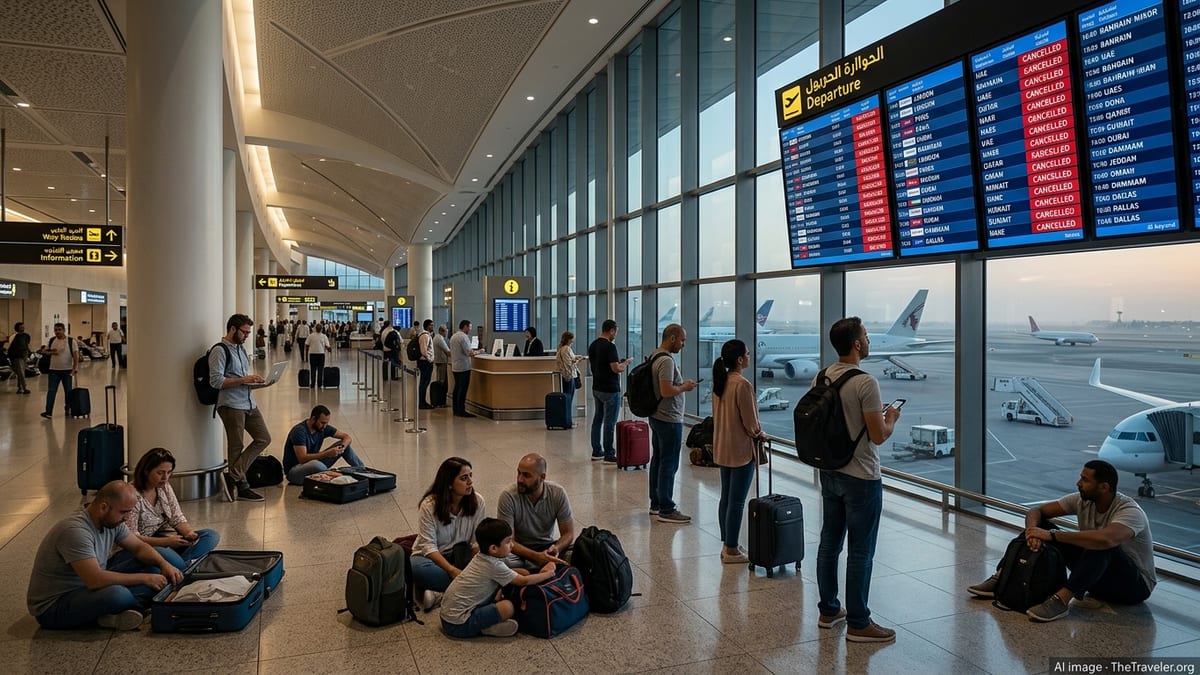
A new wave of airspace restrictions and operational cutbacks across the Gulf is driving severe disruption to global travel, with publicly available data indicating at least 181 flight cancellations and 434 delays affecting major carriers such as Gulf Air, Flynas, Emirates and Saudia, and routes linking Dammam, Jeddah, London, Paris, Dallas and other key hubs.
Get the latest news straight to your inbox!
Airspace Limits Across the Gulf Trigger Fresh Disruption
Monitoring services tracking real time operations across the Middle East report that a patchwork of airspace closures and restrictions involving Bahrain, the United Arab Emirates, Qatar, Oman and Kuwait has sharply curtailed scheduled passenger traffic. Publicly available information shows that civil aviation authorities and airport operators in several of these states have imposed tighter controls on departures and overflights in response to heightened regional tensions, forcing airlines to ground aircraft or reroute around closed corridors.
Aggregated status boards for major Gulf airports indicate that the latest disruption has translated into at least 181 cancellations and 434 delays within a short operating window, with a disproportionate impact on long haul services that rely on Gulf hubs as connective nodes between Europe, Asia and North America. These figures continue to evolve as airlines adjust schedules and aircraft rotations, but early data points to one of the most concentrated bursts of operational turmoil since the initial wave of airspace shutdowns in early March 2026.
Publicly accessible advisories compiled by aviation enthusiasts and frequent flyer communities suggest that cancellations and rolling delays are affecting both local point to point services within the Gulf and complex multi leg itineraries involving transfers through the region. With several countries adjusting restrictions on a day to day basis, airlines have been left with limited room to restore predictable schedules, increasing the likelihood of further last minute changes.
Major Gulf Carriers Cut and Reroute Services
The latest figures indicate that leading Gulf and regional carriers are again at the center of the disruption. Gulf Air, Flynas, Emirates, Saudia and other Middle Eastern airlines have cancelled or significantly delayed a range of services as they react to constrained airspace and revised safety assessments. According to published operational updates and schedule tracking, these carriers have trimmed frequencies on busy trunk routes and in some cases temporarily suspended flights to particular destinations.
Emirates, typically one of the most reliable long haul operators in the region, has already been through several rounds of adjustments in March, switching between broad suspensions and limited repatriation style operations on select days. Recent community sourced flight logs show the airline operating a reduced set of services to cities such as Jeddah, London and Dallas on specific dates while other departures on the same routes remain cancelled or heavily delayed.
Gulf Air and Flynas appear to be particularly exposed to constraints on Bahrain and Saudi linked airspace, with multiple reports of passengers facing back to back cancellations on connections routed through Bahrain or secondary Saudi gateways. Saudia, with a large domestic and regional network built around Jeddah, Riyadh and Dammam, is also listed among carriers posting significant delays as it works around changing airspace availability and slot limitations.
Foreign airlines using Gulf hubs for onward connections have not been spared. Public schedules show European and Asian carriers trimming services into affected airports, both to manage operational risk and to avoid stranding aircraft and crew in locations where onward flying remains uncertain.
Key Hubs From Dammam and Jeddah to London and Paris Affected
The operational upheaval is most visible at major regional hubs, where departure boards are again dominated by cancellations and rolling delay notices. King Fahd International Airport serving Dammam and King Abdulaziz International Airport in Jeddah are among the Saudi gateways seeing substantial schedule disruption, affecting both domestic links within the kingdom and international services across the Middle East, Europe and Asia.
Data from global flight tracking platforms shows that disruption is not confined to the Gulf. Long haul routes connecting European capitals and North American cities to the Middle East are also absorbing the shock. Flights between Doha, Dubai or other Gulf hubs and major European cities such as London and Paris have been delayed, rerouted along longer southern corridors, or cancelled outright when safe or commercially viable routings are unavailable.
In North America, Dallas Fort Worth has emerged in published interim schedules as one of the long haul destinations affected by the upheaval in Gulf operations. Adjusted timetables for at least one leading Gulf carrier show revised or reduced service on the Doha to Dallas route during the second half of March, reflecting the knock on effects of limited airspace access and aircraft availability.
Secondary regional airports that normally rely on Gulf hubs for onward connectivity are also feeling the impact. Travelers originating in South Asia, East Africa or smaller European markets frequently route through Doha, Dubai, Abu Dhabi, Jeddah or Dammam, so a cancellation or major delay at a Gulf hub can cascade into missed connections and extended layovers far from the original point of departure.
Passengers Face Long Delays, Rerouting and Uncertain Timelines
For passengers, the immediate effect of the latest wave of cancellations and delays is a renewed sense of uncertainty. Public comments across traveler forums describe journeys that have stretched from hours into days, with some passengers facing repeated cancellations as airlines reshuffle limited operating flights to prioritize stranded travelers or essential traffic.
According to aggregated reports, many travelers are being rerouted via alternative gateways such as Muscat, Riyadh or Cairo when seats are available, often involving multiple changes and overnight stops. Others are being advised to wait for rebookings on later dates, particularly where airspace restrictions are described as temporary and subject to review over coming days.
Travel insurance policies and airline waiver programs are again under scrutiny, as passengers seek clarity on coverage for extended hotel stays, missed onward connections and non refundable ground arrangements. Consumer advocates note that eligibility may depend on whether disruptions are categorized as extraordinary circumstances beyond the airline’s control or as operational decisions within the carrier’s remit.
With the situation evolving quickly and restrictions differing between Bahrain, the UAE, Qatar, Oman, Kuwait and neighboring states, publicly available guidance consistently urges passengers to monitor airline communications closely and to verify the real time status of flights before heading to the airport. Industry observers expect that any easing of airspace constraints will be incremental, suggesting that irregular operations could persist for some time.