

More news on this day
Air travel across the Middle East is facing its most severe disruption in years as a widening conflict and expanded airspace warnings trigger a fresh wave of flight cancellations, diversions, and schedule cuts that are rippling through global travel networks.
Get the latest news straight to your inbox!
Airspace Warnings Expand as Conflict Widens
Publicly available aviation advisories show that large areas of Middle East airspace, including parts of Iran, Iraq, Israel, Jordan, Lebanon, Kuwait and Gulf states, are now subject to heightened risk notices or operational restrictions. Updated guidance from European regulators in mid March urged carriers to avoid broad swathes of the region at all altitudes, citing the danger posed by ongoing military operations and long range missile and drone activity.
These warnings follow a rapid escalation in late February, when strikes involving Iran, Israel and the United States prompted several countries to temporarily close or restrict their skies. In some cases, air navigation has been reopened only under emergency conditions, prioritizing evacuations and cargo movements while keeping most scheduled passenger services suspended.
The result is a fragmented patchwork of open, partially open, and effectively closed corridors that airlines must navigate day by day. Industry analysts note that while there is no single blanket closure over the Middle East, the combination of formal restrictions and operator risk assessments is producing an effect similar to a regional shutdown for many routes.
Fresh Cancellations Hit Key Hubs and Routes
Major carriers serving Tel Aviv, Beirut, Erbil and Gulf destinations have introduced new rounds of cancellations and suspensions in recent weeks, building on initial cuts announced at the start of the crisis. European and North American airlines have extended waivers and pushed back estimated restart dates as conditions remain volatile, leaving many services grounded well into March and April.
In the Gulf, disruptions linked to the closure and partial reopening of Qatari airspace have constrained operations at Doha, one of the region’s main long haul hubs. Reports indicate that only limited emergency and repatriation flights are being authorized on certain days, while regular commercial schedules remain sharply reduced.
Other regional gateways have been affected in more uneven ways. Airports in the United Arab Emirates and Saudi Arabia continue to handle significant traffic, but with some routes suspended and others operating on altered routings that skirt high risk zones. Publicly available schedules show that frequencies to conflict-adjacent markets such as Iran, Iraq and parts of the Levant remain especially vulnerable to last minute changes.
The renewed cuts arrive just as some airlines had begun cautiously rebuilding networks to Israel and neighboring countries after earlier periods of tension. Travelers who booked spring itineraries months ago are now facing rolling cancellations, rebookings through distant hubs, or long delays waiting for repatriation options.
Global Flight Paths Squeezed Into Narrow Corridors
The turmoil is increasingly affecting passengers far beyond the Middle East. Route mapping published by aviation data providers indicates that thousands of flights linking Europe and Asia are being funneled into narrow corridors that avoid both Russian and Iranian airspace, significantly lengthening journeys.
Long haul services between Western Europe and East Asia, and between Europe and the Indian subcontinent, are among the most affected. Airlines are threading aircraft through a constrained band of airspace to the south of Russia and to the north or west of the main conflict zones, as well as via safer corridors above Saudi Arabia and Oman to bypass unstable areas over Iraq, Syria, Yemen and the Red Sea.
These detours add flight time, increase fuel burn and constrain scheduling flexibility. Aviation analysts note that even carriers that do not serve the Middle East directly are paying more for fuel and facing tighter aircraft rotations, which in turn are feeding into higher fares and reduced spare capacity across their systems.
Travel planners describe a cascading effect, where a single airspace closure can force multiple airlines to converge on the same alternative routes, creating congestion in previously secondary corridors and raising the risk of knock on delays and missed connections.
Egypt Emerges as Critical Transit Bridge
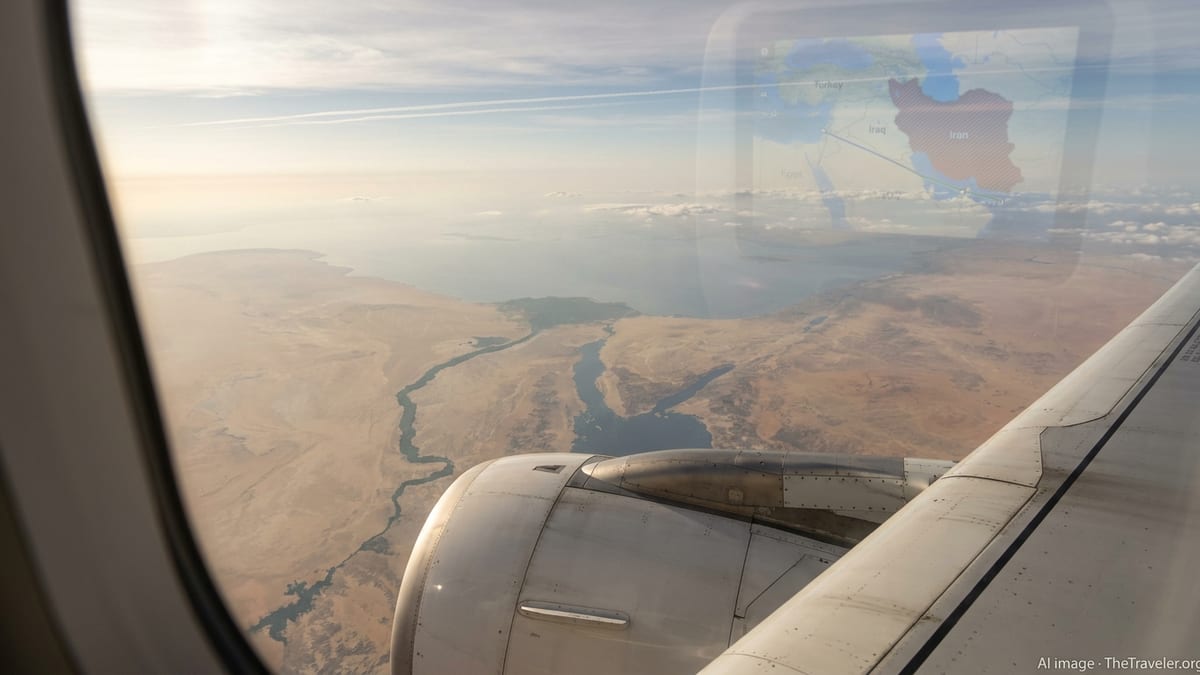
As airspace over large parts of the Gulf and Levant remains constrained, Egypt is emerging as a pivotal east west bridge. Coverage in regional media highlights Cairo’s growing role as a transit hub linking Europe, Africa and Asia, with airlines increasingly routing traffic through Egyptian skies and airports to avoid higher risk zones to the east and north.
Egyptian officials have publicly emphasized that the country’s airspace remains open and that its main airports are operating normally. National carrier schedules indicate added emphasis on connecting traffic, with Cairo in particular positioned as a staging point for rerouted flights that might previously have used Gulf hubs more heavily.
This new prominence brings both opportunity and pressure. While Egypt can capture additional transfer passengers and cargo during the crisis, it must also manage higher traffic volumes, maintain robust safety margins and be ready to adjust operations quickly if conflict dynamics shift.
For travelers, the growing reliance on Egyptian corridors means that more itineraries between Europe, Africa and Asia now include changes in Cairo instead of the traditional hubs of Doha, Dubai or Abu Dhabi, at least for the duration of the current turbulence.
Travelers Confront Uncertainty, Higher Costs and Changing Advice
For passengers, the deepening air turmoil translates into persistent uncertainty. Travel advisories in several Western countries currently urge citizens to reconsider or avoid non essential trips to multiple Middle Eastern destinations, while also warning that routes transiting the region may be subject to sudden disruption.
Airlines are responding with an array of flexibility measures, including fee free changes, extended travel waivers and, in some cases, options to reroute or delay trips for many months. However, published guidance also makes clear that travelers may still face higher fares if they switch to more expensive routes or dates, especially as longer flight times and rising fuel costs filter into ticket prices.
Industry commentary suggests that travelers with imminent departures to or via the Middle East should monitor their bookings closely, keep contact details updated with airlines, and be prepared for last minute schedule changes. Passengers are also being encouraged to allow extra time for connections, particularly when using crowded alternative hubs or newly congested air corridors.
With no clear timeline for de escalation, the Middle East’s air travel turmoil is increasingly shaping global itineraries rather than remaining a localized disruption. For now, both airlines and passengers are adjusting to a reality in which cancellations, diversions and elongated routes are a defining feature of long haul travel rather than a temporary exception.