

More news on this day
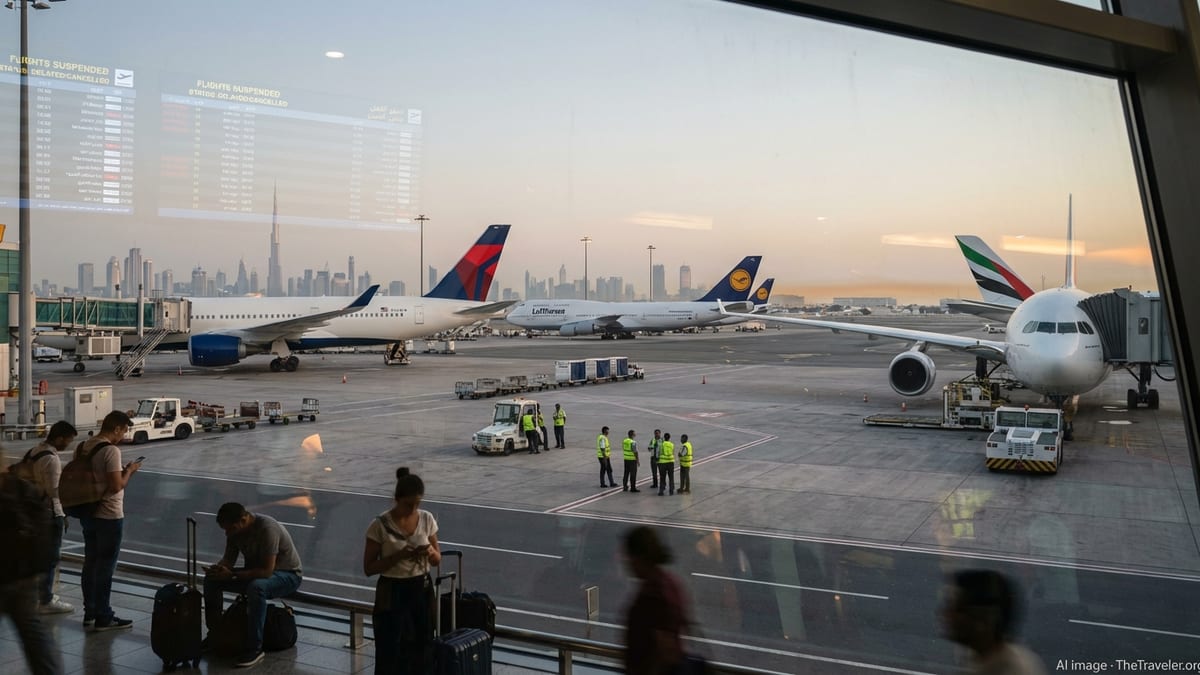
Middle Eastern carriers are grappling with one of their worst crises in decades as conflict-driven airspace closures trigger more than 5,200 flight cancellations, stranding wide body aircraft and tens of thousands of passengers at major Western gateways including London, Paris and New York.
Get the latest news straight to your inbox!
Conflict Fallout Closes Key Corridors and Grounds Fleets
Published coverage on the 2026 Iran war and related regional tensions shows that a swathe of airspace across Iran, Iraq, Syria, Israel and parts of the Gulf has effectively shut one of the world’s busiest aviation corridors linking Europe, Africa and Asia. In response, major Middle Eastern carriers have suspended or sharply reduced operations at their main hubs, cutting the flow of connecting traffic that normally passes through Dubai, Doha and Abu Dhabi.
Industry aggregators and flight tracking analyses examined in recent days indicate that since strikes began in late February, more than 5,200 flights operated by Middle Eastern airlines alone have been canceled, with overall global cancellations tied to the conflict running several times higher. The suspensions have included long haul services that form the backbone of Gulf network models, from Southeast Asia to Europe and from South Asia to North America.
Passenger airlines are not the only ones affected. Operational bulletins from logistics and cargo specialists describe restricted or suspended operations for several regional carriers, and caution that the mere expiry of individual notices does not signal a return to normal traffic flows. With airspace still constrained and insurance costs elevated, schedules are being rebuilt week by week rather than restored in one step.
Aviation analysts point out that Gulf carriers carried more than 40 percent of all Asia Europe connecting traffic before the crisis, concentrating global flows through a compact cluster of hubs. The sudden loss or reduction of that capacity has created a cascading disruption that continues to reverberate far beyond the Middle East itself.
London, Paris and New York Turn into Aircraft Parking Lots
As Middle Eastern hubs throttled back, the disruption shifted westward. Reports compiled by travel industry outlets and independent trackers describe wide body jets from Gulf and wider Middle Eastern airlines parked for extended periods at major Western airports, including London Heathrow, Paris Charles de Gaulle and New York’s John F. Kennedy International Airport.
These aircraft often arrived just before new waves of cancellations or airspace closures took effect, leaving them unable to continue onward or return to their home bases. With turnaround slots gone and crew duty limits tightening, some jets have remained on the ground for days while airlines search for alternative routings or await fresh safety assessments.
Operational data gathered during the final week of March highlighted how quickly this imbalance can build. London and Paris, already grappling with weather and staffing related disruption, saw additional delays and cancellations as ground handlers, immigration staff and airport infrastructure contended with unscheduled aircraft on stands and large numbers of disrupted connecting passengers.
In New York, images and accounts shared through consumer reports and aviation forums describe crowded departure halls and long lines at airline service desks for flights connecting to Middle Eastern hubs. While some repatriation and special relief services have been organized, the unpredictable nature of airspace restrictions has made it difficult for carriers to guarantee onward travel even for those who do manage to depart.
Billions in Revenue at Risk as Costs Mount
Economic assessments of the 2026 Iran conflict and its impact on aviation point to a mounting financial toll for airlines in and beyond the Middle East. Industry estimates compiled from consultancy notes and specialist travel analysis suggest that tens of thousands of canceled flights worldwide, coupled with sharply higher fuel prices and longer diversions, are on track to translate into multi billion dollar revenue losses for the sector this year.
The hit to Middle Eastern carriers is particularly acute. Their business models rely heavily on high volume connecting traffic through a relatively small number of hubs, and the sudden loss of over 5,200 flights in a matter of weeks has wiped out a significant share of booked revenue for the current quarter. At the same time, airlines must continue to cover aircraft lease payments, staff salaries and airport charges even when planes are idle.
Analysts tracking airline filings also note a sharp increase in operating costs for flights that continue to run. Detours around closed airspace add hours to journey times between Asia and Europe, increasing fuel burn at a time when oil prices have spiked on fears over security in the Strait of Hormuz. Some long haul flights that once required a single crew pairing now push the boundaries of duty limits, further raising costs.
Smaller regional airlines with weaker balance sheets appear especially exposed. Commentaries from aviation finance specialists warn that if conflict related restrictions persist into the second half of 2026, a wave of consolidation, restructurings or even insolvencies among secondary carriers cannot be ruled out. For now, many are conserving cash by grounding parts of their fleets and prioritizing only the most commercially essential or politically sensitive routes.
Passengers Face Prolonged Uncertainty and Complex Rebookings
For travelers, the immediate impact has been felt in the form of sudden cancellations, rolling delays and multi day waits for alternative flights. Passenger rights organizations and travel advisory services report that many itineraries involving Gulf stopovers unraveled with minimal warning, leaving customers stranded mid journey in European and Asian hubs while airlines worked through backlogs.
Across London, Paris and New York, travelers on affected services have faced a patchwork of policies depending on their carrier and departure point. Some Middle Eastern airlines have introduced broader ticket waiver windows, allowing free rebooking or refund requests for journeys scheduled in the coming weeks. Others have focused on reaccommodating disrupted passengers on a case by case basis, prioritizing those already in transit.
Consumer guidance shared by advocacy groups consistently urges passengers with upcoming itineraries via Dubai, Doha, Abu Dhabi or other Gulf gateways to monitor their booking status daily rather than waiting for last minute notifications. Where possible, travelers are being encouraged to consider routings via alternative hubs such as Istanbul, Singapore or selected European cities that still offer one stop connectivity without traversing the most heavily restricted airspace.
However, those options come at a price. Travel pricing data compiled by fare tracking services shows that demand has surged for non Gulf routings between Europe and Asia, pushing up average economy and premium cabin fares. With airlines still adjusting schedules and capacity, the balance between rebooking passengers from canceled flights and accommodating new bookings is likely to remain delicate for some time.
Slow Path to Recovery as Schedules Are Redrawn
Although a handful of major Middle Eastern airlines have started to restore a portion of their schedules, recovery remains tentative and uneven. Public timetables for early April show some carriers planning to ramp operations on selected routes, while others keep blanket suspensions in place to and from key conflict adjacent markets.
Aviation data specialists tracking capacity filings for Gulf and wider Middle Eastern hubs note that available seats between Asia and Europe remain significantly below pre conflict levels. Airlines are filing short term schedules that preserve flexibility rather than committing to full seasonal programs, a sign that planners anticipate a prolonged period of volatility through at least the middle of the year.
For airports in London, Paris and New York, that means continued uncertainty over stand allocation, passenger flows and staffing requirements. Airport operators must prepare simultaneously for sudden surges in displaced travelers when repatriation or relief flights operate, and for quieter periods when regular Gulf services remain suspended.
Travel industry observers caution that even if de escalation in the region leads to a phased reopening of airspace, it may take many weeks for flight operations and passenger itineraries to fully normalize. Until network planners are confident that key corridors will remain reliably open, airlines are likely to favor conservative scheduling and maintain contingency routings, leaving global travelers to navigate a more fragmented and less predictable map of long haul connections.