

More news on this day
Thousands of Middle Eastern flights have been canceled in recent weeks as conflict-linked airspace closures ripple across global networks, leaving wide-body jets and passengers stranded at major Western hubs including London, Paris and New York.
Get the latest news straight to your inbox!
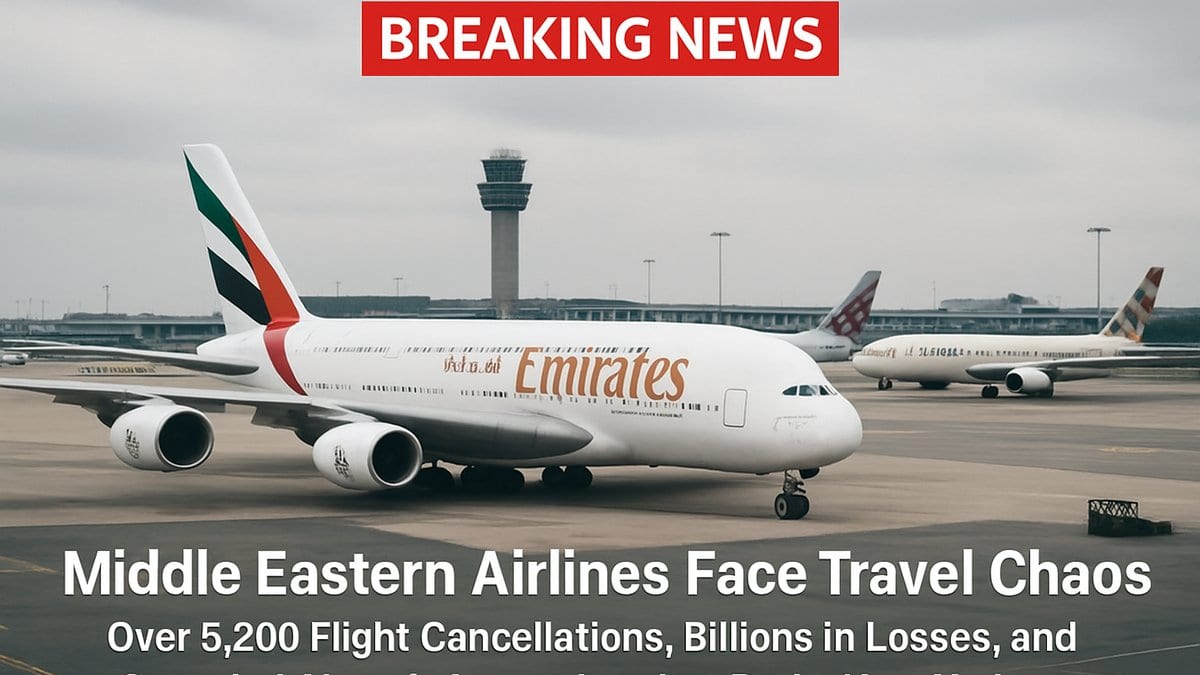
Conflict Closes Airspace and Shuts Down Gulf Hubs
Flight-tracking data and aggregated industry analyses indicate that airspace closures over Iran, Iraq, Syria, Israel and parts of the Gulf have effectively sealed one of the world’s most heavily used aviation corridors between Europe, Africa and Asia. Since strikes began in late February 2026, publicly available summaries suggest that more than 5,200 services operated by Middle Eastern carriers alone have been canceled, with total global cancellations tied to the conflict several times higher.
Reports on the economic impact of the 2026 Iran war describe how airspace restrictions and damage at major Gulf airports triggered a rapid suspension of operations by leading Middle Eastern airlines, including Emirates, Etihad and Qatar Airways. These carriers, which normally function as connective tissue between Europe, North America and Asia, have been forced to ground large portions of their fleets or redeploy aircraft on truncated networks.
Independent aviation trackers and financial commentary point to a sharp drop in regional capacity, with some estimates indicating that Middle Eastern carriers cut more than half of their scheduled seats in March 2026 compared with the previous year. Additional analysis suggests that when broader airspace closures are counted, total cancellations across the wider Middle East have already exceeded 40,000 flights, underlining the severity of the disruption.
As routes via the Gulf fall offline, airlines based in Europe and Asia have been pushed to devise longer, less efficient routings that skirt closed skies. These detours add hours to typical journeys, increase fuel burn and complicate crew scheduling, feeding directly into operational costs and pushing ticket prices sharply higher on remaining services.
Stranded Aircraft in London, Paris and New York
While the epicenter of the crisis lies in the Middle East, its most visible consequences are increasingly evident at Western gateways. Operational snapshots from Heathrow, Charles de Gaulle and John F. Kennedy airports show long-haul aircraft from Gulf and wider Middle Eastern airlines parked on remote stands for extended periods or cycling through irregular rescue and repatriation flights rather than routine schedules.
Previous planning schedules for Emirates, Qatar Airways and other regional airlines show dense daily services linking Dubai, Doha and Abu Dhabi with London, Paris and New York. With those hubs now operating on skeleton timetables or fully suspended for regular transit traffic, a portion of the wide-body fleet that would normally turn around multiple times a day instead spends long intervals on the ground at European and U.S. airports, awaiting clearance for ad hoc operations or repositioning flights.
Operational updates compiled by logistics and travel-management firms describe how these stranded aircraft have effectively become floating capacity, redeployed when brief windows of airspace access or special approvals open for evacuation or essential travel. In some cases, aircraft are being ferried empty to secondary airports in Europe or North Africa to free up scarce parking space at overcrowded hubs.
The visible presence of grounded Middle Eastern jets at Heathrow, Charles de Gaulle and JFK also reflects the complex regulatory environment. Carriers must navigate security restrictions, insurance limits and airport slot rules while balancing the need to keep aircraft and crews positioned for a potential resumption of normal services if regional conditions stabilize.
Billions in Losses and a New Financial Test for Gulf Carriers
Economic assessments of the 2026 Iran conflict consistently highlight aviation as one of the most exposed sectors. Publicly available estimates suggest that the combined impact of airspace closures, fuel price spikes and mass cancellations has already inflicted losses in the billions of dollars across Middle Eastern carriers, reversing years of profitability and rapid growth at Gulf super-connectors.
Industry commentary comparing the present crisis with the early months of the COVID-19 pandemic notes striking similarities: revenue has collapsed on core long-haul connecting routes, while high fixed costs for aircraft leases, financing and staff remain. Analysts warn that despite stronger balance sheets than many global peers, several carriers in the region may face liquidity pressures if severe restrictions continue into the summer travel season.
Some financial observers point out that while state backing gives certain Gulf airlines more room to absorb shocks, smaller regional operators without deep-pocketed shareholders are especially vulnerable. Past aviation downturns show that prolonged disruption often accelerates consolidation, with weaker airlines forced into restructuring, merger talks or insolvency when cash reserves run dry.
In parallel, airport operators and tourism sectors in the Gulf are suffering from the evaporation of transfer traffic. Dubai, Doha and Abu Dhabi, which built multi-billion-dollar infrastructure programs around hub-and-spoke connectivity, are now contending with drastically reduced passenger volumes, imperiling revenue projections and investment plans that relied on sustained growth through the late 2020s.
Passengers Face Rerouting, Higher Fares and Legal Grey Areas
For travelers, the immediate impact of more than 5,200 Middle Eastern flight cancellations has been a scramble for alternatives. Publicly accessible disruption trackers and consumer reports describe passengers stranded en route between Europe, Africa and Asia as itineraries built around Gulf stopovers unravel with little warning.
With direct Gulf links to London, Paris and New York curtailed, airlines are rebooking customers via longer routings through remaining open hubs, such as Istanbul, key European capitals or Southeast Asian gateways. These complex journeys often require additional connections and overnight stays, while limited seat availability pushes fares higher on unaffected routes, particularly for last-minute travel.
Travel-rights organizations note that passenger protections vary significantly depending on the origin and operating carrier. On departures from the United Kingdom or European Union, regulations such as UK261 and EU261 generally guarantee refunds when flights are canceled, but compensation for additional costs can be contested when airlines cite extraordinary circumstances linked to war or security. Journeys originating elsewhere may only be covered by individual airline policies or travel insurance, leaving some passengers to absorb hotel, meal and rebooking expenses themselves.
Insurance policies have emerged as a crucial yet uneven safety net. Many standard travel plans contain exclusions for war or terrorism-related disruption, while premium policies with broader coverage are seeing a surge in interest. Insurers and brokers are beginning to adjust wording and pricing to reflect the elevated risk that major air corridors can close abruptly for reasons beyond weather or conventional operational constraints.
How Long Could the Disruption Last for Global Travelers?
Forecasts for the duration of the current turmoil are highly uncertain. Analysts examining previous aviation shocks, including the closure of Russian airspace in 2022 and earlier conflicts affecting the Middle East, suggest that even after a ceasefire or partial political settlement, it can take months for airlines and regulators to fully reopen routes and rebuild schedules.
Infrastructure damage at key Gulf airports, combined with ongoing security concerns around overflight of contested territories, may further slow the pace of normalization. Airlines are cautious about committing aircraft and crews back into routes that could be abruptly shut again, preferring flexible deployment and short-notice schedule adjustments over a rapid return to pre-crisis levels.
For travelers planning journeys that would typically rely on Middle Eastern connections, publicly available guidance from travel advisors and aviation specialists increasingly emphasizes flexibility. Recommendations include allowing longer connection times, being prepared for rerouting via unconventional gateways, and carefully reviewing ticket conditions and insurance cover before committing to nonrefundable itineraries.
As the northern summer season approaches, the evolving situation in the Middle East will remain a central factor for long-haul travel between Europe, Africa, Asia and Oceania. With thousands of flights already canceled, billions in estimated losses and wide-body aircraft marooned from Dubai to New York, the crisis is reshaping global aviation in real time and forcing airlines and passengers alike to navigate a far more fragile route network.