

More news on this day
Middle Eastern airlines are heading into 2026 on track for record profitability even as the region faces heightened geopolitical risk, airspace disruptions and softer economic forecasts, highlighting a striking paradox at the heart of global aviation.
Get the latest news straight to your inbox!
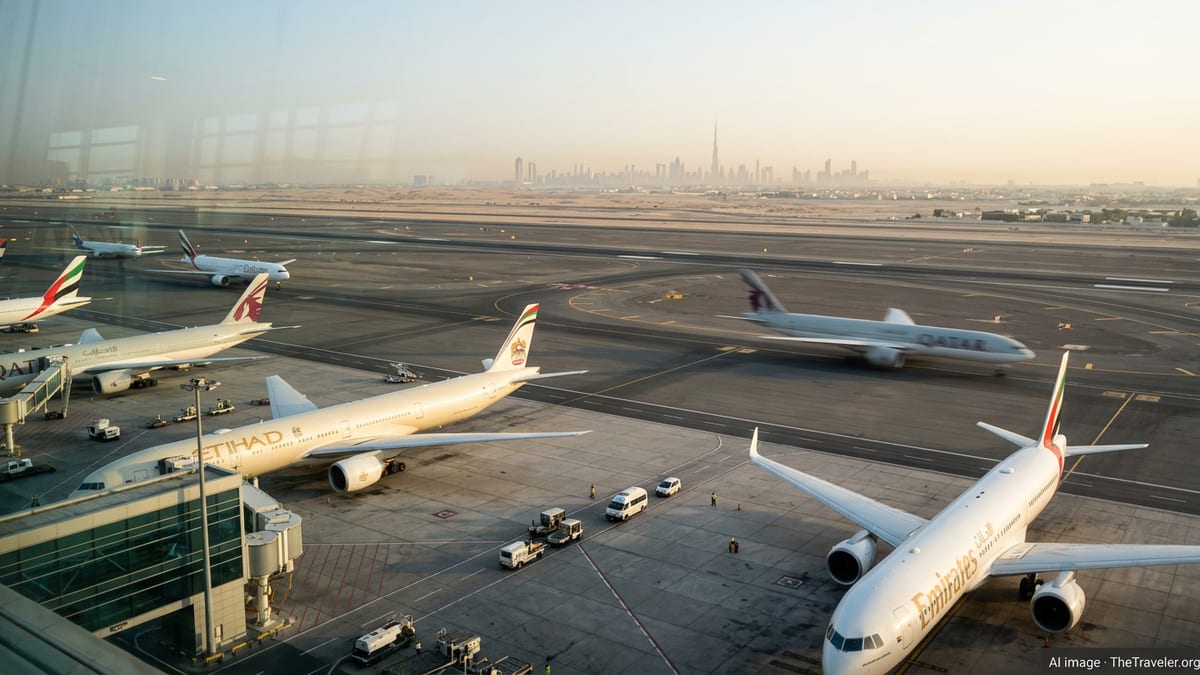
Forecasts Put Middle East at Top of Global Profit League
Industry forecasts compiled by the International Air Transport Association indicate that Middle Eastern carriers will again outpace every other region on profitability in 2026. Projections point to around 6.8 to 6.9 billion dollars in net profit for airlines based in the region, with net margins of roughly 9 percent and the highest profit per passenger worldwide. That compares with global margins that are expected to hover below 4 percent, underscoring how outsize the region’s earnings contribution has become relative to its share of global traffic.
Passenger volumes across Middle East airlines are projected to reach about 240 million travelers in 2026, according to recent outlooks, with growth rates above the global average. Analysts note that the region’s super-connector hubs remain central to long-haul flows between Europe, Asia and Africa, even as demand patterns shift and some Western carriers re-evaluate exposure to Middle Eastern markets. The combination of resilient long-haul demand and disciplined capacity growth is seen as a key factor supporting margins.
Profit per passenger in the region is also set to remain far ahead of peers. IATA’s regional breakdowns for 2024 and 2025 already show Middle East airlines earning more than double the global average on a per-passenger basis, and updated presentations suggest that advantage is likely to hold or widen going into 2026. That financial cushion is giving carriers room to absorb higher fuel prices, insurance premiums and detour costs linked to conflict zones.
Record Earnings at Gulf Carriers Fuel Expansion Plans
Flagship airlines in the Gulf have entered 2026 from a position of unusual financial strength. Emirates reported record profits in both its 2023–24 and 2024–25 financial years, with group earnings climbing above 5 billion dollars and revenues at all-time highs on the back of robust demand for connecting traffic through Dubai. Publicly available company figures show record passenger numbers, rising seat capacity and strong load factors, even as the airline continued to invest in cabin upgrades and fleet renewal.
Qatar Airways and Etihad Airways have followed a similar trajectory. Qatar Airways disclosed its highest-ever annual profit in the most recent fiscal year, exceeding 2 billion dollars, backed by record passenger volumes and a still-dominant cargo business. Etihad, which spent much of the previous decade restructuring, reported the strongest performance in its history in 2025, with a profit equivalent to several hundred million dollars and margins that management presentations describe as more than double the industry average.
Those earnings are being recycled into aggressive fleet and network expansion. Emirates has announced large orders for Boeing 777-9 aircraft and additional Airbus A350 jets at recent industry shows, signaling long-term confidence in demand for wide-body capacity through Dubai. Other regional carriers, including flydubai and Saudia Group, have also placed substantial orders, while Saudi Arabia’s new carrier Riyadh Air is moving toward the start of commercial operations after formal regulatory approval in 2025. The orderbooks suggest that, despite short-term uncertainty, the Gulf states are betting on a structurally larger role in intercontinental aviation.
War, Reroutings and the Cost of Geopolitical Risk
The robust financial outlook comes against a deteriorating geopolitical backdrop. Escalating conflict involving Iran and neighboring states in early 2026, layered on top of ongoing instability in parts of the Levant and Red Sea region, has led to repeated warnings over the economic outlook for Gulf economies. Some economic assessments now flag the risk of a sharp contraction in regional gross domestic product if disruption persists, citing grounded aircraft, reduced tourism inflows and pressure on trade routes.
Airlines are already grappling with the operational impact. Restrictions and self-imposed suspensions on overflights of conflict areas are forcing carriers to reroute services around parts of the Middle East, adding flight time and fuel burn on some of the most commercially important corridors linking Europe with South and East Asia. Publicly available traffic data and schedule filings show longer routings on several trunk routes, while some secondary destinations have seen frequencies reduced or temporarily halted.
Higher insurance and security-related expenses are another headwind. Market commentary suggests that premiums for operating in and around designated risk zones have risen since late 2025, adding to the broader inflationary pressures airlines face on labor and infrastructure. Yet analysts say the region’s leading carriers have so far been able to pass a significant share of these additional costs on to passengers, aided by tight capacity, constrained competition on some long-haul markets and the continued appeal of one-stop itineraries through modern Gulf hubs.
Resilient Demand at Mega-Hubs Offsets Regional Slowdown
One reason Middle Eastern airlines can sustain strong profits amid turbulence is the geographic and commercial positioning of their main hubs. Dubai, Doha and Abu Dhabi sit astride high-growth traffic flows between Asia, Europe and Africa, as well as increasingly important South–South routes linking Asia to Latin America and Africa. Even as regional point-to-point demand softens in response to political tensions and slower economic growth, connecting traffic through these hubs remains resilient.
Recent passenger statistics for Dubai International Airport, which regained its status as the world’s busiest airport by international traffic, highlight record annual volumes in 2024, with expectations of further growth into 2025 and 2026. Similar trends are visible in publicly available data from Doha and Abu Dhabi, where airport expansion programs and new terminal capacity are designed to accommodate tens of millions of additional passengers per year.
Strategic diversification of traffic flows is also helping carriers manage risk. Network maps show that Gulf airlines have been increasing their presence in secondary European cities, expanding into Central and Eastern Europe, and adding frequencies in fast-growing markets such as India, Southeast Asia and East Africa. This broader footprint can partly offset volatility in any single region and limits the revenue impact of temporary suspensions in conflict-affected airspace.
New Competitors, Sustainability Pressures and the 2026 Outlook
While Middle East airlines appear well placed to extend their profitability lead in 2026, they face a complex mix of emerging challenges. New state-backed carriers, most notably Riyadh Air, are preparing to compete for transfer traffic and premium customers, backed by large fleet orders and ambitious national tourism strategies. Their rise could reshape traffic distribution across the region’s hubs and put pressure on yields if capacity expands faster than demand.
At the same time, global moves toward decarbonization are beginning to alter cost structures. IATA’s latest outlooks estimate that spending on sustainable aviation fuel will increase significantly by 2026, with incremental costs running into several billion dollars industry-wide. Middle Eastern carriers, which operate large fleets of wide-body aircraft and rely heavily on long-haul flying, may face a disproportionate share of those costs as mandates tighten in key markets and corporate customers demand lower-emission options.
Nevertheless, industry projections show Middle East airlines maintaining the highest regional net profit margin in 2026, supported by strong fundamentals, state-backed infrastructure investment and the enduring appeal of their hubs to global travelers. The unfolding test for the region’s aviation sector will be whether it can sustain that performance while navigating heightened geopolitical risk, rising environmental expectations and intensifying competition within its own backyard.