

More news on this day
After days of war-induced airspace shutdowns that stranded hundreds of thousands of passengers across the Middle East and beyond, leading Gulf carriers Emirates and Etihad are rapidly rebuilding their route networks, signaling a fragile but accelerating return to normality for one of the world’s most important aviation corridors.
From Sudden Shutdown to Gradual Reopening
The current recovery follows one of the most severe shocks to global aviation since the early pandemic years. Coordinated strikes involving the United States, Israel and Iran in late February triggered sweeping airspace closures across Iran, Iraq, the United Arab Emirates, Qatar and several neighboring states. Key hubs including Dubai International, Abu Dhabi’s Zayed International and Doha’s Hamad International effectively went dark for routine commercial traffic, forcing mass cancellations and unprecedented diversions.
On the worst days of the disruption, analysts estimate that more than 1,800 flights were canceled across the region, with around 90,000 passengers a day typically funneled through the Gulf’s three heavyweight carriers, Emirates, Qatar Airways and Etihad. Aircraft already airborne were sometimes forced into marathon return journeys or lengthy detours, while new departures were scrubbed with little notice as authorities prioritized military operations and safety.
By early March, civil aviation regulators began permitting limited corridors to reopen under tight security protocols. That has allowed some scheduled passenger services to restart, albeit with curtailed frequencies, altered routings and extensive last minute changes. For now, airlines are treating every day’s schedule as provisional, updated in near real time as overflight permissions are granted or revoked.
The result on the ground at Gulf hubs is a mixture of relief and lingering uncertainty. Departure boards that had shown walls of cancellations are slowly refilling with active flights, but airport authorities continue to warn travelers not to arrive without confirmed bookings and to expect crowded terminals, rolling queues and long waits for rebooking.
Emirates Scales Back Up Toward Its Global Network
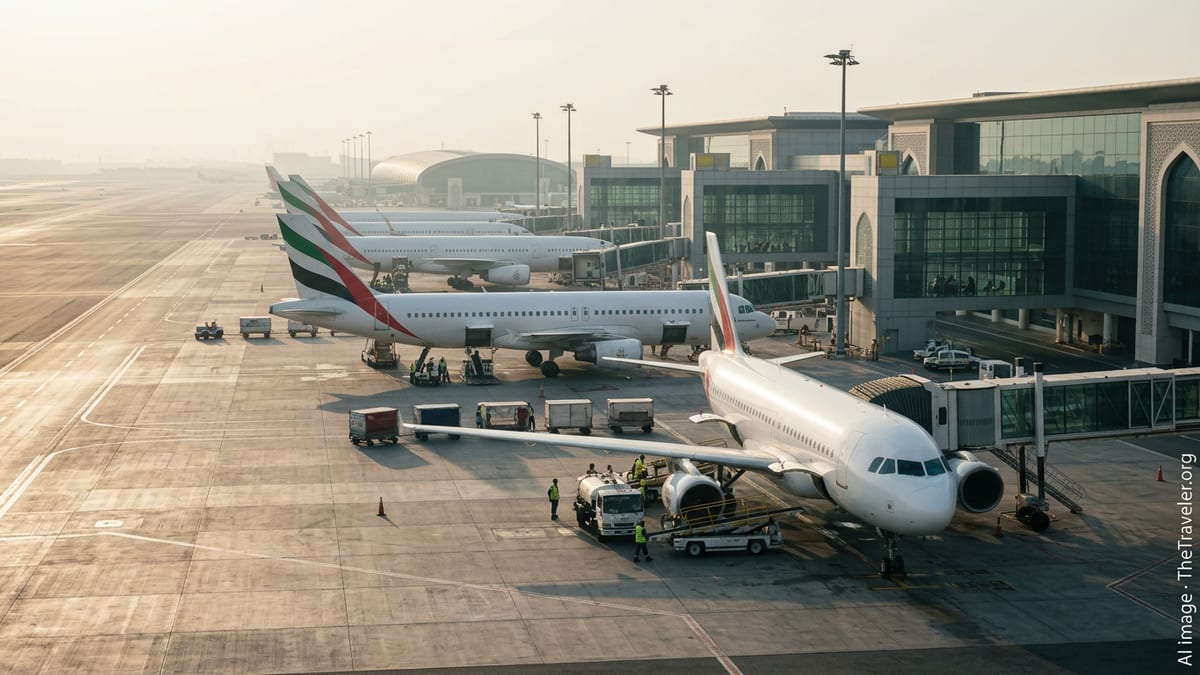
Dubai based Emirates, the largest long haul carrier in the region, has moved fastest to rebuild capacity as soon as its home airspace was partially reopened. The airline began operating a reduced schedule in the first week of March focused on trunk routes linking Dubai with major cities in Europe, Asia, Africa and North America. Operations teams prioritized high demand markets and key connectivity flows, using wide body aircraft as efficiently as possible while some corridors over conflict zones remain off limits.
By March 7, Emirates was operating more than a hundred round trip flights a day to over 80 destinations, approaching around 60 percent of its pre crisis network, according to industry reports. Senior executives have briefed partners that they expect to restore close to their full 140 destination map within days if security conditions do not deteriorate again, though timings and routings may remain fluid.
In practice that means many flights are being re routed further south or north to skirt closed airspace, adding flight time and fuel burn. Some services are operating less frequently than published timetables, and certain secondary destinations remain paused while the carrier concentrates on core hubs such as London, Frankfurt, New York, Sydney, Mumbai and key African gateways.
For travelers, Emirates has urged patience and flexibility. Passengers with canceled bookings are being prioritized for reaccommodation, while airport access at Dubai International is still being controlled to avoid overcrowding. Travelers are being advised to check flight status repeatedly before leaving for the airport and to expect hold times and digital queues when contacting customer service.
Etihad’s Cautious Restart from Abu Dhabi
Abu Dhabi based Etihad Airways has taken a more conservative approach, reflecting both the scale of the disruption to the United Arab Emirates airspace and the carrier’s smaller global footprint. Etihad initially suspended regular commercial operations through March 6, focusing only on ad hoc repatriation and special services coordinated with foreign governments and corporate clients. That allowed the airline to reposition aircraft and crew while detailed risk assessments were carried out on potential routings.
With partial reopening of Emirati skies, Etihad has now launched a limited commercial schedule to and from Zayed International. The airline is currently operating a reduced but broad network of around 70 destinations, including major European gateways such as London, Paris and Frankfurt, alongside key routes to India, Southeast Asia and select North American cities. Not all destinations operate daily, and many flights remain subject to late operational approval.
Etihad has warned that its provisional timetable, published through March 19, should be treated as indicative rather than guaranteed. All services, it stresses, can be retimed, rerouted or canceled at short notice if regional airspace conditions change. Passengers are being firmly advised not to travel to the airport unless they have a confirmed booking and up to date flight status, in an effort to avoid scenes of overcrowding that marked the earliest days of the shutdown.
The carrier has also extended flexibility policies for tickets issued before the crisis, allowing many customers to rebook or request refunds without penalties. For corporate accounts and tour operators, Etihad’s sales teams are working route by route to restore group allocations and block space as confidence in the stability of flight corridors improves.
Patchwork Recovery Across the Region
While Emirates and Etihad are leading the visible return of large scale operations, the wider regional picture remains fragmented. Qatar Airways continues to face some of the heaviest restrictions, with Qatari airspace still under tight control and regular commercial flights to and from Doha only gradually resuming via limited emergency corridors. Other Middle Eastern carriers, from Kuwait Airways to smaller low cost operators, remain constrained by their own national airspace closures or by the need to avoid overflying conflict zones.
Countries on the periphery of the fighting, including Oman, Saudi Arabia and Egypt, have seen their airports become alternative gateways and diversion points. Muscat, Riyadh and Cairo have absorbed extra traffic from rerouted long haul services, sometimes with hastily arranged charter and repatriation flights. Indian carriers such as Air India and IndiGo, along with European and Asian airlines, are also rebuilding partial schedules to Gulf destinations, typically using longer routings to bypass the most sensitive skies.
The result is a patchwork recovery in which some popular city pairs are again being served, while others remain disconnected or linked only via complex itineraries. Ticket prices on available routes have climbed in response to capacity constraints and added operational costs, including extra fuel, crew time and insurance premiums. Industry analysts warn that if the conflict and associated restrictions persist, higher fares on flights touching the Middle East could become a feature of the market for months.
Still, for travelers who had been completely stranded, even a limited selection of outbound options marks meaningful progress. Governments are working closely with Gulf carriers to prioritize evacuation of citizens and residents, while airlines coordinate to interline stranded passengers across partners and alliances wherever possible.
What Travelers Can Expect in the Coming Days
For now, aviation officials and airline executives alike emphasize that the situation remains fluid. Every incremental reopening of an air corridor is matched by detailed risk assessments, and military developments could yet force renewed closures. Travelers planning to transit through the Gulf in the coming days should be prepared for last minute schedule changes, longer flying times and tight connection windows as networks are re stitched on the fly.
Industry observers expect Emirates to reach near full network coverage first, leveraging its large wide body fleet and central role as a connector between continents. Etihad is likely to follow with a more measured ramp up, while Qatar Airways’ timetable will depend heavily on how quickly restrictions around Doha are eased. Smaller regional airlines will restore operations more gradually as demand returns and their own safety assessments are completed.
Travel advisers recommend that passengers build extra buffer time into itineraries, avoid non essential same day connections between separate tickets and keep a close eye on airline notifications. Flexibility around dates and routings could make the difference between days stranded and a successful journey out of the region.
What is clear already is that Gulf airlines remain determined to reclaim their role at the heart of global aviation. The rapid but cautious restart by Emirates and Etihad underscores both the strategic importance of their hubs and the industry’s capacity to adapt to geopolitical shocks. As more aircraft lift off from Dubai and Abu Dhabi each day, the Middle East’s skies are slowly filling again, even as the region’s future stability remains uncertain.