

More news on this day
Hundreds of travelers across Qatar, the United Arab Emirates and Saudi Arabia are facing days of uncertainty as flight disruptions intensify at Bahrain International, Hamad International in Doha, Dubai International and King Abdulaziz International Airport in Jeddah, with multiple carriers reporting more than 200 cancellations and over 100 delays amid escalating regional instability.
Get the latest news straight to your inbox!
Airspace Restrictions Feed a New Wave of Cancellations
Published advisories and aviation data for early to mid March 2026 indicate that a series of Iranian missile and drone attacks across the Gulf, and subsequent airspace restrictions, have sharply curtailed commercial flying in the region. Airspace closures and limited operating corridors have forced airlines to slash schedules or suspend services entirely on many routes linking Qatar, the UAE and Saudi Arabia with Europe, Asia and Africa.
Recent travel and security bulletins describe commercial operations at Doha’s Hamad International Airport as largely suspended, with only specific, authorized or repatriation flights allowed to operate. Bahrain International Airport has been listed as mostly halted, while services at several Saudi and Emirati airports, including Jeddah and Dubai, have been characterized as heavily disrupted or operating far below normal capacity.
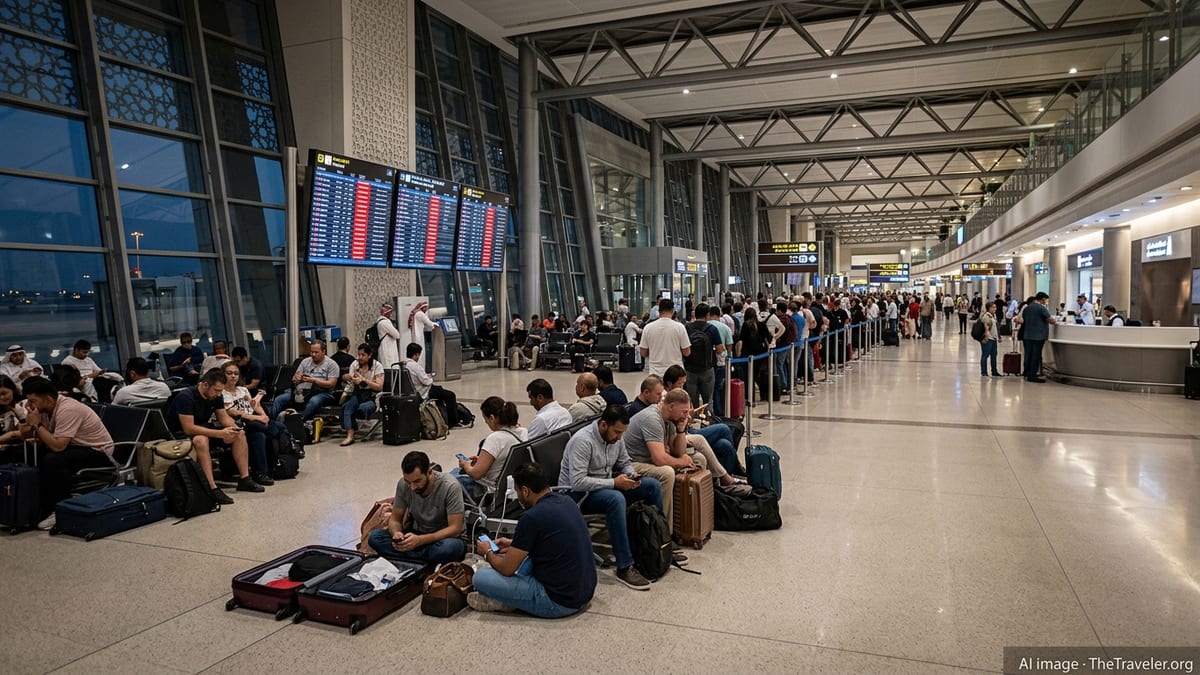
Across these hubs, airport departure boards have filled with cancellations as carriers adjust to fast-changing restrictions and safety assessments. Reports from aviation trackers and traveler accounts point to at least 211 cancelled flights and 114 delays affecting a mix of long-haul and regional services, with knock-on impacts spreading through airline networks worldwide.
In many cases, the cancellations are not isolated to a single day. Airlines have trimmed schedules across multiple dates, meaning travelers who were rebooked once are sometimes facing second or even third disruptions as operating conditions remain unstable.
Key Gulf Hubs Under Strain
The current disruption is centered on four major airports that normally function as vital transit and origin-destination hubs for global travel. Bahrain International Airport has seen its role sharply reduced after reports of damage and security concerns linked to regional strikes, leading its home carrier and partners to relocate aircraft or consolidate operations elsewhere.
In Doha, Hamad International Airport, usually one of the world’s busiest connection points, has been constrained by Qatar’s airspace restrictions. Publicly available guidance notes that standard commercial flights remain largely suspended, with only limited emergency or repatriation operations moving through the hub. Travelers who depend on Doha for onward connections to Asia, Africa and Europe have found themselves stranded or forced to seek alternate routings through other countries.
Dubai International Airport, traditionally the region’s biggest intercontinental gateway, has also been hit. News coverage of recent incidents describes strikes and nearby damage that resulted in temporary suspensions of flights and stringent safety checks. While some operations continue, capacity is reported to be far below normal, and a mix of international and regional airlines have reduced or rerouted services, putting added strain on remaining flights.
In Saudi Arabia, King Abdulaziz International Airport in Jeddah has been affected by broader national measures to manage risk and adapt to shifting airspace availability. Saudi gateways remain important alternatives for travelers trying to exit the region, but sporadic delays, schedule changes and seat shortages are increasingly common as demand concentrates on fewer operating routes.
Multiple Airlines Cut Capacity and Reroute
Across the Gulf, the disruption is not limited to any single carrier. Major Middle Eastern airlines that rely on hub-and-spoke models, including those based in Qatar, the UAE and Saudi Arabia, have all reduced frequencies, consolidated flights or paused services on selected routes. Publicly available airline notices and travel advisories point to significant capacity cuts, with some operators reportedly running at less than half of their typical schedules.
European and Asian airlines that usually operate direct services into Doha, Dubai, Bahrain and Jeddah have also adjusted. Several long-haul carriers have suspended flights to affected hubs, rerouted aircraft through more northerly or southerly corridors, or introduced technical stops to avoid restricted airspace. These changes protect crews and passengers but add complexity, time and cost to journeys.
The combination of local hub reductions and international rerouting has compounded pressure on the system. Aircraft and crews are out of position, maintenance windows are disrupted and ground operations are stretched by constant schedule revisions. Travelers who manage to secure alternative flights often face lengthy layovers in secondary hubs or detours through cities that are not usually part of their itineraries.
Low-cost and regional airlines are also experiencing turbulence, particularly those that depend on short-haul traffic between Gulf states. Reduced intra-Gulf connectivity has made it harder for stranded travelers to reposition to airports where flights are still operating, limiting options for those seeking to leave the region quickly.
Hundreds of Passengers Stranded Across Qatar, UAE and Saudi Arabia
As cancellations and delays have mounted, travelers have turned to social media and online forums to describe crowded terminals, long queues at service desks and uncertainty about when they will be able to depart. Accounts from passengers in Doha, Dubai, Bahrain and Jeddah point to overnight stays in airports, repeated rebookings and difficulties securing timely information as airline call centers and chat channels struggle with volume.
Reports indicate that some passengers have been offered hotel accommodation or meal vouchers where local conditions allow, while others remain in transit areas due to visa limitations or a lack of available rooms. Families traveling with children and older passengers appear particularly affected when flights are cancelled at short notice or rebooked several days later.
In several Gulf countries, heightened security measures and temporary road closures around airports have added another layer of complexity. Travelers attempting to transfer by land between states, for example from Bahrain or Qatar into Saudi Arabia to reach alternative departures, have faced checkpoints, documentation checks and evolving entry requirements.
For many, the greatest challenge is uncertainty. With airspace status and operating permissions subject to change over short periods, travelers are finding that tickets reissued for later dates can still be vulnerable to further disruption if the regional situation deteriorates or reopening timelines shift.
What Affected Travelers Should Do Now
Consumer and security advisories covering the Middle East situation emphasize that travelers should avoid heading to the airport without a confirmed, operating flight. Instead, they recommend using airline apps, official websites and verified social media channels to monitor real-time status, rebooking options and any waivers that allow itinerary changes or refunds.
Many airlines serving Bahrain, Doha, Dubai and Jeddah have introduced flexible travel policies, including free date changes or refunds for flights cancelled because of the instability. Travelers are encouraged to keep all booking references and receipts, and to document any additional expenses, in case they are eligible for reimbursement under airline rules or travel insurance policies.
Specialist travel advisories also suggest having a backup routing plan that avoids the most affected hubs, especially for essential trips. This might include flying into alternative regional gateways that remain open with fewer restrictions, or connecting through European, African or Asian cities that offer stable onward links. However, travelers are advised to factor in possible transit visa requirements and longer journey times.
Given the fluid security environment, publicly available guidance highlights the importance of registering travel plans with consular services when possible, and of maintaining contact with employers, schools or tour organizers. While there are signs that limited corridors and repatriation flights are gradually expanding, analysts warn that full normalization of schedules in Bahrain, Qatar, the UAE and Saudi Arabia may take time, and that further short-notice adjustments remain likely as the Middle East situation evolves.