

More news on this day
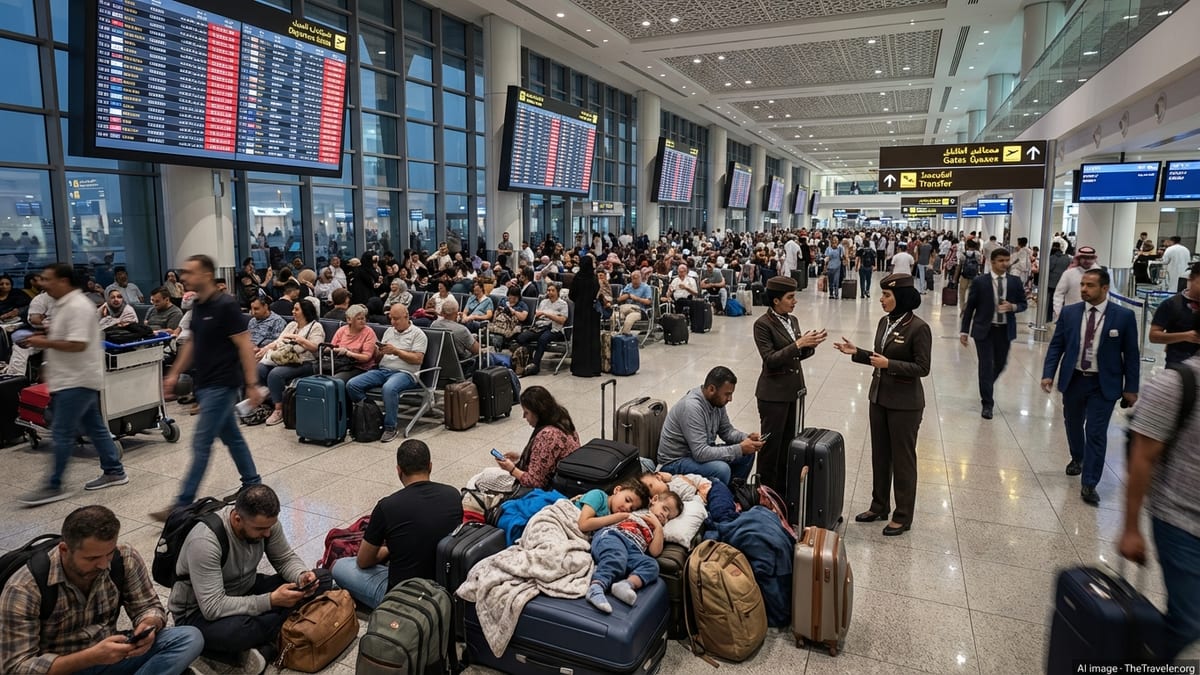
Thousands of passengers traveling through the Middle East face days of uncertainty as widespread airspace restrictions across Bahrain, Kuwait, Iraq and neighboring states trigger cascading delays and cancellations, disrupting hundreds of flights operated by Qatar Airways, Gulf Air, Saudia and other major carriers.
Get the latest news straight to your inbox!
Regional Airspace Restrictions Trigger Massive Disruptions
Publicly available aviation data and regional media coverage indicate that coordinated or near-simultaneous airspace restrictions across several Middle Eastern countries have forced airlines to thin or suspend schedules, particularly on routes touching Bahrain, Kuwait, Iraq and nearby hubs. Flight-tracking snapshots for recent days show hundreds of services registered as delayed and more than seven hundred as cancelled across the wider region, underlining the scale of the operational shock.
While precise tallies shift by the hour, aggregated figures from airport departure boards and airline advisories point to at least 367 departures experiencing significant delays and around 725 outright cancellations across affected carriers and airports within a short multi-day window. These numbers capture only formally logged disruptions and do not fully reflect missed connections, diversion-related strandings or flights removed from sale before they reached the departure board.
Major Gulf carriers have had to adjust quickly. Qatar Airways, Gulf Air and Saudia appear prominently in disruption data, alongside other regional and international airlines that rely on Gulf airspace for Europe–Asia and intra–Middle East links. In many cases, aircraft and crew have been left out of position after sudden closure notices, compounding the impact far beyond the first wave of grounded flights.
Aviation analysts note that the Gulf region functions as a central crossroads in global air traffic. When multiple states simultaneously restrict or close airspace, ripple effects spread rapidly across continents, affecting passengers who may never have intended to transit the Middle East but whose flights rely on those skies for efficient routing.
Passengers Stranded in Major Hubs from Dubai to Beirut
The knock-on effects of the shutdown have been most visible inside crowded terminals at key transit hubs. Social media posts, airport live feeds and airline app notifications from the past several days depict long queues and packed concourses at airports including Dubai International, Doha’s Hamad International, Kuwait International, Bahrain International, Riyadh and Jeddah in Saudi Arabia, and Beirut–Rafic Hariri International.
Travelers on itineraries operated or codeshared by Qatar Airways, Gulf Air, Saudia and other Gulf-based airlines have reported being stuck between segments as onward legs vanish from departure boards. Some passengers have found themselves marooned in Dubai or Doha after their connecting flights to destinations such as Beirut, Baghdad or Kuwait City were cancelled following fresh airspace restrictions further along the route.
In Lebanon, publicly accessible airport schedules and local coverage show a pattern of cancellations on services linking Beirut with Gulf destinations and Iraq. Airlines have scrapped or consolidated rotations as regional routings become unviable, narrowing options for travelers trying to reach or leave the country. Further south, Dubai has remained physically open but subject to tight operational constraints, with many flights departing late, operating as repositioning services, or being dropped entirely at short notice.
Information from airline apps and online booking engines indicates that, in several cases, passengers have been automatically rebooked onto later dates or alternate routings that involve detours via European, North African or South Asian hubs. However, limited seat availability and the fluid security picture mean that even reissued itineraries are vulnerable to further change, prolonging airport stays and heightening frustration.
Qatar Airways, Gulf Air, Saudia and Others Cut and Reroute Schedules
Based on published travel advisories and airline schedule updates, Qatar Airways has slashed a significant portion of its usual regional network, particularly flights that would overfly restricted corridors or serve airports in states that have temporarily closed their skies. The carrier has instead prioritized a smaller number of long-haul and repatriation-style services, often routed along narrower corridors cleared by aviation authorities.
Gulf Air, the flag carrier of Bahrain, has similarly trimmed services, with Bahrain’s position along sensitive air corridors limiting options for safe overflight. Public timetables show multiple daily rotations to regional destinations reduced to a handful of services, and some routes temporarily suspended. For passengers, this translates into longer waits in Manama’s terminal and fewer same-day alternatives if a flight is cancelled.
Saudia, which normally operates an extensive domestic and international network from hubs in Riyadh and Jeddah, has also faced severe constraints where routes intersect with restricted airspace. Available operational notices and live departure data point to a mixture of outright cancellations and substantial delays, as flights are re-timed or rerouted to thread remaining open corridors while maintaining distance from conflict zones.
Other regional and international airlines that rely on Middle Eastern overflight rights are also prominently represented in disruption logs. Several European and Asian carriers have scrubbed flights to Gulf cities or adopted elongated routings that increase flying time and fuel burn. Industry observers highlight that such workarounds are feasible only on a limited scale; many services are simply being cancelled when additional distance or detours would undermine safety margins or commercial viability.
Operational and Economic Strain Across the Travel Ecosystem
The immediate operational strain on airlines is matched by mounting economic and logistical pressure across the broader travel ecosystem. Airport ground handlers, hotel operators, tour companies and business travel agencies face an influx of stranded passengers seeking accommodation and revised plans. Reports from major hubs suggest that airport-area hotels in cities such as Dubai and Doha have seen occupancy spike, with some properties reaching capacity during peak disruption days.
Travel insurance providers are also contending with a rise in claims as passengers seek reimbursement for missed connections, nonrefundable bookings and emergency re-routings purchased out of pocket. Policy wording varies widely, and publicly available consumer guidance shows a patchwork of outcomes depending on whether disruptions are categorized as security-related, weather-like “force majeure,” or airline-controlled schedule changes.
Businesses that depend on predictable air links to and through the Gulf are beginning to tally costs as well. Conference organizers and corporate travel managers report, via trade press coverage and public statements, that large meetings have been postponed or shifted online due to uncertainty over delegate arrival. Cargo flows have also been disrupted, with priority space on remaining operational flights focused on essential freight rather than general goods.
Aviation industry commentators caution that even after airspace gradually reopens, airlines will need time to unwind backlogs, return aircraft and crew to normal positions, and rebuild confidence among travelers. As seen during previous large-scale disruptions, schedules may remain fragile for days or weeks, with rolling delays and occasional cancellations persisting after the headline crisis appears to ease.
What Travelers Can Expect in the Coming Days
Looking ahead, travelers with plans involving Bahrain, Kuwait, Iraq, the United Arab Emirates, Qatar, Saudi Arabia or Lebanon in the near term should prepare for continued volatility. Flight searches and airline advisories suggest that many routes remain off sale or are listed with limited frequencies well into the current booking window, indicating that carriers do not anticipate a rapid return to full operations.
Airlines including Qatar Airways, Gulf Air and Saudia are publishing and updating waivers that allow affected passengers to rebook, seek refunds or reroute via alternative gateways, according to publicly visible policy notices. However, implementation on the ground can be uneven, especially where call centers and airport ticket desks are overwhelmed by demand. Travelers may face long waits for assistance and should be prepared for multiple rounds of changes as operations adjust to shifting airspace permissions.
Consumer advocates and travel industry analysts consistently point to several themes in public guidance: check flight status repeatedly in the hours before departure, monitor airline and airport channels for new advisories, and build in substantial buffers for connections where travel cannot be postponed. Where possible, passengers are encouraged to keep itineraries flexible, opt for tickets that permit changes, and budget for potential unexpected overnight stays near major hubs.
For now, the picture remains fluid. The combination of airspace closures, partial reopenings and tightly controlled corridors means that headline numbers such as 367 delayed and 725 cancelled flights may continue to climb. Until regional skies stabilize, thousands of travelers are likely to remain in limbo in terminals from Dubai and Doha to Kuwait City, Manama, Riyadh and Beirut, waiting for a seat on the next flight that can safely depart.