

More news on this day
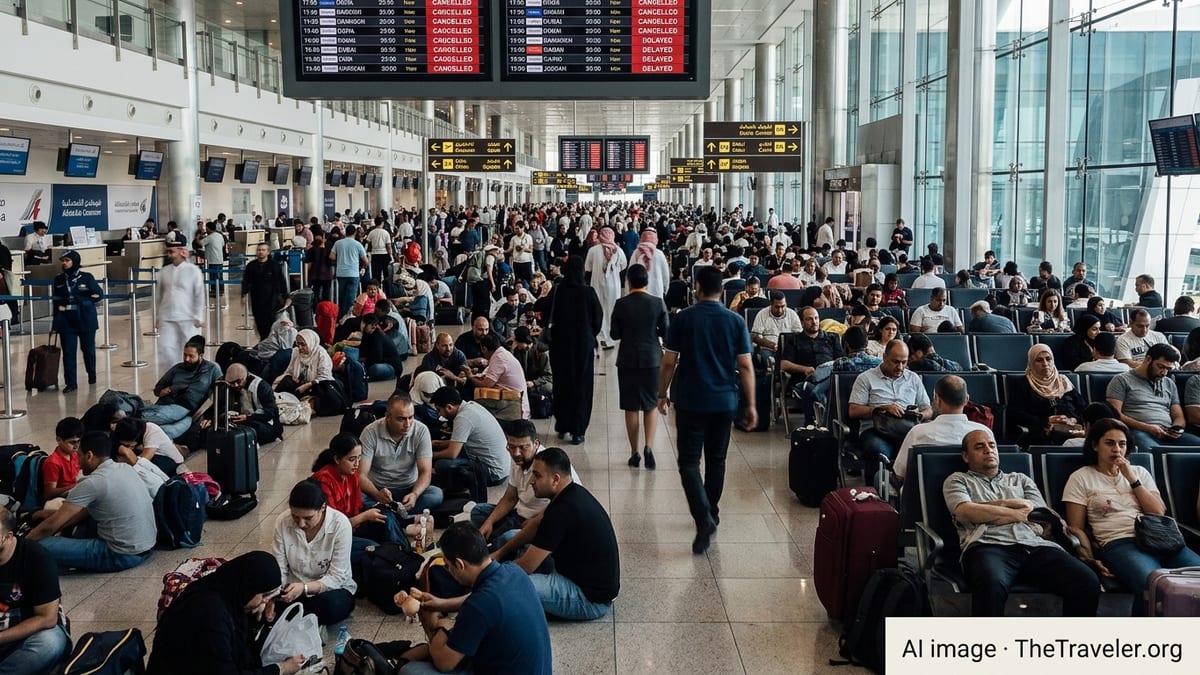
Thousands of travelers across the Middle East have been left stranded after widespread airspace restrictions and security concerns prompted aviation authorities and airlines in the United Arab Emirates, Saudi Arabia, Bahrain, Kuwait, and Turkey to ground 297 flights and delay 1,842 more, disrupting operations for FlyDubai, Qatar Airways, Saudia, Pegasus Airlines, and other carriers at major hubs in Dubai, Istanbul, Riyadh, and Doha.
Get the latest news straight to your inbox!
Regionwide Airspace Restrictions Ripple Through Major Hubs
Publicly available flight-tracking data and travel advisories show that airspace closures and severe operational limits across the Gulf have triggered cascading disruption at some of the world’s busiest transit airports, with Dubai International, Doha’s Hamad International, Riyadh’s King Khalid International, and Istanbul’s main airports experiencing significant schedule upheaval. While some services continue to operate on limited or rerouted corridors, the pattern of grounded and heavily delayed flights points to a system under intense strain.
Reports indicate that restrictions in the skies over the United Arab Emirates, Bahrain, Kuwait, Qatar, and parts of Saudi Arabia have forced airlines to either suspend rotations entirely or reconfigure network plans at short notice. Turkish carriers have also been affected, as congested diversion routes and changing overflight permissions complicate access between Istanbul and Gulf destinations.
The combined effect has been a sharp reduction in available seats on key trunk routes linking Europe, Asia, and Africa through Middle Eastern hubs. Published coverage and industry summaries suggest that hundreds of thousands of passengers may be indirectly affected when missed connections and knock-on delays are taken into account, even beyond the immediate tally of grounded and late-running flights.
Travel risk bulletins note that the situation remains fluid, with airspace corridors subject to sudden closure and reopening. This volatility means flight schedules can change repeatedly within hours, complicating efforts by airlines to restore predictable operations and leaving travelers uncertain about when they will be able to move on.
FlyDubai, Qatar Airways, Saudia and Pegasus Among Hardest Hit
Low-cost and full-service carriers based in the Gulf and Turkey have borne the brunt of the turmoil. FlyDubai, which relies heavily on short and medium-haul links between Dubai and regional cities, has seen multiple rotations grounded and others pushed back by many hours as crews, aircraft, and slots fall out of sync.
Qatar Airways, a key global network carrier operating from Doha, has faced extensive disruption as its long-haul connections depend on stable access to regional airspace. According to published aviation data, a sizable portion of its departures and arrivals have been delayed or re-timed, and some services have been consolidated as the airline attempts to prioritize stranded transit passengers.
Saudi Arabia’s flag carrier Saudia has also been significantly affected, particularly at Riyadh and Jeddah, where constraints on regional air corridors and heightened security procedures have slowed operations. In Turkey, Pegasus Airlines and other Istanbul-based carriers have encountered their own challenges as they attempt to serve Gulf destinations while also managing rerouted traffic from Europe and Asia.
Industry trackers show that the disruptions are not limited to a single operator or nation but are instead shared across multiple airlines whose networks intersect in the Middle East. This interconnectedness means that delays to one carrier’s departures can quickly translate into missed onward connections for passengers traveling with others.
Stranded Passengers Face Long Waits and Limited Alternatives
Scenes from airports in Dubai, Doha, Riyadh, and Istanbul, described in regional media and social posts, depict crowded terminals where travelers queue at ticket desks and customer service counters seeking rebooking options. In many cases, same-day alternatives are unavailable due to the volume of grounded flights and the need to prioritize those who have already been stranded for several days.
Travel advisories circulating among corporate travel managers and consumer outlets emphasize that passengers should avoid heading to the airport without confirmed rebookings, as walk-up assistance can be limited and accommodation options near major hubs are becoming strained. Some airlines are reportedly operating limited recovery or repositioning flights targeted at moving backlogged passengers, but capacity remains tight.
Because the affected airports serve as vital intercontinental transfer points, the disruption reaches far beyond the Middle East itself. Travelers originating in Europe, North America, Africa, and Asia who had planned routine connections through Dubai, Doha, Riyadh, or Istanbul now face detours via alternate hubs or the prospect of waiting until regional airspace stabilizes.
The unpredictability of schedules has also complicated the situation for travelers with time-sensitive commitments such as visa windows, work start dates, or cruise departures. Public information from consular and travel bodies highlights the importance of monitoring entry rules closely, as extended delays can inadvertently push trips beyond the validity of transit permissions or pre-approved stays.
Operational Recovery Hampered by Security and Routing Constraints
Aviation analysts note that restoring regular operations in the Middle East is more complex than simply reopening airports. Even as some routes resume, airlines must contend with new or evolving overflight restrictions, longer alternative routings, and congestion on the limited corridors that remain available, all of which reduce overall capacity and increase costs.
Published economic and aviation assessments point out that multi-country airspace closures and intermittent missile and drone activity in parts of the region have driven caution among carriers and air navigation authorities. Many flights have been required to take extended detours to avoid sensitive zones, which in turn lengthens flight times, disrupts crew duty limits, and creates additional delays downstream.
Airlines attempting to rebuild schedules must also reposition aircraft and crew that were left out of place when airspace first closed or flights were abruptly halted. This recovery phase can take days, even under relatively stable conditions, and is further complicated when conditions on the ground and in the air remain uncertain.
Operational notices suggest that carriers are prioritizing strategic trunk routes and repatriation-style services to move the highest number of stranded passengers with limited resources. Secondary and leisure routes may therefore resume more slowly, leaving some destinations with only sporadic or no service in the short term.
What Travelers Can Do as Disruptions Continue
Consumer travel guidance derived from airline notices and travel-advisory documents consistently recommends that affected passengers manage their bookings digitally wherever possible. Official apps and booking portals are generally updated before airport display boards, and they often provide self-service options for rebooking, refund requests, and travel credits.
Travelers are being urged to monitor their flight status up to the time of departure, as last-minute airspace changes can alter flight times or lead to cancellations. Those with itineraries involving multiple tickets or separate bookings are advised to pay particular attention, since missed connections in the Middle East may not automatically trigger protection on onward legs with different airlines.
Travel experts also underline the importance of reviewing travel insurance policies for coverage related to airspace closures, security incidents, and extended delays. Some policies may cover accommodation and meal costs after a specified threshold of delay, while others may only address trip cancellation or lost segments, leaving substantial expenses to travelers.
With uncertainty still surrounding the pace of normalization across Middle Eastern airspace, publicly available commentary from aviation and risk analysts suggests that travelers who have flexibility may wish to postpone nonessential trips or route through alternate hubs where practical. For those already in transit and stranded at airports across Dubai, Istanbul, Riyadh, and Doha, patience and close monitoring of airline communications remain essential as carriers gradually work through the backlog.