

More news on this day
Thousands of travellers were stranded across major Middle Eastern hubs on Saturday after a sweeping wave of airspace restrictions and safety curbs grounded at least 346 flights and delayed more than 500 others, disrupting operations at airports in the United Arab Emirates, Turkey, Bahrain, Oman, Saudi Arabia and beyond.
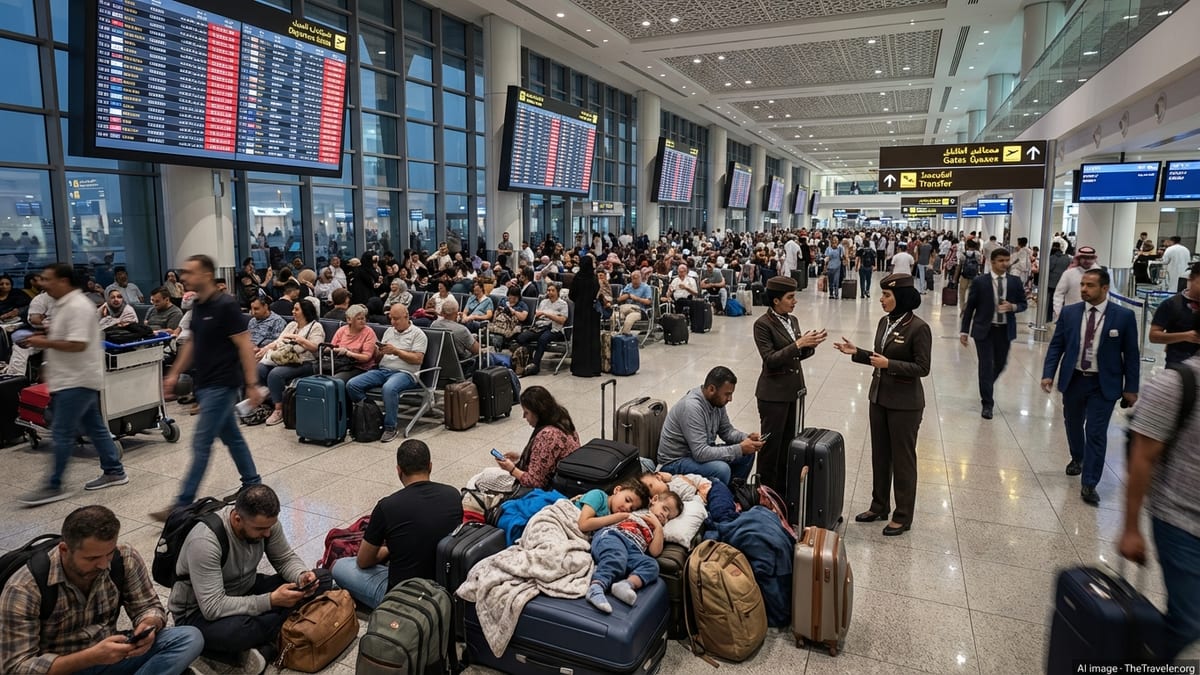
Rapid Escalation Leaves Key Hubs Gridlocked
Airports in Dubai, Abu Dhabi, Doha, Jeddah, Muscat, Bahrain, Istanbul and smaller hubs such as Fujairah reported mounting delays as airlines halted departures and diverted inbound services following intensified military strikes involving the United States, Israel and Iran. Flight tracking maps showed vast swathes of airspace over Iran and parts of the Gulf and Eastern Mediterranean effectively empty, forcing carriers to suspend or reroute services across some of the world’s busiest long-haul corridors.
Emirates and Etihad in the United Arab Emirates, Gulf Air in Bahrain, Royal Jordanian, as well as Turkish Airlines and several Gulf and Asian carriers, either cancelled routes outright or imposed rolling delays as they sought alternative routings around conflict zones. At major hubs, long-haul arrivals from Europe, North America and Asia were held on the ground at origin airports or turned back mid-route, adding further complexity to an already fragile global schedule.
Regional aviation officials said the priority remained protecting passengers and crew amid fast-changing risk assessments. With multiple neighbouring states tightening or partially closing their skies, airlines were left with narrow corridors of approved airspace, increasing flight times, fuel burn and crew duty constraints, which in turn contributed to cancellations and missed connections.
Emirates, Etihad and Gulf Carriers Face Network Disruption
Dubai-based Emirates, one of the world’s largest long-haul carriers, suspended numerous services touching Iranian and adjacent airspace and warned of extended delays for flights across its network. The airline said passengers transiting through Dubai on affected routes would be rebooked where possible but cautioned that the scale of the disruption meant some travellers could face overnight stays or longer waits for available seats.
Abu Dhabi’s Etihad Airways similarly adjusted or cancelled flights to regional destinations where airspace restrictions made safe operations difficult or uneconomical. The carrier reiterated that it would only operate through approved corridors and urged passengers to monitor their flight status and allow additional time at airports, particularly for complex itineraries connecting Europe and Asia via the Gulf.
In Bahrain, Gulf Air cut services on select regional routes and warned that flights into and out of Manama may experience knock-on delays, especially where aircraft and crew were displaced by earlier diversions. Other Gulf-based airlines, including low-cost operators serving secondary cities in Saudi Arabia and Oman, also reported schedule changes, underscoring how tightly interlinked the region’s aviation networks have become.
Ripple Effects Felt from Dubai and Doha to Istanbul and Jeddah
At Dubai International, one of the world’s busiest international airports, long queues formed at transfer desks as transit passengers from Europe, Africa, Australasia and North America sought new connections after missed onward flights. With hotel capacity in the city already tight at peak travel season, some travellers reported being issued meal vouchers and lounge access while they waited for re-accommodation options to open up.
In Doha, Hamad International Airport grappled with a backlog of passengers after multiple airlines rerouted or cancelled flights that would normally overfly Iranian or adjacent airspace. Ground staff were deployed across terminals to help connect stranded passengers with new itineraries, but the combination of aircraft out of position and strict crew duty limits meant many connections could only be restored gradually.
Further north, Istanbul’s major airports experienced capacity strains as Turkish Airlines and other carriers adjusted eastbound routes, in some cases stacking departure banks to make use of limited safe corridors. In Saudi Arabia, Jeddah and Riyadh saw disruption to both regional and long-haul services, particularly those linking South and Southeast Asia with Europe and North America, as airlines sought longer, more circuitous paths around restricted skies.
Passengers Face Long Delays, Patchy Information
For passengers, the impact was immediate and often confusing. With conditions changing hour by hour, airport displays and airline apps struggled to keep up with rolling cancellations and equipment swaps. Some travellers arriving into Dubai, Jeddah and Istanbul discovered only on landing that their onward connections no longer existed or had already departed after rapid schedule changes.
Families en route to holidays in the Gulf, business travellers heading to conferences in Dubai and Doha, and migrant workers returning to jobs in Saudi Arabia and the United Arab Emirates all found themselves in the same queues, competing for limited spare seats on remaining services. Social media posts from airports across the region showed crowded departure halls, makeshift sleeping areas on terminal floors and long lines at customer service counters.
Consumer advocates urged affected travellers to keep all travel documentation and receipts for out-of-pocket expenses, noting that compensation rules vary widely by airline and jurisdiction. They also recommended that passengers accept re-routing options where offered, even if indirect, as capacity on remaining flights was tightening rapidly due to aircraft and crew being tied up on longer, diversion-heavy routes.
Uncertain Outlook for Restoring Full Schedules
Aviation analysts said the unprecedented scale of the latest airspace disruptions would likely take days, if not longer, to unwind fully. Even if restrictions are relaxed quickly, airlines must reposition aircraft and crews, reassemble banked connection waves at key hubs, and work through a backlog of stranded passengers before normal patterns can resume.
Carriers in the region have grown adept at managing geopolitical risk after repeated flare-ups over the past several years, but the current combination of airspace closures and active military operations has sharply reduced their room for manoeuvre. Many airlines have already been operating longer routings to avoid other conflict zones, leaving limited flexibility to absorb additional detours without shaving frequencies or temporarily suspending routes.
For now, travellers booked through affected hubs are being advised to monitor official airline channels closely, register for flight-status alerts and consider postponing non-essential trips. With 346 flights cancelled and more than 500 delayed across the Middle East in a single day, industry observers warn that the knock-on effects may ripple through global networks well beyond the region’s borders before traffic flows stabilise again.