

More news on this day
Thailand’s fragile tourism rebound is facing a fresh crisis as the escalating US–Israel–Iran war shuts down key Middle Eastern airspace, forcing mass flight cancellations, driving up airfares and threatening to wipe out hundreds of billions of baht in projected tourism revenue if the disruption drags on.
Get the latest news straight to your inbox!
Regional War Turns Gulf Hubs Into Aviation Bottlenecks
The latest phase of the Iran war, triggered by joint US and Israeli strikes on Iran on 28 February, has rapidly spilled into global aviation, turning the Gulf’s major hubs into chokepoints for travel between Europe, the Middle East and Asia. Iran, Iraq and Israel have all restricted or closed large sections of their airspace to civilian traffic, while strikes and security concerns have disrupted operations in Saudi Arabia, Qatar, the United Arab Emirates, Bahrain and Kuwait.
According to regional briefings and travel advisories, airports in Dubai, Abu Dhabi, Doha, Riyadh and other Gulf cities have suffered waves of cancellations, diversions and partial shutdowns as airlines scramble to avoid high risk zones. Long haul carriers that normally funnel European, American and Middle Eastern passengers to Thailand through these hubs have had to suspend routes or introduce lengthy detours that add hours of flying time and sharply increase fuel costs.
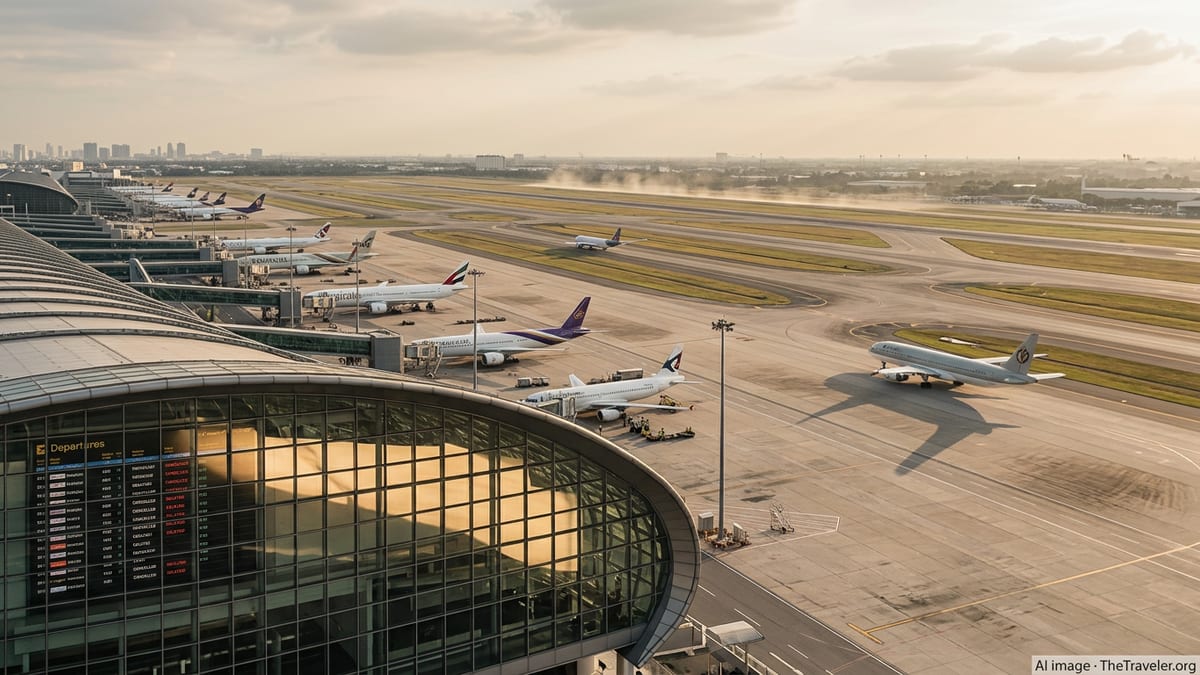
These cascading disruptions are already being felt at Bangkok’s Suvarnabhumi airport and other Thai gateways. Thai authorities report hundreds of cancellations on routes that either originate in the Middle East or traditionally rely on Gulf stopovers, eroding one of Thailand’s fastest growing and highest spending visitor segments just as the country was counting on a strong high season to solidify its post pandemic recovery.
Industry analysts warn that if broad airspace closures across the Middle East persist for several months, the shock could reverberate far beyond immediate flight disruptions, reshaping long haul travel patterns and weakening Thailand’s strategic dependence on Gulf carriers as transit partners for Europe and the wider region.
Flight Cancellations Mount As Routes Are Redrawn
New data from the Tourism and Sports Ministry and Thai aviation agencies illustrate how quickly the situation has deteriorated. Between 28 February and early March, more than 600 flights to and from Thailand were canceled, with Suvarnabhumi bearing the brunt as the main international hub. A significant share of those flights were operated by Middle Eastern and European airlines or relied on now disrupted corridors across Iran and Iraq.
Thailand’s air navigation service provider, Aerothai, has been rushing to redesign flight paths to keep aircraft clear of conflict zones while maintaining as much connectivity as possible. Officials describe a complex daily puzzle in which air traffic controllers must funnel long haul flights north over Central Asia or south via the Arabian Sea and Red Sea, depending on evolving military and airspace restrictions.
The Civil Aviation Authority of Thailand says this rerouting has immediate cost implications. Detours of one to six additional flight hours are pushing up fuel burn by as much as 20 to 30 percent on some long haul routes, pressures that are quickly feeding into ticket prices. Airfares from Bangkok to major European capitals have surged, in some cases doubling compared with pre crisis levels, as airlines pass on higher operating costs and reduce seat capacity.
While Thailand’s airports remain operational and authorities insist there are no widespread passenger strandings, the combination of cancellations, higher fares and longer flight times is already discouraging bookings from Europe, the Middle East and the Americas. Travel agents report a sharp rise in itinerary changes as tourists try to avoid transits through Gulf hubs or postpone trips to Southeast Asia altogether.
Tourism Revenue Scenarios Darken, With Losses in the Hundreds of Billions
Thailand entered 2026 aiming to build on last year’s tourism rebound with more than 36 million foreign arrivals and well over 3 trillion baht in tourism receipts. Those targets are now under review as officials model the fallout from the airspace crisis and the broader US–Israel–Iran conflict on visitor numbers and spending.
Initial assessments from the Tourism Authority of Thailand and the Tourism and Sports Ministry point to three tiers of damage. In an optimistic scenario where airspace restrictions ease within three weeks, authorities forecast a loss of roughly 200,000 foreign visitors and more than 13 billion baht in revenue, mainly from long haul markets. If the war and closures last two months, forecasts suggest up to 600,000 fewer visitors and losses rising into the tens of billions of baht.
Tourism economists and private sector analysts are more pessimistic about a prolonged conflict, particularly if repeated missile strikes and security incidents keep Gulf hubs operating well below capacity. In that worst case, Thailand could face a shortfall of several million long haul visitors over the remainder of the year, blowing a hole of 300 billion baht or more in projected tourism receipts as high spending guests from Europe and the Middle East stay away or choose alternative destinations with more reliable air links.
Such a hit would not only delay Thailand’s return to pre pandemic revenue levels but also weigh on broader economic growth, given tourism’s large contribution to employment and foreign exchange earnings. Hoteliers, airlines and tour operators warn that without targeted relief, a deep and extended revenue slump could lead to renewed layoffs and stalled investment just as the sector was beginning to stabilize.
Saudi Arabia and Gulf Markets: From Growth Engine to Major Risk
Visitors from Saudi Arabia, the United Arab Emirates, Qatar, Bahrain, Kuwait, Oman and Jordan had become a cornerstone of Thailand’s diversification strategy, helping the country reduce overreliance on traditional markets such as China and Russia. Middle Eastern arrivals typically feature higher per capita spending on hotels, shopping and medical tourism, and have been aggressively courted through new marketing campaigns and expanded air links over the past two years.
The current conflict is abruptly reversing that momentum. The closure or heavy restriction of airspace in several Gulf states, combined with intermittent attacks on infrastructure and oil facilities, has led Saudi Arabia and its neighbors to scale back or suspend a range of routes, including those connecting to Bangkok and Phuket. Iranian carriers serving Thailand have been grounded entirely due to the closure of Iranian airspace, effectively erasing that market for now.
Travel advisories out of the Gulf and wider region, including warnings for non essential travel and heightened security alerts, are amplifying the shock. Package tour operators in Saudi Arabia and the United Arab Emirates report a spike in cancellations for Thailand itineraries as families postpone international travel and airlines struggle to guarantee reliable schedules. The same pattern is emerging in other source markets across the Middle East as uncertainty grows over how long the conflict will last.
For Thailand, the sudden reversal in a once booming Middle Eastern segment underscores the risks of depending heavily on a single transit corridor and a handful of hub airports. Industry leaders are now calling for an urgent pivot toward more direct point to point connectivity with Europe and Asia, even if that means higher short term costs, as well as deeper promotion in markets that can be reached without crossing the volatile Gulf region.
Bangkok Moves to Contain Damage and Reassure Travelers
The Thai government has launched a series of rapid response measures aimed at softening the blow to travelers and maintaining confidence in the country as a safe and accessible destination. The Ministry of Tourism and Sports convened an emergency task force this week to coordinate with airlines, airports, immigration and tourism operators on both immediate assistance and longer term contingency planning.
Among the first steps was a temporary waiver of overstay fines for foreigners whose visas expired after 28 February but who have been unable to depart due to canceled or heavily delayed flights linked to the Middle East crisis. Travelers can apply for a short extension of stay, while immigration authorities have been instructed to exercise discretion for passengers who can show evidence of disrupted itineraries.
Airports of Thailand, which manages the country’s six main international airports, says terminals are operating normally and that staff are working with airlines to rebook affected passengers when seats become available. Authorities are emphasizing that Thailand itself remains safe and fully open for tourism, seeking to separate the perception of turmoil in Middle Eastern transit hubs from conditions on the ground in Bangkok, Phuket, Chiang Mai and other destinations.
At the policy level, tourism officials are accelerating promotional campaigns in short haul markets across Asia, where travel is less dependent on Gulf corridors, and exploring incentives for carriers that can operate alternative long haul routes avoiding the most affected airspace. While such measures cannot fully offset the potential 300 billion baht revenue shock from a protracted conflict, they reflect a determination to keep Thailand on travelers’ maps as the Middle East crisis continues to reshape global air travel.