

More news on this day
Travelers flying through Egypt on February 28 are facing significant disruption, with 107 flight delays and 61 cancellations affecting services by EgyptAir, Lufthansa, Emirates and British Airways at Cairo, Hurghada and Alexandria amid widening Middle East airspace closures.
Regional Airspace Crisis Ripples Into Egyptian Hubs
Air travel across the Middle East was thrown into turmoil on February 28 after coordinated United States and Israeli strikes on Iran prompted a cascade of airspace closures in Iran, Iraq, Kuwait, Bahrain, Qatar, the United Arab Emirates and other states. The sudden restrictions have forced airlines to cancel or reroute hundreds of flights, reconfiguring key long-haul corridors between Europe, Asia and North America almost overnight.
Although Egypt’s own airspace remains open, the knock-on effects have hit its main gateways hard. Cairo International Airport, the country’s primary hub, along with the Red Sea resort airport of Hurghada and Alexandria’s Borg El Arab, together recorded a combined 107 delays and 61 cancellations on Saturday, according to airport and industry data. Many of those flights were either bound for or arriving from Gulf and Levant destinations that suddenly fell behind newly imposed no-fly lines.
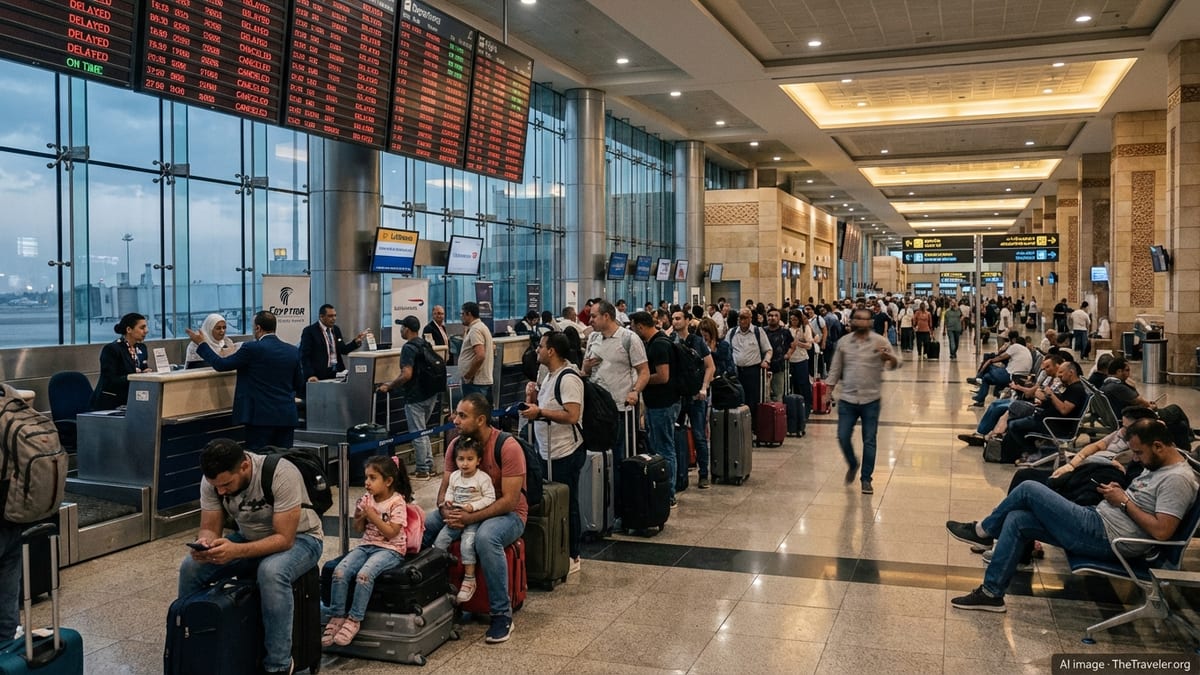
The result has been crowded terminals, long queues at airline service desks and mounting frustration among travelers who arrived to find their trips disrupted with little advance warning. Airport staff in Cairo and Hurghada reported passengers sleeping in departure halls as carriers worked to rebook stranded customers or arrange hotel accommodation where possible.
The disruption coincides with a busy late-winter travel period for Egypt, when inbound tourism typically remains strong and outbound traffic to Gulf labor markets is high. Aviation officials acknowledged that even a single day of cascading cancellations can strain airport resources and airline operations, particularly where Egypt functions as a vital connecting point between Africa, the Middle East and Europe.
EgyptAir Halts Regional Routes as Foreign Carriers Adjust Schedules
EgyptAir has moved to suspend a swath of regional services in response to the evolving security and airspace picture. The state-owned carrier announced on Saturday that flights from Cairo to 13 cities, including Kuwait, Dubai, Doha, Manama, Abu Dhabi, Sharjah, Qassim, Dammam, Erbil, Baghdad, Amman, Beirut and Muscat, would be halted until further notice. Executives said the decision was driven by neighboring countries’ airspace closures and the need to prioritize safety.
While EgyptAir’s domestic network and most Africa and Europe routes are continuing to operate, the suspension has effectively cut off some of the carrier’s busiest short- and medium-haul links, amplifying the disruption for passengers transiting through Cairo. Travelers booked on multi-leg itineraries are being offered rebooking options where alternative routings are available, but many connections that once relied on Gulf hubs are currently impossible.
Foreign airlines are also feeling the impact. Lufthansa, Emirates and British Airways have all adjusted operations involving Egypt, with aircraft and crews caught up in broader network upheavals as routes to and across the Gulf are suspended or sent on longer detours. Some services into Cairo and Hurghada have been delayed by hours as aircraft wait out new routing clearances or reposition from congested alternative hubs such as Istanbul and Jeddah.
Industry analysts note that Egypt’s position on the edge of the conflict-affected airspace leaves carriers with difficult choices. Flights that once operated on relatively direct paths over the Levant and northern Gulf now require additional flight-planning, fuel and crew time to avoid closed corridors. That complexity can quickly cascade into delays for both inbound and outbound services touching Egyptian airports.
Tourism and Local Economies Feel the Strain
The wave of delays and cancellations comes at a sensitive moment for Egypt’s tourism sector, a critical source of foreign currency and employment. Cairo, Hurghada and Alexandria serve as major entry points for visitors heading to heritage sites, Nile cruises and Red Sea resorts, and any sustained disruption risks denting confidence among tour operators and independent travelers alike.
Hotels in Hurghada reported late arrivals and missed check-ins as charter and scheduled flights from Europe ran behind schedule or were scrubbed entirely. Some resort operators said they were forced to rearrange airport transfers at short notice and accommodate guests whose return flights had been postponed, raising costs in a sector already grappling with fluctuating demand linked to regional tensions.
In Cairo, guides and travel agencies reported last-minute cancellations of day trips to the Giza Plateau and museum visits, as travelers opted to remain close to their hotels while waiting for updated flight information. For Alexandria, where Borg El Arab Airport is a key gateway for expatriate workers and diaspora visitors, disruptions have complicated family visits and business trips, affecting local transport and hospitality businesses that depend on steady passenger flows.
Economists warn that if airspace closures and reroutings extend over days or weeks, the impact could move beyond temporary inconvenience to measurable revenue losses for airlines, airports and the wider tourism ecosystem. Egypt’s authorities are therefore keen to present the country as a stable operating environment, even as they acknowledge that events beyond their borders are driving much of the present disruption.
Authorities Urge Passengers to Check Flights and Expect Changes
Egypt’s Ministry of Civil Aviation said it is closely monitoring regional developments from a dedicated crisis room, coordinating with international aviation agencies and domestic operators to keep airports functioning as smoothly as possible. Officials have emphasized that Egyptian airspace remains open and that the country is prepared to receive diverted aircraft unable to land at their original Gulf or Levant destinations.
Authorities and airlines alike are urging passengers to verify their flight status before heading to the airport and to expect schedule changes on short notice. EgyptAir and foreign carriers operating into Cairo, Hurghada and Alexandria have issued advisories through customer-service channels, encouraging travelers to use mobile apps and call centers to confirm departure times, gate changes and rebooking options.
At the terminals, ground staff have been tasked with managing crowd flow and providing updated information as operations evolve through the day. Some airlines have relaxed change penalties and fare rules for affected routes, although specific policies vary by carrier and are being updated as the situation unfolds.
Travel agents in Egypt and overseas are advising clients with imminent departures to factor in longer check-in times and to carry essentials in their hand luggage in case of prolonged waits or unexpected overnight stays. Many are also recommending flexible booking options for trips in the coming weeks, given uncertainty over how long regional airspace restrictions will remain in place.
Uncertain Outlook for Reopening of Regional Routes
With military and diplomatic dynamics still in flux, there is no clear timetable for the full resumption of suspended routes serving Cairo, Hurghada and Alexandria. Aviation experts caution that even if some airspace corridors reopen quickly, carriers may take longer to restore pre-crisis schedules as they assess security guidance, aircraft availability and passenger demand.
For EgyptAir, the immediate priority is managing stranded passengers and stabilizing its network around routes that remain viable without crossing closed skies. The carrier’s crisis management team is reviewing options daily, but any restart of flights to heavily affected Gulf and Levant destinations will depend on government-to-government coordination and the reopening of key airspace segments.
International airlines serving Egypt face similar calculations. Emirates, Lufthansa and British Airways are likely to maintain a cautious posture, gradually reintroducing flights as conditions allow while building in additional buffers for routing changes and crew duty limits. In the interim, travelers can expect thinner schedules, longer journey times and a greater risk of last-minute disruptions on routes touching the wider region.
For passengers and the travel industry in Egypt, the day’s 107 delays and 61 cancellations are a stark reminder of how quickly geopolitical shocks can reverberate through global aviation. How long the disruption lasts will depend not only on technical airspace decisions but on the course of a fast-moving regional crisis unfolding largely beyond the control of airlines and airports on the ground.