

More news on this day
Widening conflict across the Middle East is rippling through global aviation, with sweeping airspace closures forcing mass rerouting of flights, pushing up costs and throwing tourism-dependent economies into fresh uncertainty just as peak travel season approaches.
Get the latest news straight to your inbox!
Airspace Closures Hit Key Global Transit Hubs
The latest round of conflict that escalated on February 28, 2026 has led to temporary or prolonged closures of airspace in Iran, Qatar, Israel, the United Arab Emirates and parts of neighboring states. Publicly available aviation notices and industry trackers indicate that Qatar’s airspace remains formally shut, while Israel and the UAE have imposed heavy restrictions, severely limiting commercial traffic.
These moves have effectively throttled Hamad International Airport in Doha and sharply curtailed operations at Dubai International and Abu Dhabi International, three of the world’s most important long-haul hubs. Travel advisories issued in early March describe airspace across much of the Gulf as closed or constrained, with only limited evacuation and special services operating while regular schedules remain suspended or heavily reduced.
For international airlines crossing between Europe, Asia, Africa and Oceania, the Middle East functions as a central “switching yard” for global passenger flows. According to aviation data cited in recent industry reports, Gulf hubs handle roughly one third of Europe–Asia traffic and more than half of connections between Europe and Australia or New Zealand, magnifying the global impact of each closure decision.
In parallel, security concerns and infrastructure disruptions have constrained operations at Israel’s Ben Gurion Airport and at airports in Lebanon and Bahrain, while regional regulators continue to warn of elevated risks along several popular air corridors. Even where runways remain technically open, carriers are adjusting routings to avoid perceived high-risk zones.
Rerouted Long-Haul Flights Add Hours and Costs
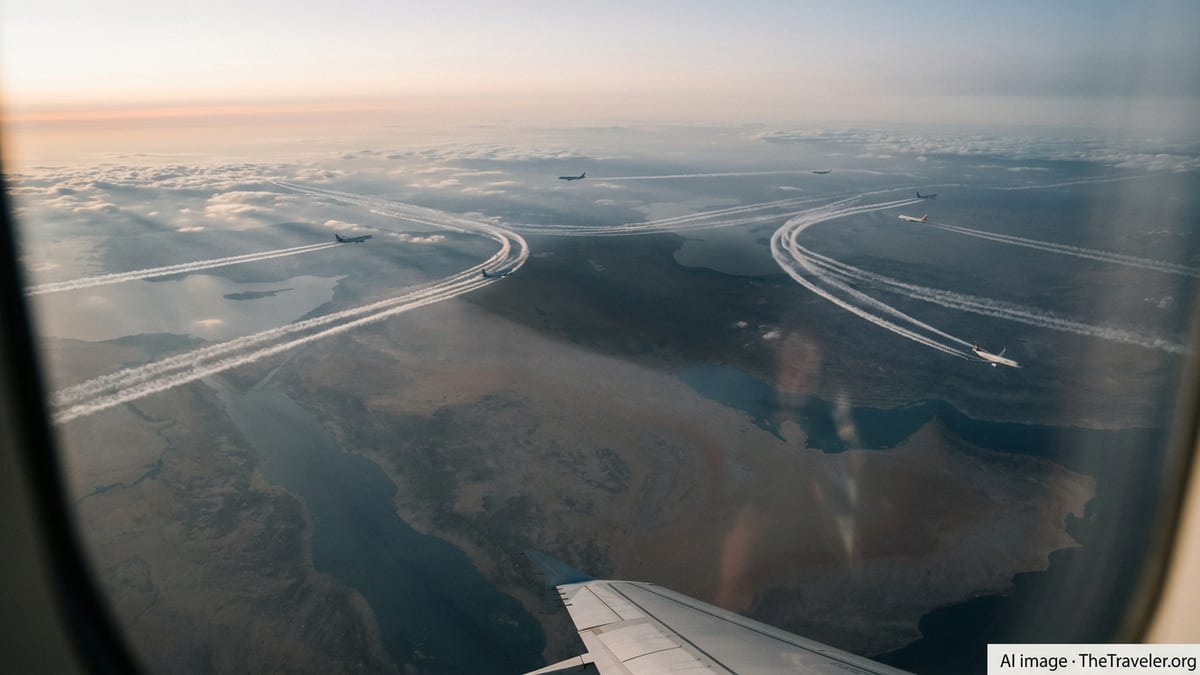
With swathes of Middle Eastern airspace now off limits, airlines are redrawing long-haul maps in real time. Flights that once traced near-straight great-circle paths across Iran, Iraq and the Gulf are being pushed farther south over the Arabian Sea, or diverted north via Turkey and the Caucasus where capacity allows. Asia–Europe and Asia–North America routes are among the most affected.
Recent operational updates from carriers in India, Southeast Asia and Europe describe detours adding 60 to 180 minutes to some sectors, depending on aircraft type and routing options. Aviation analysts quoted in current trade and consumer travel coverage estimate that each additional hour of flying can add several thousand dollars in fuel and operating costs per flight, at a time when jet fuel prices are already rising in response to disrupted oil flows through the Strait of Hormuz and nearby shipping lanes.
Some airlines have responded by trimming frequencies on the longest, most fuel-intensive routes, while others have opted for technical fuel stops in secondary hubs to preserve range. Smaller and lower-margin carriers face particularly difficult choices, with limited flexibility to absorb higher costs or to quickly reconfigure networks. In several cases, airlines have temporarily suspended services to the Middle East altogether, prioritizing core routes with stable overflight permissions.
Schedule complexity is also increasing. Reroutings can disrupt crew duty-time planning, aircraft rotations and slot timings at congested airports far from the conflict zone. Industry operations briefings suggest that knock-on delays are now being recorded in Europe, South and Southeast Asia as aircraft and crews struggle to return to position after extended flights.
Tourism Hotspots Feel the Shockwave
While much of the immediate aviation disruption is centered in the Middle East, the economic fallout is spreading across global tourism. Mediterranean destinations, Indian Ocean islands and Southeast Asian resorts are reporting rising cancellations and booking hesitancy linked directly to flight uncertainty and higher fares on key long-haul routes.
In Europe, national and regional tourism bodies are warning that the war could erode inbound demand for 2026, particularly from high-spending visitors originating in Asia, Australia and the Gulf. Italian industry associations, for example, have already flagged potential multi-billion-euro revenue losses this year as travelers postpone or reroute holidays amid volatile air connections and anxious news headlines.
Outbound tourism from the Middle East itself has also been sharply curtailed. With major Gulf carriers reducing schedules and some states advising citizens to defer nonessential travel, premium leisure segments that typically fill business-class cabins to Europe and Asia are under pressure. Retail, hospitality and cultural attractions in cities heavily reliant on Middle Eastern visitor spend, such as London, Paris and Istanbul, are bracing for a softer season.
At the same time, destinations positioned as alternative hubs away from the conflict zone are seeing a short-term surge in demand. Carriers are funnelling passengers through secondary connecting points in Southern Europe, North Africa and Central Asia, offering new one-stop combinations between continents. Travel analysts caution, however, that these shifts may be temporary and come with their own capacity and infrastructure challenges.
Travelers Face Uncertainty, Higher Fares and Longer Journeys
For individual travelers, the impact of the Middle East airspace closures is being felt most acutely in disrupted itineraries and shrinking choice. In the days immediately after February’s escalation, tens of thousands of passengers were left stranded across the Gulf and wider region as flights were abruptly canceled and rebooking options limited. Evacuation-style services and ad hoc repatriation flights have since helped ease the backlog, but regular capacity remains significantly reduced on some corridors.
Consumer advisories from airlines and travel platforms over the past week consistently urge passengers to monitor bookings closely, confirm transit rules and allow for longer journey times. Many carriers are offering flexible rebooking and refund policies for tickets issued before the escalation, though conditions vary. Where alternative routings are available, they often involve additional stops and overnight layovers, turning what were once single-connection journeys into multi-leg odysseys.
Fares are also coming under upward pressure. With fewer non-stop options on popular city pairs such as London–Sydney, Frankfurt–Bangkok or New York–Delhi via the Gulf, remaining seats on indirect routes are commanding higher prices. Industry commentators point to the combination of longer flight times, higher fuel bills and reduced capacity as a recipe for sustained fare inflation on many long-haul markets if the disruption persists into the busy northern summer.
Travel insurance considerations are adding another layer of complexity. Some policies exclude coverage for events linked to war or civil unrest, while others offer partial protection for delays and cancellations. Consumer groups are advising travelers to scrutinize policy wording carefully and to document all communications with airlines and agents when seeking refunds or compensation.
Aviation Industry Confronts a New Era of Route Risk
For airlines and regulators, the latest Middle East crisis reinforces a longer-term shift in how route risk is managed. In a recent safety briefing, the International Air Transport Association highlighted the growing exposure of global aviation to geopolitical flashpoints and warned that fragmented decision-making on airspace closures can create uncertainty for carriers and passengers alike.
Regulators in Europe, North America and Asia have issued fresh conflict-zone guidance in recent days, identifying portions of Middle Eastern airspace as high-risk and advising operators to avoid or strictly assess certain flight levels. Airlines are layering these notices onto their own internal risk assessments, which factor in aircraft vulnerability, navigation options and the availability of alternative routings in the event of sudden escalations.
Industry observers note that this conflict arrives on top of existing challenges, including constrained aircraft supply, tight labor markets and climate-related disruptions. The combination raises questions about the resilience of a global network that increasingly relies on a handful of mega-hubs in politically sensitive regions for its most lucrative long-haul flows.
In the short term, the trajectory of flight schedules will depend on whether regional tensions ease enough for airspace to reopen in a meaningful way. Until then, travelers can expect longer journeys, more complex connections and higher prices on many international routes, while airlines and tourism boards work to adapt to a rapidly shifting aviation map.