

More news on this day
More than 15,000 flights have been cancelled or rerouted in less than a week as large parts of Middle Eastern airspace shut down following the latest escalation in the US–Israel–Iran conflict, upending tourism plans, crippling Gulf hubs in the United Arab Emirates and Qatar, and forcing airlines worldwide to redraw some of their busiest long-haul corridors.
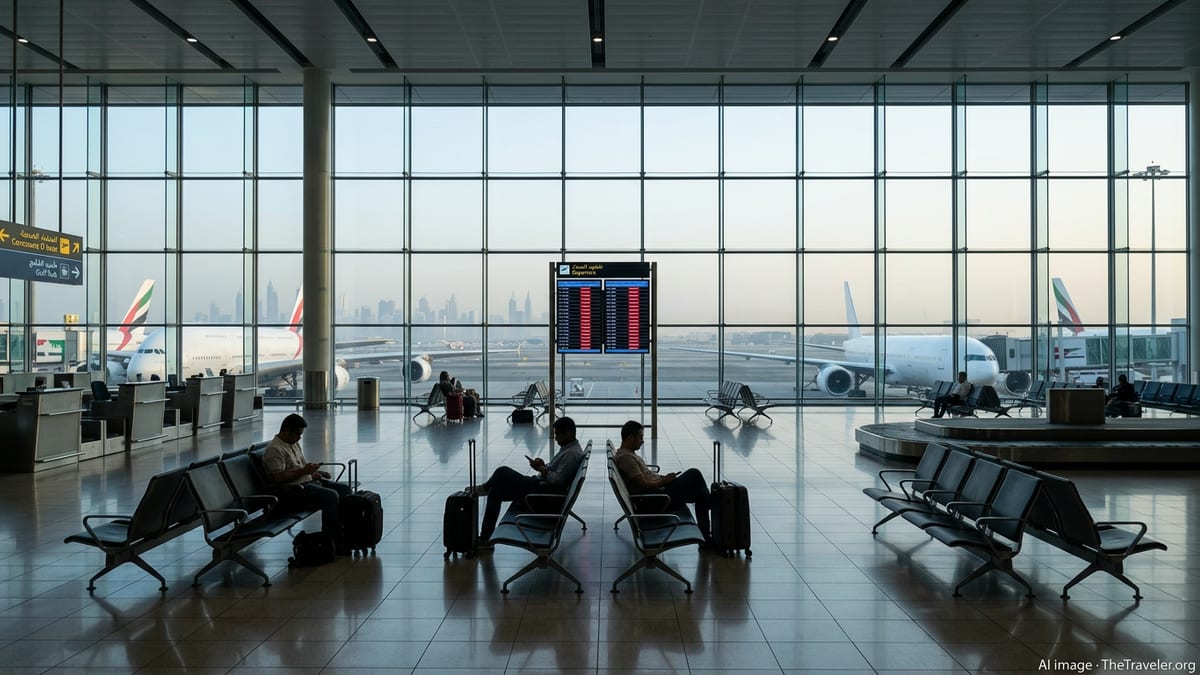
Airspace Shutdown Turns Gulf Hubs Into Ground Zero
Beginning on February 28, 2026, Iran, Iraq, Israel, Kuwait, Qatar, Bahrain, Syria and the United Arab Emirates imposed full or partial airspace closures as missile exchanges and retaliatory strikes intensified, according to regional aviation and government advisories. Within hours, Dubai International, Abu Dhabi and Doha’s Hamad International Airport were effectively taken offline as transit hubs, forcing hundreds of arriving and departing flights to divert or return to origin.
Flight analytics firms estimate that more than 3,400 flights were cancelled on Sunday alone, followed by well over 1,000 additional cancellations on Monday, as closures were extended and airlines began to thin out schedules rather than operate day-to-day. Industry data for the wider Gulf region show that across several days of disruption, over half of all scheduled services to and from the Middle East were cancelled, representing more than 4 million lost seats and pushing the cumulative tally of affected services beyond 15,000.
The scale of the shutdown is unprecedented in a region that has built its economic strategy around acting as a bridge between Europe, Asia and Africa. Flights that would normally hopscotch via Dubai or Doha to connect cities such as London and Sydney, Mumbai and New York, or Johannesburg and Paris suddenly lost their primary transit points, creating a cascading effect across airline networks from North America to East Asia.
Saudi Arabian airspace, one of the few major corridors to remain open, quickly became saturated as carriers tried to route around closed neighbors. Air traffic controllers reported heavy congestion and longer separation times, which in turn generated rolling delays even for flights able to operate. That congestion highlights how concentrated global aviation has become around a handful of Middle Eastern chokepoints.
UAE: Tourism Flagship Brought to a Standstill
The United Arab Emirates, whose aviation and tourism sectors contribute a substantial share of GDP, has been among the hardest hit. Dubai International Airport, regularly ranked among the world’s busiest for international passengers, saw normal operations suspended as authorities closed national airspace for security reasons and later moved to what regulators called “exceptional” operations to move stranded travelers out in controlled waves.
Emirates, flydubai, Etihad Airways and Air Arabia all cancelled or drastically reduced schedules as airspace restrictions tightened. While some limited services have restarted on carefully designed routes that avoid conflict zones, airlines are prioritising passengers already in transit or holding earlier bookings, leaving many new travelers unable to secure seats during what would typically be a high season for leisure and business visits.
Hotels and tour operators across Dubai and Abu Dhabi report a sudden wave of cancellations and no-shows as international visitors either cannot reach the country or opt to postpone trips. Analysts warn that even a short-lived airspace shutdown can erase months of marketing gains for destinations that rely heavily on stopover tourism, luxury shopping trips and major events to keep occupancy high.
Economic consultancies now estimate that international arrivals to the wider Middle East could fall between 11 and 27 percent in 2026 if the conflict and closures drag on, with the UAE bearing a disproportionate share of the losses due to its dependence on long-haul air connectivity and high-spend visitors. For many small local businesses in hospitality, retail and entertainment, the shock has been immediate and severe.
Qatar: Hamad International Silenced as Airspace Closes
Qatar, home to one of the region’s most important transfer hubs at Hamad International Airport, has taken the unusual step of closing its airspace entirely in response to Iranian missile strikes and falling debris risks reported across the country. That decision brought Qatar Airways’ normally extensive global network to an abrupt halt, with the carrier confirming a temporary suspension of regular flight operations to and from Doha.
Aircraft already en route when closures were announced have been diverted to alternate airports in Europe, South Asia and the Gulf, leaving crews and equipment out of position. With Qatari airspace sealed, even overflights that would not normally land in Doha have been forced to detour, adding time and fuel burn to journeys between Europe, Asia and Africa.
The impact on tourism is stark. Qatar has spent heavily to position itself as a premium stopover destination and conference hub following its global exposure from the 2022 World Cup. Now, major events, exhibitions and leisure trips are being postponed or moved elsewhere as inbound delegates and visitors struggle to find viable routings that do not rely on Doha as a gateway.
Authorities in Qatar have not yet provided a timetable for reopening the skies, instead signalling that security assessments will dictate the pace of any resumption. Until then, the country’s tourism board and hospitality sector face an open-ended pause at a moment when they had expected to be consolidating post-pandemic growth.
Global Travelers Face Detours, Higher Fares and Longer Trips
For travelers far beyond the Middle East, the closures are being felt in longer routes, missed connections and rising fares. Major European and Asian airlines that traditionally depend on Gulf overflights to link their own networks are cancelling or rerouting services, sometimes adding several hours to journeys to skirt closed airspace over Iran, Iraq, Israel and neighboring states.
Passengers who do manage to travel are reporting complex itineraries that involve backtracking through secondary hubs in Turkey, Egypt or Southern Europe, overnight layovers, and last-minute rebookings. With aircraft and crews displaced from their normal rotations, airlines are juggling shortages on multiple continents, leading to knock-on delays even on routes that never approach the Middle East.
Travel advisers warn that schedules are changing on an almost hourly basis as carriers wait for updated risk assessments and slot allocations in the few corridors that remain open. They recommend that passengers booked to travel anywhere near the region in the coming weeks avoid heading to the airport without a confirmed operating flight, monitor airline apps closely, and be prepared for involuntary rerouting or date changes.
Higher costs may be an enduring legacy of this crisis. Detours that add hundreds of nautical miles to a route significantly increase fuel consumption, while extended block times mean aircraft can complete fewer rotations per day. Airlines are already signalling that they will need to recoup those expenses, either through temporary surcharges or by permanently adjusting fare structures on key intercontinental corridors.
Tourism’s Fragile Recovery Exposed
The airspace chaos has landed at a delicate moment for global tourism. Many destinations in Europe and Asia rely on Gulf carriers to provide seamless one-stop access from emerging markets, especially in South Asia and Africa. With Emirates, Qatar Airways and Etihad Airways operating far below normal capacity, those visitor flows have slowed sharply, threatening resorts and city destinations that had only recently returned to or surpassed pre-pandemic visitor numbers.
Within the Middle East itself, tourism-board campaigns that billed 2026 as a year of renewed festivals, sporting events and cultural programming are being hastily rewritten. Industry executives warn that confidence is easily shaken: travelers who struggle to get home or see trips collapse at short notice may hesitate before planning another visit to the region, even after the skies reopen.
Yet aviation analysts also note that past shocks, from volcanic ash clouds to regional conflicts, show that demand can rebound quickly once airspace restrictions lift and clear safety assurances are in place. The core geographical advantage of Gulf hubs, sitting astride the shortest paths between continents, has not changed, even if this crisis has underscored how exposed global travel remains to sudden geopolitical ruptures.
For now, however, the picture is one of grounded aircraft, half-empty terminals and bewildered passengers. Until governments restore confidence in the safety of the skies above the Middle East, the world’s most connected travel crossroads will remain partially severed, and the reverberations will be felt on departure boards and beach fronts far beyond the Gulf.