

More news on this day
Ripple effects from a patchwork of Middle Eastern airspace closures and restrictions are now disrupting Oman Air’s network, leaving many travelers facing longer journeys, short-notice schedule changes, and uncertainty around upcoming trips.
Get the latest news straight to your inbox!
Evolving Conflict and a Patchwork of Airspace Closures
Regional tensions linked to the current Iran war have triggered rolling airspace closures across parts of the Middle East in recent weeks, affecting both overflight routes and access to major hubs. Publicly available information indicates that airspace over Iran, Qatar, Bahrain, Kuwait and segments of Iraq and Israel has been fully or partially closed at various points, while the United Arab Emirates and other Gulf states have periodically restricted sectors or corridors for security reasons.
Industry advisories and analytical reports describe Saudi Arabia as one of the few major east–west corridors still broadly available, although it is operating close to capacity as airlines divert around conflict areas. Oman’s airspace has largely remained open, and Muscat is being described in aviation briefings as a key alternative pathway for Europe–Asia traffic trying to avoid higher-risk zones. Even so, temporary restrictions and flow controls around Oman have been reported, adding complexity to flight planning.
The result is a constantly shifting map for carriers such as Oman Air, which must respond to last-minute Notices to Air Missions, changing military risk assessments, and congestion in the remaining open corridors. Schedules that were built around direct, fuel-efficient routings are now being reworked day by day, with some services canceled outright when safe or legal paths are unavailable.
Travel advisories compiled by security consultancies and logistics providers note that the situation is fluid, with potential for sudden closures even in airspace that appears stable. For passengers, that means that a flight operating normally one day may be delayed, rerouted, or withdrawn from sale the next, depending on developments along its planned route.
How Oman Air’s Network Is Being Affected
For Oman Air, the most immediate impacts are on routes that would ordinarily cross or approach closed or high-risk airspace, including services linking Muscat with destinations in the Levant, parts of the Gulf, and certain European and Asian cities. Publicly available schedules and traveler reports indicate that some flights have been canceled or consolidated, while others have been retimed by several hours to accommodate longer routings through Saudi and Egyptian airspace.
Passengers connecting through Muscat are seeing extended travel times as flights avoid restricted corridors and operate at less efficient altitudes or detour further south and west. Aviation analysis circulated to corporate clients highlights increased fuel burn and crew duty-time constraints as additional operational pressures, which can in turn force Oman Air to thin frequencies or introduce day-of-departure changes.
Cargo operations tell a similar story. Trade-facing advisories note that Oman Air Cargo is continuing to move freight, but with limits on capacity and special handling for some categories of goods. With neighboring hubs such as Doha and Dubai experiencing intermittent disruptions and crowding, Muscat’s role as a relief valve has grown, increasing the strain on airport resources and air traffic management.
Travelers posting to public forums over the past two weeks describe cases where Oman Air departures from Muscat were shifted by several days, or where transit connections had to be rebuilt after partner airlines altered their own schedules. While individual experiences vary, these reports are consistent with a network under sustained pressure from events largely beyond the carrier’s control.
What Passengers Can Expect in the Coming Days
Given the volatile security landscape, passengers booked on Oman Air in March 2026 should be prepared for short-notice changes to itineraries, including departure time shifts, aircraft swaps, and in some cases rerouting through alternative airports. Industry guidance stresses that even when airports in Oman and Saudi Arabia are operating normally, disruptions elsewhere in the network can cascade into delays and missed connections.
Travel risk assessments published this month suggest that point-to-point flights into Muscat from relatively unaffected regions are the most likely to operate close to schedule, while itineraries that rely on overflying or connecting through heavily impacted parts of the Middle East remain vulnerable to disruption. Europe–Asia journeys that once used more northerly tracks are now often channeled through the Gulf and Red Sea regions, adding to congestion and increasing the chance of knock-on delays.
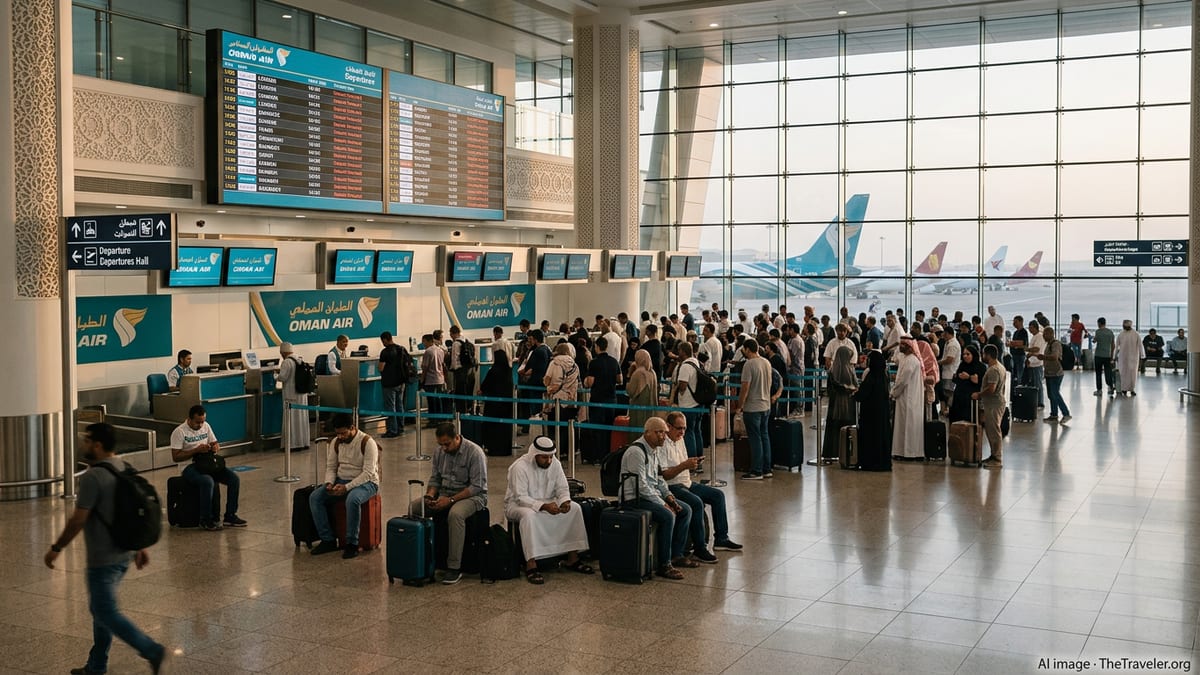
Passengers can also expect busier terminals and longer processing times at Muscat International Airport as diverted traffic and rebooked travelers pass through. Advisory notes from aviation consultancies reference “resilience hub” dynamics at Muscat, describing higher-than-normal passenger volumes, extended queues at transfer desks, and increased demand for airport hotels when connections are missed.
Looking slightly further ahead, analysts caution that the timeline for a return to regular operations will depend on both the security outlook and regulatory decisions by regional authorities. Even if some airspace blocks reopen, airlines and insurers may be slow to restore pre-crisis routings, which could leave Oman Air’s schedules in a transitional state for weeks.
Managing Bookings and Minimizing Disruption
Travel and risk-management specialists are broadly aligned on several practical steps for passengers flying with Oman Air while airspace disruptions continue. The first is to monitor bookings closely through the airline’s official channels and mobile app, as day-of-departure changes and rolling schedule updates are more likely in this environment than in normal times.
Publicly available travel advisories recommend allowing extra time between connecting flights, especially when itineraries involve switching airlines or terminals at Muscat or other regional hubs. Where possible, travelers are being advised to choose longer minimum connection times than they might ordinarily accept, in case inbound flights are delayed by reroutes around closed airspace.
Passengers are also encouraged to familiarize themselves with Oman Air’s current rebooking and refund policies, which may include flexible waivers for tickets to or from heavily affected destinations. Industry bulletins highlight the importance of checking eligibility periods and fare-class conditions, as waiver windows can change as the situation evolves.
For those yet to book, travel managers often suggest avoiding extremely tight schedules, late-night connections with limited backup options, and nonessential same-day commitments at destination. Some corporate travel programs are temporarily directing staff to route via relatively stable hubs even if that adds time or cost, prioritizing reliability over speed.
Insurance, Safety Perception, and When to Reroute
Beyond the immediate operational issues, the wave of airspace closures has raised questions about safety and travel insurance coverage for journeys involving Oman and the wider region. Specialist insurers and assistance providers note in publicly posted guidance that most standard policies continue to cover trips that transit through conflict-adjacent areas, but exclusions may apply for travel into specific countries or for canceling a trip solely out of fear.
Travelers are advised by these providers to review policy language carefully, including clauses covering war, terrorism, and government-imposed airspace restrictions. Where coverage is limited, some underwriters are offering optional upgrades for high-risk regions, although availability can tighten as a crisis deepens.
On the safety front, aviation regulators and risk consultancies emphasize that flights that are still operating have been routed to comply with current security guidance and risk assessments. The more common consequence for Oman Air customers is disruption rather than exposure to direct danger: cancellations, diversions to alternative airports such as Muscat instead of closed hubs, and extended time spent in transit.
Deciding whether to reroute or postpone travel ultimately depends on each traveler’s risk tolerance, itinerary, and flexibility. Publicly available expert commentary suggests that those with nonessential trips involving multiple connections through the most affected airspace blocks may wish to delay or seek routings that minimize exposure to sudden closures, while those on simpler Oman Air itineraries into and out of Muscat may find their flights continue to operate with manageable delays rather than wholesale cancellations.