

More news on this day
Sudden airspace closures and missile strikes across the Middle East have choked off one of the world’s busiest aviation arteries, stranding travelers, rerouting long-haul flights and underscoring how dependent global air travel has become on a narrow Gulf corridor.
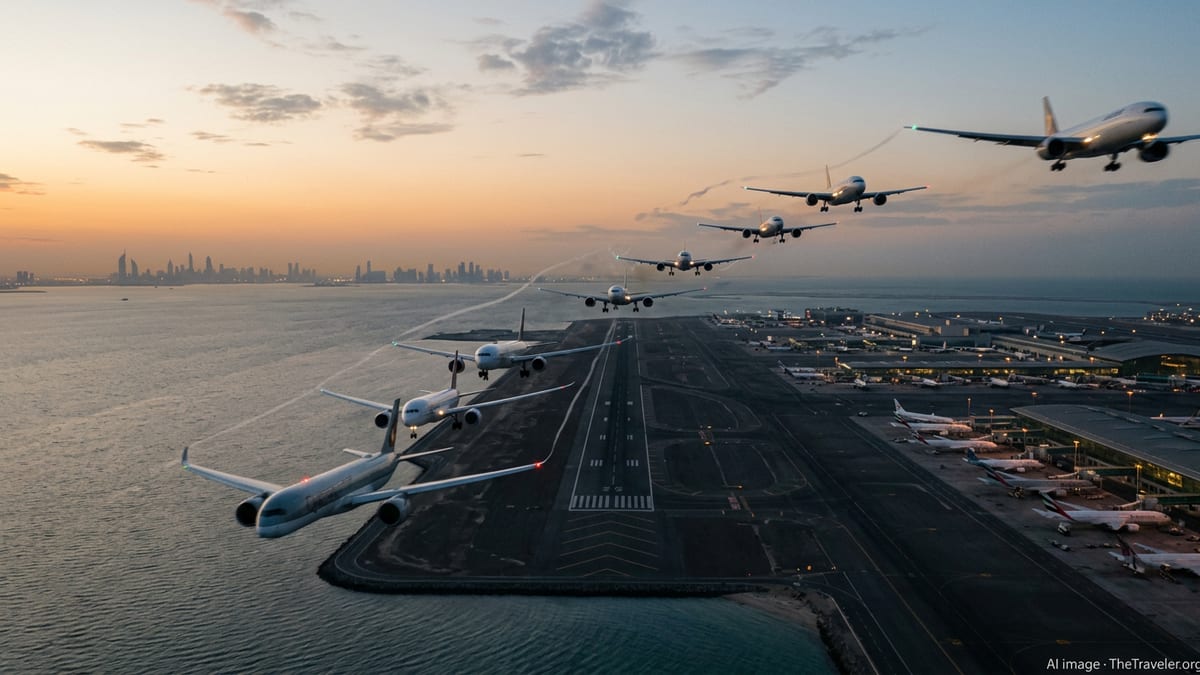
A Vital Global Artery Brought to a Standstill
In the days since the latest US and Israeli strikes on Iran triggered retaliatory attacks across the Gulf, large sections of Middle Eastern airspace have effectively gone dark. Authorities in Iran, Iraq, Israel, Kuwait, Qatar, Bahrain, Syria and the United Arab Emirates have imposed sweeping flight bans or severe restrictions, forcing thousands of cancellations and diversions across the global network.
Key hubs in Dubai, Abu Dhabi and Doha, usually among the busiest crossroads for passengers traveling between Europe, Africa and Asia, have been operating at a fraction of normal capacity after nearby airports and runways sustained damage or came under direct threat. Aviation tracking data shows routes that once cut efficiently across the Persian Gulf now looping far to the north or south, adding hours to flight times and leaving aircraft queued for scarce alternative corridors.
The shutdown has hit particularly hard because the Gulf has, over the past two decades, evolved into a central hinge of the global air system. With Russian airspace already off limits to many Western carriers and parts of the Black Sea and Red Sea deemed unsafe, the closure of Middle Eastern skies removes yet another key bridge between continents, leaving airlines with few efficient options.
Saudi and Oman Corridors Strain Under Diversions
With much of the core Gulf airspace closed or heavily restricted, traffic has been funneled into the remaining viable routes, especially over Saudi Arabia and, to a lesser extent, Oman. Aviation and government advisories describe Saudi airspace as the only major east–west corridor still broadly open, with air traffic controllers grappling with unprecedented levels of congestion as airlines scramble to secure safe passage.
This sudden concentration of flights has turned the skies over the Arabian Peninsula into an airborne bottleneck. Airlines have been forced to accept extended routings and departure slots as control centers meter traffic for safety, compounding delays at already stretched airports from Istanbul and Cairo to Muscat and Jeddah. Oman, which initially adopted a cautious stance, is now absorbing overflow traffic, further testing infrastructure at Muscat and Salalah.
The result is a cascading series of knock-on effects far beyond the conflict zone. Flights linking East Asia to Europe and North America are departing late or arriving in the early hours, crew rotations are being disrupted, and aircraft are spending more time in the air and less time on the ground, complicating maintenance schedules. Travelers, meanwhile, have had to adapt to last-minute rebookings and unplanned overnight stops as airlines juggle capacity around the narrowed corridor.
Passengers Face Stranded Hubs and Surging Fares
For passengers, the disruption has been both immediate and disorienting. In the United Arab Emirates, only a limited number of evacuation and special relief flights have been allowed to depart, even as thousands of tourists, migrant workers and business travelers remain stuck in hotels and terminals in Dubai and Abu Dhabi. Similar scenes of uncertainty have played out in Doha and Kuwait City, where closures and damage have halted or sharply reduced regular schedules.
Travelers who can move are increasingly bypassing the Gulf altogether. Demand has surged on direct Europe Asia routes via Central Asia and Turkey, as well as on connections through hubs like Istanbul, Delhi and Singapore. Travel agents and online booking platforms report sharply higher fares for remaining seats, with some premium cabins on popular routes selling out days in advance and economy tickets priced at several times their usual levels.
The disruption is not limited to passenger travel. Cargo operators have been forced to reroute freighters around the Gulf and adjacent conflict zones, lengthening supply chains that had only recently stabilized after the pandemic. Logistics firms report rising fuel surcharges and extended transit times as planes detour along safer but longer flight paths, threatening to feed broader inflationary pressures.
Longer Detours, Higher Costs and Climate Consequences
The grounding of the Gulf corridor is magnifying an already costly pattern of global detours. Since Russia’s invasion of Ukraine in 2022 closed large swaths of northern routes to many airlines, east west traffic has been edging southward into the Middle East and Central Asia. With so many of those skies now restricted or closed, carriers are being pushed even farther off the great circle paths that once minimized time and fuel burn.
Industry analyses suggest that rerouted long haul flights between Europe and Asia can consume up to a third more fuel when forced to arc around conflict zones, significantly increasing operating costs. Those expenses are likely to be passed on to travelers through higher fares and surcharges, particularly on routes that remain heavily dependent on Middle Eastern transit points.
There are climate implications as well. Longer routings mean more emissions at a time when aviation is under pressure to decarbonize. Environmental researchers warn that every large scale airspace closure that forces mass detours effectively bakes in an additional carbon penalty, complicating airlines’ efforts to meet net zero targets even as regulators tighten oversight of flight paths over conflict areas.
Structural Vulnerabilities in a Corridor-Dependent System
The latest crisis has laid bare how structurally exposed global aviation has become to geopolitical shocks in a handful of strategic corridors. Years of consolidation around hub and spoke models in the Gulf, combined with prior closures over Russia, parts of Ukraine, Syria and sections of the Red Sea region, have left airlines with a shrinking set of safe and efficient options to connect continents.
Safety regulators and airspace planners are now openly questioning whether too much traffic has been concentrated into too few high risk chokepoints. The pattern of rapid, often overnight closures in Iraq, Iran and neighboring states over the past several years has repeatedly forced airlines into reactive rerouting, highlighting the difficulty of long term planning in a volatile security environment.
Airlines and governments are beginning to explore possible mitigations, from diversifying hubs and prioritizing more resilient trans polar and trans African routes to enhancing real time risk assessment tools that better integrate military intelligence with civil aviation planning. However, such shifts require years of investment, bilateral agreements and infrastructure upgrades, meaning the world’s dependence on the Gulf corridor is unlikely to ease quickly.
For now, the grounded jets and looping detours around a darkened Middle East underscore how even a region representing a small share of the planet’s landmass can exert outsized influence on the pace and predictability of global travel. Until a wider, more flexible network of corridors emerges, every new flare up over the Gulf will reverberate through departure boards from Los Angeles to Lagos, Shanghai to São Paulo.