

More news on this day
Rapidly escalating airspace closures across the Middle East are triggering a fresh global aviation crisis, with Canada now joining Spain, Latvia, Greece, Hong Kong and Iran among the countries experiencing widespread flight cancellations, diversions and severe schedule disruption.
Get the latest news straight to your inbox!
A Conflict Zone Turns Into a Global Aviation Bottleneck
Recent conflict involving Iran and regional powers has transformed Middle Eastern skies into one of the most restricted areas in modern aviation history. Large sections of airspace over Iran, Iraq, Israel, Qatar, Kuwait, Bahrain and parts of the Gulf have been effectively shut to civilian traffic, according to published aviation advisories. These closures layer on top of already restricted Ukrainian and Russian airspace, leaving airlines with few viable long-haul corridors between Europe, Asia and Africa.
Travel and risk consultancies report that multiple Gulf states have extended formal notices to air missions, keeping their skies closed or heavily restricted for an open-ended period. Airports that once acted as seamless global hubs are operating at sharply reduced capacity or handling only limited emergency and repatriation services. This has left aircraft and crews stranded out of position and has created cascading disruption well beyond the immediate region.
Aviation analysts note that the closures come at a time when global schedules were already tightly wound after years of post-pandemic rebuilding. With little spare capacity, even modest rerouting and retiming of flights can quickly ripple outward, affecting passengers and airlines on multiple continents that never planned to transit the Middle East at all.
Industry comparisons increasingly point to the 2010 European volcanic ash crisis, when large swathes of European airspace were closed. The current disruption, however, is more complex, combining security restrictions, military risk, and congested alternative routes that lengthen flight times and raise operational costs worldwide.
Canada Feels the Shockwaves Across the Atlantic
Canada has emerged as a significant secondary front in the disruption, despite being thousands of kilometers from the conflict zone. Publicly available flight-tracking data and airline updates show cancellations and extensive rerouting on services linking Canadian cities to South Asia, the Middle East and parts of Africa. Journeys that typically crossed the Middle East are now being pushed north via the Caucasus and Central Asia or south via North Africa and the Arabian Sea, adding hours of flight time.
Canadian travelers connecting through Doha, Dubai or Abu Dhabi have been particularly affected as those hubs grapple with suspended or heavily curtailed operations. Social media posts and airline customer advisories describe passengers from Toronto, Montreal and Vancouver facing last-minute cancellations to Doha and other Gulf destinations, as well as rebookings days or weeks into the future due to limited seat availability on alternative routings.
Canadian aviation and consumer regulators have issued general guidance reminding travelers to monitor airline notifications, review travel insurance coverage and allow for extended layovers or unexpected overnights. Travel insurers and tour operators are also adjusting their risk assessments for itineraries that depend on Middle Eastern transit points, directing some customers to itineraries routed entirely through Europe or East Asia instead.
For airlines serving Canada, the implications go beyond individual cancellations. Longer routes translate into significantly higher fuel burn, crew duty-time challenges and tighter aircraft rotations. Industry estimates cited in recent trade coverage suggest that rerouting a single long-haul flight around closed Middle Eastern corridors can add between one and two hours to total flight time, raising per-flight costs and pressuring schedules on both sides of the Atlantic and Pacific.
Spain, Latvia and Greece Face Europe-to-Asia Gridlock
European carriers and airports are confronting a new wave of disruption centered on long-haul traffic to Asia, Australia and East Africa. Spain, Latvia and Greece, each hosting airlines that connect Europe with the broader Eastern hemisphere, have seen mounting cancellations and missed connections as traditional eastbound air corridors are cut off or restricted.
In Spain, major hubs such as Madrid and Barcelona are managing a mix of delayed departures, forced technical stops and full cancellations on flights that once overflew parts of the Middle East. Some services are routing south via Egypt and the Red Sea, while others are diverted north of the conflict area, consuming additional fuel and narrowing operating margins. European consumer organizations report rising complaints around missed onward connections to Latin America and within Europe when long-haul segments arrive hours late.
Latvia and Greece, with their growing roles as transfer points between Northern Europe, the Balkans and the Caucasus, are experiencing their own knock-on effects. Flights to Gulf destinations have been suspended or reconfigured, while services to South and East Asia are being re-timed or funnelled through alternative partner hubs. Travel updates from several European airlines indicate that aircraft scheduled to operate Asian routes are being redeployed or forced into longer layovers, straining fleet availability during already busy spring travel weeks.
European aviation authorities and regional air traffic managers are also dealing with overcrowded skyways on the remaining open routes. Reports indicate that traffic is clustering into a narrower band of airspace over Turkey, the eastern Mediterranean and parts of Central Asia, requiring careful spacing and sometimes leading to airborne holding or ground delays, particularly during peak banking hours at major European hubs.
Hong Kong and Iran at the Center of Asia’s Disruption
Asia’s aviation network is equally entangled in the crisis. Hong Kong, one of the region’s most important long-haul gateways, has seen its Europe-bound schedules reworked as airlines navigate the closure of large portions of Middle Eastern airspace. Flights that once charted relatively direct paths across West Asia are now looping northward at higher latitudes or south toward the Indian Ocean, increasing journey times and compressing turnaround windows at already busy Asian airports.
Travel advisories for Hong Kong highlight that passengers connecting to Europe or the Middle East should expect frequent schedule changes, extended travel times and a higher risk of missed onward connections. Airlines based in East and Southeast Asia are issuing rolling updates on affected routes, with particular strain evident on services linking Hong Kong, Singapore and major European cities such as London, Paris and Frankfurt.
Iran, at the center of the hostilities, has become a near-empty patch on global flight-tracking maps. Open-source aviation data shows that international commercial overflights across Iranian territory have diminished drastically, with surrounding states applying their own closures or restrictions. The result is a large geographic void in the middle of traditional East–West routes, forcing airlines to bunch into a limited number of safer corridors and raising premiums for aviation war risk insurance.
Asian carriers with strong Gulf connections, including those serving expatriate communities in the Gulf states, are contending with suspended routes and stranded crews. Travel forums and passenger reports describe multi-leg, multi-day journeys replacing what were once single overnight flights between Asia and destinations in Europe or North America, as travelers stitch together itineraries that avoid the conflict zone.
Operational, Financial and Traveler Impacts Mount Worldwide
The cumulative effect of these closures is reshaping global airline operations in real time. Industry analyses cited in recent financial reporting point to sharply rising fuel bills as aircraft take longer routes, along with increased crew costs when extended duty times necessitate additional stopovers or augmented staffing. Aircraft utilization is falling on some long-haul routes as ground times stretch, limiting the number of rotations a single airframe can complete each week.
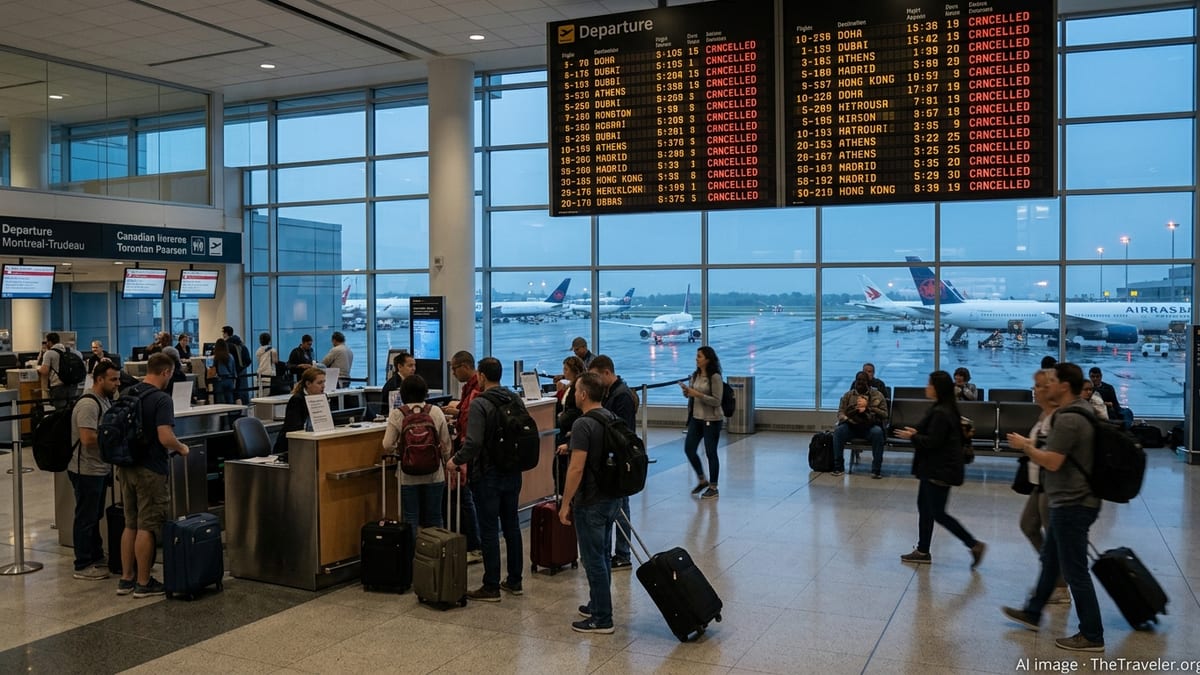
For travelers, the impact is immediate and highly visible. Extended check-in queues, rapidly changing departure boards, and a surge in airport hotel bookings are being reported at hubs far outside the Middle East, from Toronto and Madrid to Athens and Hong Kong. Passengers attempting tight connections are particularly vulnerable, as even small departure delays can now translate into missed long-haul segments that may not have available seats for several days.
Travel experts are advising passengers with upcoming international trips that cross between Europe, Asia and Africa to build in additional buffer time, favor flexible tickets and monitor airline communications closely in the days before departure. Some tour operators are temporarily avoiding itineraries that rely on connections through Gulf hubs, pivoting instead to routings via Istanbul, northern Europe or direct transpacific services where feasible.
While there is no clear timeline for a full reopening of Middle Eastern airspace, aviation planners and economic forecasters warn that even a partial, prolonged shutdown could influence global travel patterns well into the peak summer season. Airlines are beginning to adjust capacity forecasts, and there are early indications that fares on the remaining viable long-haul corridors may edge higher as carriers attempt to recover increased operating costs in a significantly more fragile global aviation environment.