

More news on this day
Global air travel has been thrown into turmoil as widespread airspace closures across Iran, Israel, Iraq, Syria, Qatar, Bahrain, Kuwait and the United Arab Emirates force airlines to cancel more than 1,000 flights and delay over 18,000 worldwide, leaving thousands of passengers stranded at Dubai International Airport and other major hubs.
Regional Airspaces Shut After Strikes on Iran
The cascading disruption follows joint United States and Israeli strikes on Iran at the end of February, which prompted Iran and multiple neighboring states to rapidly close their skies to civilian traffic. Aviation tracking platforms on Saturday and Sunday showed vast stretches of airspace over the Gulf and Levant almost completely devoid of commercial flights as authorities moved to contain the security risk.
Among the governments announcing full or partial closures were Iran, Israel, Iraq, Syria, Qatar, Bahrain, Kuwait and the United Arab Emirates, along with restrictions affecting parts of Jordan and Saudi Arabia. In practice, this sealed off one of the world’s most critical east west corridors, normally used by airlines linking Europe and North America with South and Southeast Asia, Australia and Africa.
Regulators framed the moves as temporary, but industry analysts warned that even short shutdowns in such a strategically central region can reverberate across global schedules for days. Airlines have been forced to either ground aircraft outright or undertake lengthy diversions that add hours of flying time, fuel burn and crew costs to already tight operations.
Safety bulletins from civil aviation authorities in India and Europe urged carriers to avoid affected airspaces at all altitudes, designating large swaths of the Middle East as high risk while military activity and potential follow on attacks remain a concern.
Dubai, Abu Dhabi and Doha Hubs Brought to a Standstill
The closures have hit hardest at the Middle East’s big three connecting hubs Dubai International, Abu Dhabi’s Zayed International and Doha’s Hamad International which together normally funnel hundreds of thousands of passengers a day between continents. Operators at Dubai and Abu Dhabi reported that between them more than 1,000 arriving and departing services were canceled within roughly 24 hours, with many more delayed or diverted.
Dubai International, the world’s busiest airport for international traffic, suspended all takeoffs and landings after reporting damage from an apparent missile strike and confirming that several airport workers had been injured. Its second airport, Dubai World Central Al Maktoum, also halted commercial operations. Flight information boards quickly filled with red status lines as check in queues lengthened and security areas overflowed.
Emirates, Etihad and Qatar Airways have each canceled a majority of their scheduled departures over the weekend, according to aviation analytics data, with some airlines preemptively axing flights into early next week. At one point, more than half of Emirates’ services were reported canceled, while Etihad and Qatar Airways also scrapped or rerouted large portions of their networks that touch the Gulf region.
Because these carriers operate hub and spoke models built around tightly timed connections, a missed inbound from Europe or Asia can ripple through to onward flights to Africa, North America and Australasia. Passengers whose aircraft did manage to land in the region often found their onward connections grounded, leaving them effectively stranded in transit.
Scenes of Chaos for Stranded Passengers
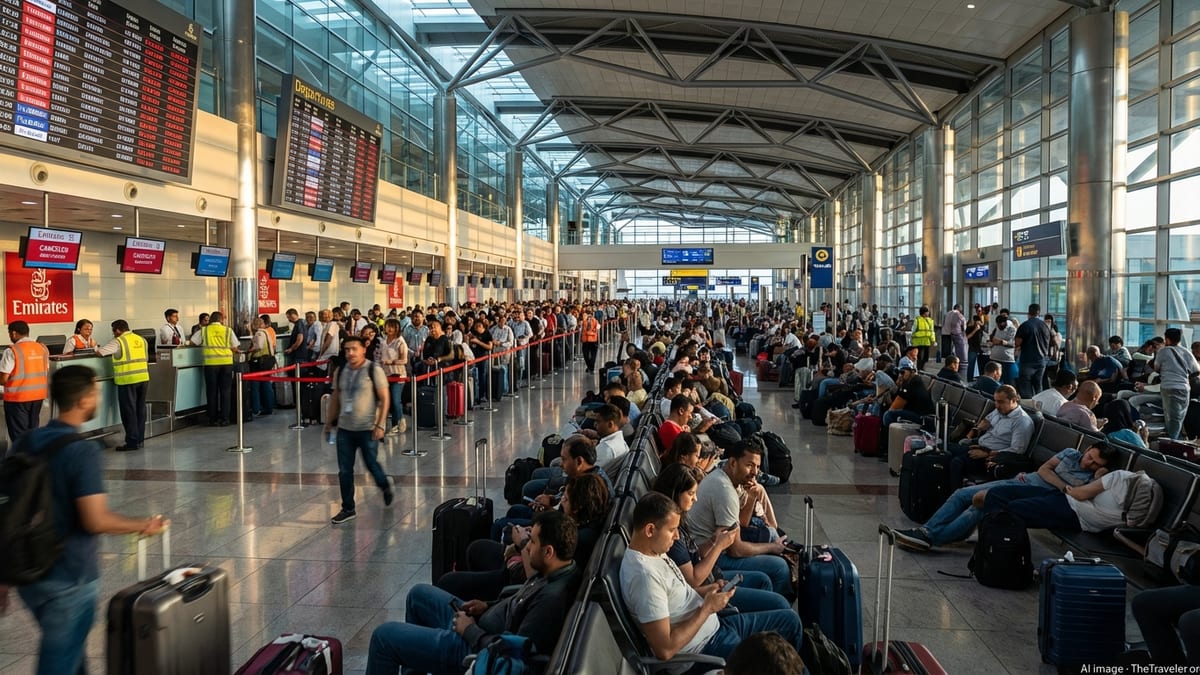
Inside terminals across the Gulf, scenes on Sunday were of weary travelers camped out on luggage, parents trying to entertain children on the floor near shuttered departure gates, and queues snaking from airline service desks far into arrival halls. At Dubai and Doha, airport operators deployed additional staff and set up temporary help counters to handle rebooking queries and distribute water and basic refreshments to those facing overnight waits.
Travelers described sudden midair diversions, with pilots informing passengers that their destination airports had closed while they were already en route. Long haul flights from Europe and North America turned back hours into their journeys or diverted to alternative hubs such as Istanbul, Jeddah, Muscat or Athens, where local ground handling teams scrambled to find hotel rooms and new routing options.
Airlines have issued broad travel waivers, allowing passengers booked to or through affected airports to rebook without change fees or opt for refunds. Even so, the sheer volume of disrupted itineraries has overwhelmed call centers, with many customers reporting multi hour waits to speak with agents. Some travelers with non flexible tickets or separate onward bookings face complex, and in some cases costly, efforts to piece together new routes.
Industry observers note that while airlines generally have contingency plans for regional conflicts, the combination of airspace closures, direct damage to infrastructure and simultaneous shutdowns at multiple mega hubs has created a highly unusual and challenging scenario for both carriers and airport operators.
Global Ripple Effects Reach Europe, Asia and North America
The impact of the Middle East airspace shutdown extends far beyond the region itself. Airlines in India, Europe and North America have all suspended or rerouted flights that would normally traverse Iranian, Iraqi or Gulf skies, creating knock on delays and cancellations thousands of miles away from any active conflict.
Major European carriers have temporarily halted services to destinations such as Dubai, Doha, Tel Aviv and Kuwait City, while also redesigning long haul routes to South Asia and Southeast Asia to avoid closed corridors. These workarounds often involve flying further north over Turkey and Central Asia or looping south over the Arabian Sea, adding significant journey time and creating congestion along remaining open airways.
In Asia, carriers from India, Japan and South Korea have adjusted schedules to cut back frequencies to the Gulf and Israel or to operate with technical stops to refuel on newly elongated routes. North American airlines have extended suspensions of flights to Tel Aviv and curtailed services that rely on Gulf hubs as connecting points to destinations in Africa and the Indian subcontinent.
With aircraft and crews out of position, even passengers on purely intra European or transatlantic routes have encountered unexplained delays and last minute aircraft changes. Aviation data providers estimate that more than 18,000 flights worldwide have experienced some form of knock on delay since the airspace closures began, in addition to the more than 1,000 outright cancellations centered on the Gulf.
Uncertain Timeline for Reopening and Advice for Travelers
Authorities in the region have so far avoided giving firm timelines for a full reopening of airspace and airports, stressing that security assessments are ongoing and subject to rapid revision if tensions escalate further. While some limited corridors for emergency, military or specially authorized flights remain in operation, regular commercial schedules will only resume once governments and aviation regulators are satisfied that risks have eased.
Airline executives and analysts expect a phased recovery, with certain routes and overflight permissions restored first, followed by the gradual rebuilding of hub connectivity. Even in an optimistic scenario, displaced aircraft, crew duty limits and backlogs of stranded passengers mean that operations are likely to remain fragile and prone to further delays for several days after official restrictions are lifted.
Travel experts are advising passengers with imminent trips involving the Middle East, South Asia or East Africa to check flight status repeatedly before heading to the airport, to allow extra time for security and check in procedures, and to prepare for potential overnight stays. Those booking new tickets are being urged to consider fully refundable fares, avoid tight self arranged connections and, where possible, route via alternative hubs not reliant on Gulf overflights.
For now, the disruption serves as a stark reminder of the aviation industry’s dependence on a handful of strategically located hubs and air corridors. As airlines, airports and regulators work to restore normal traffic flows, hundreds of thousands of travelers remain caught in limbo, their journeys reshaped by geopolitical tensions playing out high above the usual jet stream.