

More news on this day
Mass airspace closures across key Middle Eastern countries have triggered a cascading aviation crisis, stranding and rerouting thousands of passengers worldwide as the new Iran war disrupts one of the planet’s busiest flight corridors.
Get the latest news straight to your inbox!
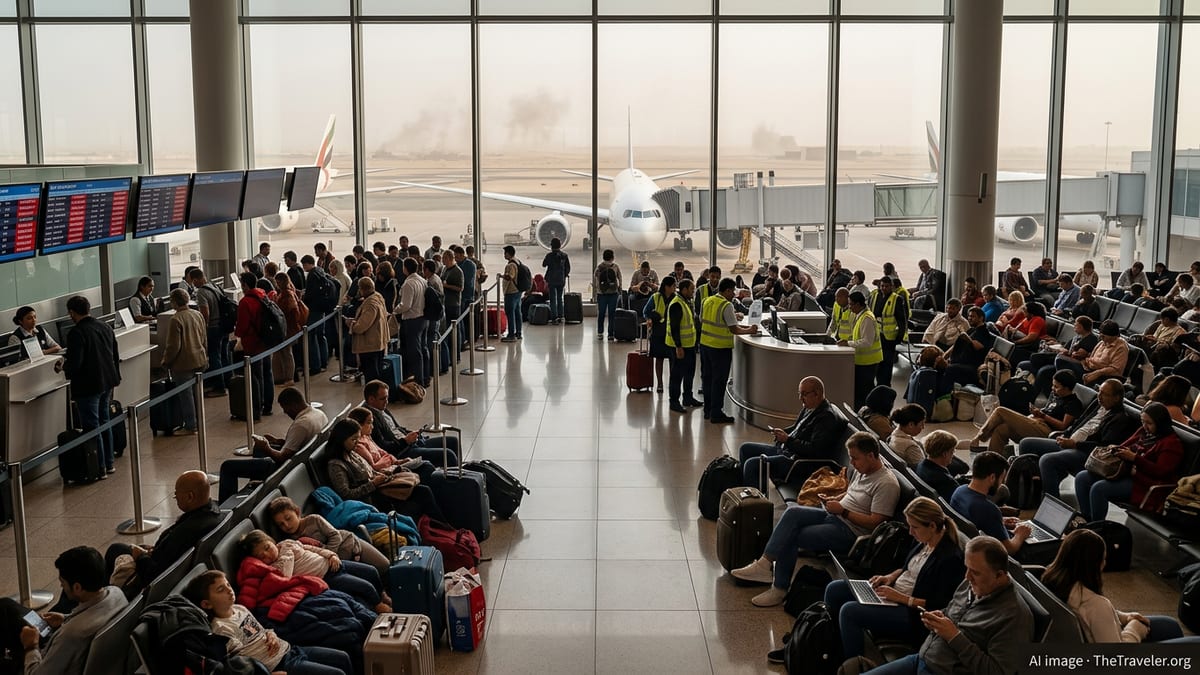
How the New War Triggered a Sudden Aviation Meltdown
The latest conflict involving Iran, the United States, and Israel, which escalated sharply from February 28, 2026, has rapidly reshaped the aviation map across the Middle East. Within hours of the first strikes, multiple states announced full or partial airspace closures, while others imposed tight restrictions on overflights. Publicly available flight-tracking data shows that skies above Iran, Iraq, Israel, Syria, Kuwait, Qatar, and parts of the Gulf became heavily restricted or effectively closed to civilian traffic.
Reports from international outlets indicate that several major hubs, including Dubai, Abu Dhabi, Doha, and airports in Israel and Kuwait, have faced heavy disruption or temporary shutdowns after nearby military activity and missile interceptions. In some locations, physical damage and security sweeps have compounded the operational challenges, forcing ground holds and last-minute cancellations.
These closures have hit at the heart of the global long-haul network. For years, airlines have relied on Middle Eastern airspace and airports as indispensable bridges between Europe, Asia, Africa, and Australasia. With large sections of these corridors now out of play or heavily constrained, airlines have been forced into complex detours, prompting longer flight times, increased fuel burn, and hard choices on which routes can realistically continue.
Industry and government travel advisories describe the present disruption as the most extensive shock to Middle East aviation since the pandemic era, with effects now felt far beyond the immediate conflict zone.
Where Travellers Are Stranded and Which Routes Are Hit Hardest
Travelers have been left in limbo across a belt of airports from the Gulf to the eastern Mediterranean. Published coverage from regional and international media describes crowded terminals in Dubai, Doha, Kuwait City, Tel Aviv, and other hubs as cancellations rolled through departure boards. In some cases, passengers already in the air were diverted to secondary airports in Turkey, Egypt, Cyprus, and parts of Europe as airspace closures took effect mid-flight.
Doha’s Hamad International Airport, a major transfer point between Asia, Africa, and Europe, has seen widespread cancellations and delays after Qatari airspace was shut in late February. Reports indicate that Israel temporarily closed its airspace during the opening phase of hostilities, halting departures and arrivals at Ben Gurion Airport and forcing airlines to suspend services. Advisory documents and airline statements further point to restricted or suspended operations across multiple Gulf gateways.
The immediate impact has fallen heaviest on transit passengers who were connecting via Gulf and Levant hubs. Many are now stranded far from their original departure or final destination points, sleeping in terminals or nearby hotels as airlines attempt to rebuild skeleton schedules and secure alternative routings. Local media in Europe and Asia describe tour groups, business travelers, and backpackers alike stuck on multi-day odysseys home as flights are repeatedly rebooked or canceled.
National governments are increasingly involved in repatriation efforts. Public information from European and North American foreign ministries outlines emergency charter flights, negotiated blocks of seats with carriers still operating around the region, and overland evacuation corridors from countries where commercial options have become too limited or risky.
How Airlines Are Rerouting Around Closed Skies
To keep at least part of the global network functioning, airlines have begun to redraw their route maps in real time. Publicly available flight paths show long-haul services between Europe and East or Southeast Asia swinging north over Central Asia or south via the Arabian Sea and the Red Sea in order to avoid closed airspace above Iran, Iraq, Israel, Syria, and the Gulf.
These detours are adding significant time to many journeys. Some eastbound and westbound services that once relied on the shorter Persian Gulf corridor are now operating with one to three additional hours of flight time, depending on origin and destination. In practical terms, this means higher fuel bills for airlines, tighter crew scheduling margins, and a greater likelihood of missed onward connections for passengers even on flights that technically still operate.
According to aviation advisories and published analysis, several major international carriers, including those based in Europe and Asia, have temporarily suspended direct services to certain Middle Eastern destinations. Others have reduced frequencies or converted passenger flights to “ferry only” segments simply to reposition aircraft and crew. Some Gulf-based airlines have concentrated operations on a limited number of still-viable corridors, prioritizing repatriation traffic and essential point to point routes over more marginal connections.
Industry analysts warn that if airspace restrictions continue for weeks, airlines may need to make deeper schedule cuts for the northern summer season, with knock on effects for tourism-dependent economies from Southeast Asia to Southern Europe.
What Travellers Need to Know Right Now
For travelers with upcoming journeys that touch the Middle East or use it as a transit corridor, the situation remains highly fluid. Travel advisories published in early March emphasize that schedules are changing at short notice, with some airports imposing rolling ground stops whenever new military activity is detected. Even flights that show as “on time” hours before departure can switch to “canceled” or “delayed” with little warning.
Airlines are generally allowing affected passengers to rebook, reroute, or seek refunds, but the options vary widely by carrier and ticket type. Publicly available policy updates from several global airlines show temporary waivers on change fees for routes passing through the region, although fare differences may still apply for rerouted itineraries. Premium cabins and direct routings away from the conflict zone are in particularly high demand, making it harder for economy travelers to find immediate alternative seats.
Travel risk and security specialists urge passengers to closely monitor both airline communications and government advisories before heading to the airport. Many foreign ministries are now recommending that non-essential travel to parts of the Middle East be postponed, especially where airspace remains closed or where airports have previously been affected by nearby strikes.
Travelers already stranded in regional hubs are being advised, through publicly available guidance, to stay in close contact with their airline via official apps or call centers rather than relying solely on airport departure boards. Some advisories also caution against using unsecured public Wi Fi networks or unofficial agents when trying to secure replacement tickets during the current disruption.
How Long Could the Global Aviation Shock Last?
The duration of the current aviation upheaval depends largely on how the conflict evolves and how quickly regional states are willing to reopen their skies. Historical precedent from earlier regional crises suggests that partial reopening of airspace can occur in stages, beginning with tightly controlled corridors for national carriers and cargo flights before expanding to wider commercial traffic.
Economic analysis published in recent days highlights the mounting cost of keeping such a critical air corridor constrained. Fuel expenses rise when airlines must avoid the most direct routes, while airports lose revenue from transit passengers and duty free spending. Gulf hubs that rely heavily on connecting traffic face particular pressure to restore at least some operations once security assessments allow.
However, in the early weeks of March 2026, risk assessments continue to warn of the possibility of further missile and drone attacks across the wider region, including near civilian aviation infrastructure. As a result, some countries and carriers are likely to maintain a conservative approach, keeping wide buffers around the conflict zone even if formal airspace closures are partially lifted.
For now, travelers and the aviation industry are bracing for a drawn out period of disruption. With thousands still trying to get home and future trips in question, the new Middle East airspace shutdown has become a stark reminder of how quickly a regional war can send shockwaves through the global travel system.