

More news on this day
Rapidly evolving airspace closures across the Middle East in early March 2026 are rippling through global aviation, forcing airlines to redraw routes, cancel services and brace for higher costs that are already unsettling the wider tourism industry.
Get the latest news straight to your inbox!
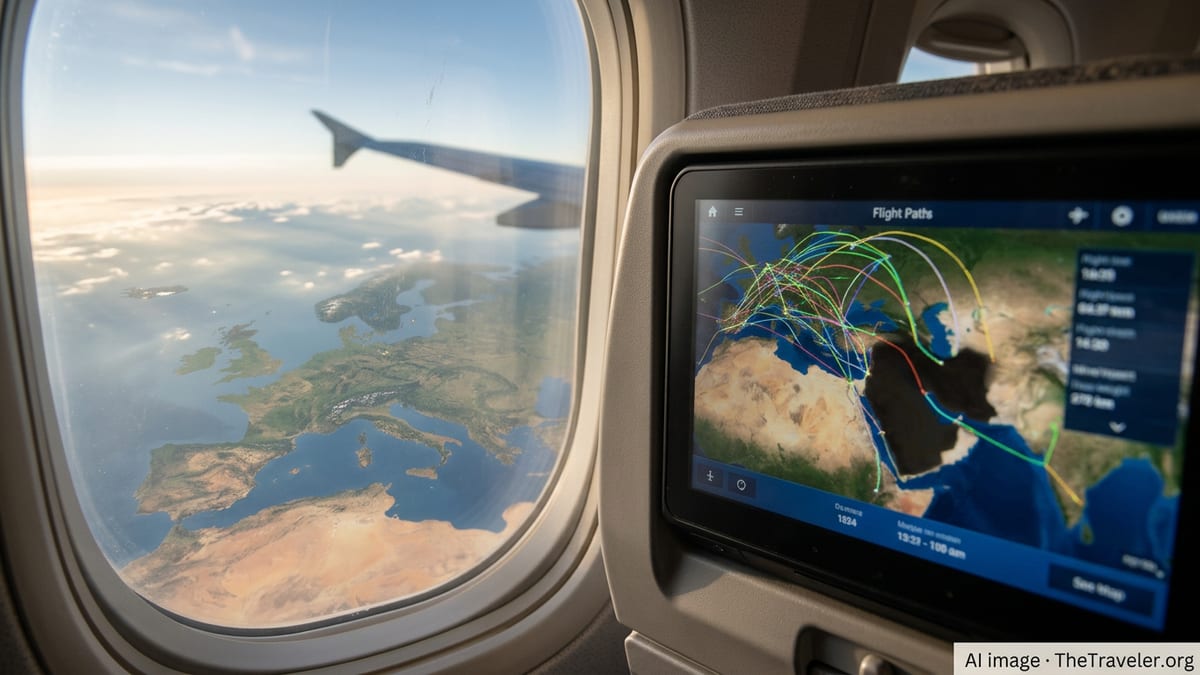
Key Middle East Corridors Go Dark
Several of the region’s most heavily used flight corridors have been severely restricted or effectively closed in recent weeks, creating a patchwork of no-go zones that airlines are racing to navigate around. Risk-mapping platforms that track Notices to Airmen show Iran, Iraq, Syria, Lebanon, Jordan, Kuwait, Qatar and Bahrain either closed to routine commercial traffic or subject to tight restrictions, while operators treat much of the surrounding airspace as high risk. Public advisories issued in early March highlight that Damascus-controlled airspace and large portions of the central Middle East corridor between Israel and Iraq remain shut due to missile and drone activity.
The disruption is not confined to conflict countries themselves. A regional port and travel advisory circulated on 3 March 2026 reports that Saudi Arabia’s national airline has suspended flights on key routes linking the kingdom with Bahrain, Kuwait, the United Arab Emirates, Qatar and destinations as far afield as Russia and Pakistan, citing airspace restrictions and security concerns. The same advisory notes that Qatari airspace has been temporarily closed, with Qatar Airways halting most operations and nearby hubs operating under severe constraints.
In parallel, commercial data compiled by independent route trackers suggests that more than 2,000 flights a day are being cancelled, diverted or significantly rerouted across the wider Middle East aviation network. Major hubs such as Dubai, Abu Dhabi, Doha, Riyadh and Jeddah are experiencing rolling schedule changes as airlines attempt to maintain skeleton connectivity while avoiding zones identified as high risk by international regulators and insurers.
Even in markets where airports technically remain open, airlines and safety bodies are urging extreme caution. European advisories reiterated in recent weeks continue to recommend that carriers avoid the airspace of Iran, Iraq, Israel, Jordan and Lebanon at all levels, with only narrow exceptions for specific coastal approaches. As a result, the main east–west trunk routes that once passed directly over the Gulf and northern Middle East have fractured into a patchwork of longer, more complex paths.
Rerouted Flights Add Hours and Costs
The practical impact of these closures is most visible on long-haul journeys linking Europe and North America with South and Southeast Asia, which traditionally rely on efficient overflight of Iran and its neighbours. Airline statements and schedule data show carriers now diverting north across Turkey and the Caucasus or far south over the Arabian Sea and Egypt, adding between 90 minutes and three hours to many journeys. Gulf superconnectors and European flag carriers alike are reporting longer block times and, on some routes, the need for technical fuel stops that had been eliminated in recent years.
Industry analysis published in the past week indicates that each additional hour of flying can add thousands of dollars in operating costs per flight, driven by extra fuel burn, crew hours and aircraft utilisation knock-on effects. Travel economics specialists estimate that on some ultra-long-haul sectors the combination of detours and elevated jet fuel prices could push incremental operating costs toward tens of thousands of dollars per rotation. For an industry that entered 2026 with net profit margins of under 4 percent, those added expenses erode already thin buffers.
These pressures are particularly acute for airlines based in or heavily reliant on the Middle East hub model. Reports from regional aviation consultancies describe carriers burning through contingency plans developed during earlier crises, shifting fleets toward safer corridors and consolidating frequencies on routes that can still be operated efficiently. Analysts quoted in Gulf business media warn that a prolonged closure of Iranian and neighbouring airspace would force airlines to permanently reconfigure some network patterns, potentially diminishing the competitive advantage of Gulf hubs as fast east–west connectors.
Even airlines based far from the region are feeling the strain. European and Asian carriers that previously overflew the Middle East on polar or Central Asian alternates during earlier flare-ups now face renewed route crowding and slot constraints, with multiple airlines funnelling into the same narrower corridors. This increases exposure to weather delays and air traffic flow restrictions, amplifying the risk that discrete regional airspace closures cascade into global punctuality problems.
Tourism Flows Disrupted from Beirut to Bali
The immediate travel fallout is most visible on routes into and out of the Middle East itself, where commercial timetables have thinned rapidly. In Lebanon, schedule data and local reporting at the start of March show Middle East Airlines cancelling multiple daily services to Gulf destinations and Iraq because most neighbouring states have partially or fully closed their airspace. While Beirut’s airport remains operational, the loss of transit and point-to-point capacity with regional hubs is already hampering inbound tourism and complicating the exit plans of foreign visitors.
Across the Gulf, travellers are contending with mass rescheduling, unexpected overnight stays and long detours. Travel advisories compiled this month warn leisure and business visitors to expect last-minute changes, extended journey times and, in some cases, the need to rebook itineraries entirely if connecting flights can no longer be coordinated over closed airspace. That uncertainty is prompting some would-be holidaymakers to defer trips to popular destinations such as Dubai, Doha and coastal resorts around the Red Sea, at least until airlines can demonstrate more stable operations.
The disruption is not limited to Middle Eastern destinations. Because the region acts as a central bridge between Europe, Africa and Asia, closures in and around the Gulf are reverberating along tourism flows as far away as the Maldives, Sri Lanka, Thailand and Indonesia. Tour operators in these markets report that packages relying on Gulf connections have become harder to price accurately or guarantee, leading some to shift capacity toward itineraries built around alternative hubs in Turkey, Central Asia or Southeast Asia. This in turn alters competitive dynamics between tourism-dependent economies, as travel demand is redirected away from routes most affected by the airspace crisis.
Corporate travel is also under pressure. Business travel surveys conducted in recent months suggested resilient demand for in-person meetings despite geopolitical tensions, but the current wave of closures introduces new friction. Companies with regional headquarters or key clients in the Gulf now face longer travel times, potential duty of care complications and higher trip costs, factors that can encourage a shift toward virtual alternatives or regional consolidation of operations.
Safety, Insurance and the New Risk Map
Underlying the operational turmoil is a rapidly evolving risk map that airlines, insurers and regulators are continuously reassessing. Conflict tracking across the Middle East since late 2023 has documented repeated use of drones and ballistic missiles in and around key transport corridors, along with high-profile incidents that underscored the danger of operating near active hostilities. Publicly available safety guidance stresses that even when airspace remains technically open, a combination of military activity, air defence systems and electronic interference can create unacceptably high risks for civilian aircraft.
Insurance markets have moved quickly in response. Aviation risk specialists cited in recent travel trade coverage report steep increases in war risk premiums for flights that transit or approach conflict-adjacent airspace, with some underwriters declining to provide cover altogether for specific routes. Where coverage remains available, airlines must either absorb the additional cost or pass it on through higher fares, compounding the financial impact of longer flight paths and elevated fuel prices.
Regulators in Europe and other major markets have issued or renewed advisories against using several Middle Eastern airspace segments except under tightly controlled conditions. In practice, this leaves airlines with little choice but to follow conservative routings even when local authorities insist their skies are safe. The result is a widening gap between the theoretical availability of routes and the practical network that airlines, insurers and safety bodies are willing to support.
For travellers, this evolving risk regime is most visible in the form of shifting schedules, suddenly unavailable connections and complex rebooking rules. Consumer advocates are urging passengers to pay close attention to airline flexibility policies and travel insurance terms, particularly for trips that cross multiple jurisdictions where advice can change with little warning.
Outlook: Prolonged Volatility for Global Travel
Industry bodies had hoped that 2026 would mark a period of consolidation after years of pandemic disruption and earlier geopolitical shocks, with global passenger numbers edging back toward longer-term growth trends. The latest Middle East airspace closures now threaten to delay that stabilisation, at least for carriers and destinations most exposed to east–west transfer traffic. Financial outlooks issued last year already flagged conflict and fuel price volatility as key downside risks; current developments appear to be bringing those risks sharply into focus.
Tourism boards and airlines across affected regions are responding with a mix of short-term crisis management and longer-range scenario planning. Some are promoting alternative routing options via less affected hubs, while others are pivoting marketing efforts toward origin markets that can continue to access destinations without transiting the most disrupted airspace. However, these strategies take time to translate into bookings, and travellers remain sensitive to headlines about airspace closures and regional conflict.
Analysts caution that even a rapid easing of tensions would not produce an immediate return to pre-crisis patterns. Previous episodes have shown that airlines can be slow to reintroduce overflight of areas associated with recent conflict, both for safety and reputational reasons. As a result, current detours and schedule thinning could harden into a new normal for some corridors, reshaping the global tourism map in ways that will only become clear over the coming months.
For now, the message from aviation and travel experts is consistent: global air travel remains fundamentally safe, but it is entering another period of heightened unpredictability. Passengers planning multi-leg trips that depend on Middle Eastern hubs are being advised, through public guidance and route-planning tools, to build in extra time, monitor airline alerts closely and be prepared for last-minute itinerary changes as the airspace picture continues to shift.