

More news on this day
Hundreds of thousands of passengers across Africa, Europe and Asia are facing sudden cancellations, diversions and marathon reroutes after a new wave of conflict-related airspace closures swept across the Middle East, forcing major hubs such as Dubai and Doha to partially shut and cutting critical long-haul links to and from South Africa.
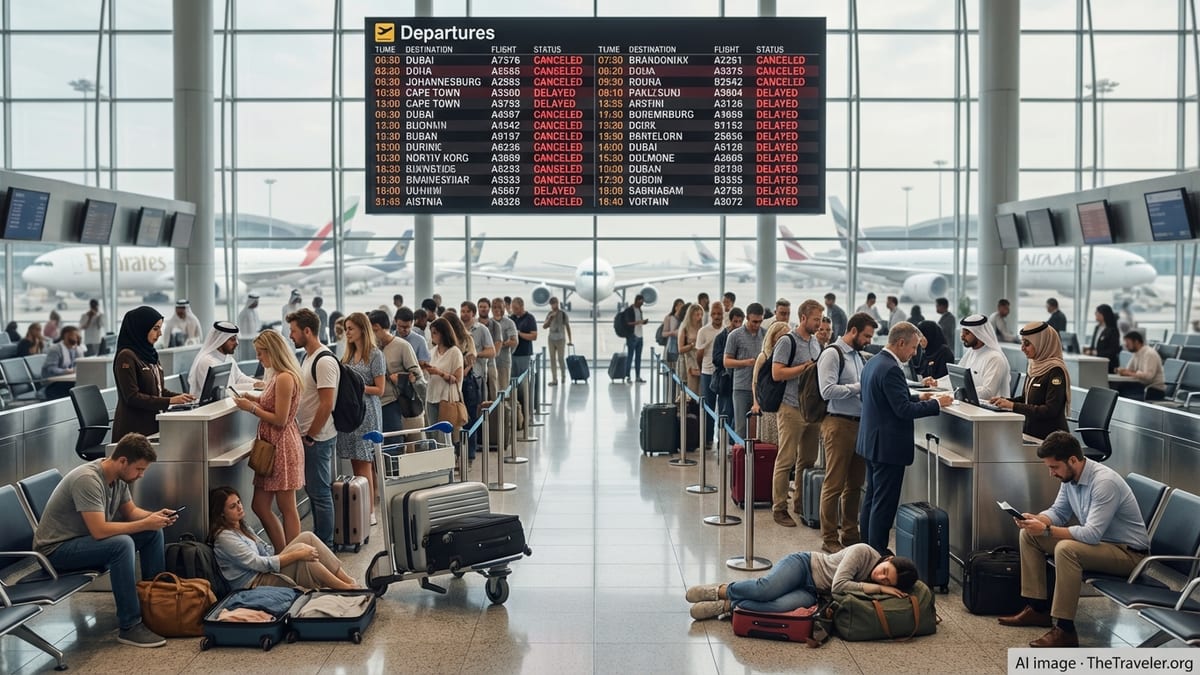
Middle East Conflict Triggers Rare Regional Airspace Shutdown
The latest escalation, unfolding from February 28, 2026, followed coordinated U.S. and Israeli strikes on Iran and swift Iranian retaliation across the Gulf. In response, authorities in Iran, Israel, Iraq, Kuwait, Bahrain, Qatar, Syria and the United Arab Emirates moved to close large sections of their airspace to civilian traffic. Aviation trackers showed vast swathes of normally busy skies abruptly empty as flight paths were frozen or pushed far to the west and south.
Major hubs including Dubai International, Abu Dhabi and Doha’s Hamad International scaled back or halted departures and arrivals for several hours at a time as officials weighed missile and drone risks against the need to keep global traffic flowing. News agencies reported more than a thousand cancellations in the region over the weekend, with knock-on disruption that is now rippling well into Europe and Africa as aircraft and crews fall out of position.
For airlines, the closures revive security concerns that have lingered since earlier missile and drone incidents around the Red Sea and Gulf, but on a wider geographic scale. Carriers must now navigate a patchwork of national restrictions layered on top of existing conflict-zone advisories from regulators such as the European Union Aviation Safety Agency, which had already urged extra caution over Israel, Iran and the Southern Red Sea.
South Africa’s Long-Haul Lifelines via Dubai and Doha Severed
South African travelers have been particularly hard hit because so much of the country’s long-haul connectivity depends on Gulf super-connectors. Emirates and Qatar Airways jointly carry large numbers of passengers between Johannesburg, Cape Town and Durban and destinations across Europe, North America and Asia, using Dubai and Doha as key transfer points.
After the latest strikes, Emirates confirmed a temporary suspension of operations to and from Dubai due to multiple regional airspace closures, while Qatar Airways paused flights to and from Doha as Qatari airspace shut. South African media reported numerous cancellations and diversions on routes linking the country with the Middle East, with some long-haul services forced to route via alternative European or African hubs instead.
Travel agents in Johannesburg and Cape Town say they are scrambling to rebook customers onto limited alternatives via Addis Ababa, Nairobi, Istanbul or European gateways. With aircraft already heavily booked for late summer and early northern spring, spare capacity is scarce and many passengers are finding themselves stranded for days or facing convoluted itineraries that add many hours to their journeys.
Domestic tourism bodies also warn that inbound visitors who planned to reach South Africa through one-stop Gulf connections are now reconsidering or postponing trips. This could weigh on safari, wine and coastal tourism operators just as they look to consolidate gains from a post-pandemic recovery in long-haul demand.
Longer Routes, Higher Fares and Tighter Capacity Worldwide
While the most visible impact is on flights directly serving the Gulf, the effects spread far beyond the region. Carriers that normally overfly Middle Eastern territory on routes between Europe, Asia and Africa are being forced to redesign flight plans at short notice, looping further south over the Arabian Sea or deeper into central Africa to avoid restricted airspace.
These detours increase flight times and fuel burn, raising operating costs on some of the world’s busiest long-haul corridors. Airline executives and analysts say that if the closures persist, higher costs are likely to filter through to passengers in the form of fare surcharges or reduced promotional capacity, especially in premium cabins where weight and range margins are tight.
Schedule reliability is also under strain. Aircraft and crews are returning late to base because of longer routes, limiting airlines’ ability to operate dense timetables and leaving little slack when new disruption strikes. Travelers can expect rolling delays, last-minute aircraft swaps and irregular operations on connecting banks at major hubs, even in regions far from the conflict.
In the cargo market, freighter operators are reporting similar challenges. Extended sectors mean fewer rotations per aircraft each week, squeezing high-yield capacity on lanes linking Asia, the Middle East and Africa. Time-sensitive shipments, from pharmaceuticals to automotive parts, may see longer lead times and rising rates if airspace restrictions continue.
What Travelers Need to Know Before Flying via the Region
Airlines and regulators are urging passengers with itineraries touching the Middle East, or using Dubai and Doha as transit points, to prepare for an unsettled period. The most important step is to closely monitor booking profiles through airline apps and email notifications, as schedules are being adjusted hour by hour in response to new military activity and airspace notices.
Most major carriers are offering limited flexibility, including change-fee waivers and, in some cases, refunds for travel on affected dates or routes. However, rebooking options can be constrained when large numbers of passengers all seek alternatives at once. Travelers may need to accept indirect routings through secondary hubs or split journeys over two days where no same-day connections are available.
Experts advise allowing longer connection times, especially when self-connecting on separate tickets, and avoiding tight layovers through any hub close to current or potential conflict zones. Those heading to or from South Africa might consider securing itineraries that route via more distant hubs in Europe or East Africa, even if they appear less convenient on paper, to reduce exposure to sudden airspace closures.
Travelers are also being urged to keep all receipts for meals, hotels and local transport when stranded, as some out-of-pocket costs may later be recoverable from airlines or travel insurance providers, depending on policy wording and jurisdiction. But with force majeure clauses frequently invoked during security crises, passengers should not assume automatic compensation for every delay or cancellation.
Safety Advisories, Insurance and Planning for the Weeks Ahead
Governments across Europe, Africa and the Asia-Pacific have updated travel advisories in line with the latest security assessments of Middle Eastern airspace. While most are not discouraging all air travel to the region, many are advising against non-essential trips to specific countries or urging travelers to reconsider transit through certain hubs until the risk picture becomes clearer.
Regulators such as EASA continue to circulate conflict-zone information to airlines, highlighting areas where overflight is considered high risk. Carriers then apply their own internal thresholds, often opting for more conservative routings than the minimum required by authorities. Passengers may therefore see differences between airlines on similar routes, with some suspending services entirely and others maintaining limited operations.
For travelers, this is a moment to review insurance coverage carefully. Some policies exclude losses arising from war or acts of terrorism, while others provide limited benefits for travel disruption but not for fear-based cancellations. Insurance specialists recommend reading exclusions closely and, where possible, choosing products that explicitly cover missed connections and extended delays due to airspace closures.
With no clear timeline for a political de-escalation, aviation analysts expect a protracted recovery. Even once skies begin to reopen, airlines will need time to rebuild networks, reposition aircraft and restore regular frequencies. For the coming weeks at least, anyone planning to fly to or from South Africa, Dubai, Doha or nearby regions should be prepared for a dynamic, occasionally chaotic, but still navigable air travel environment that demands flexibility, patience and careful advance planning.