

More news on this day
A cascading aviation emergency is unfolding across the Middle East and beyond, as sudden airspace closures linked to U.S. and Israeli strikes on Iran force mass flight diversions, strand hundreds of thousands of travelers and trigger evacuation operations by European and regional carriers.
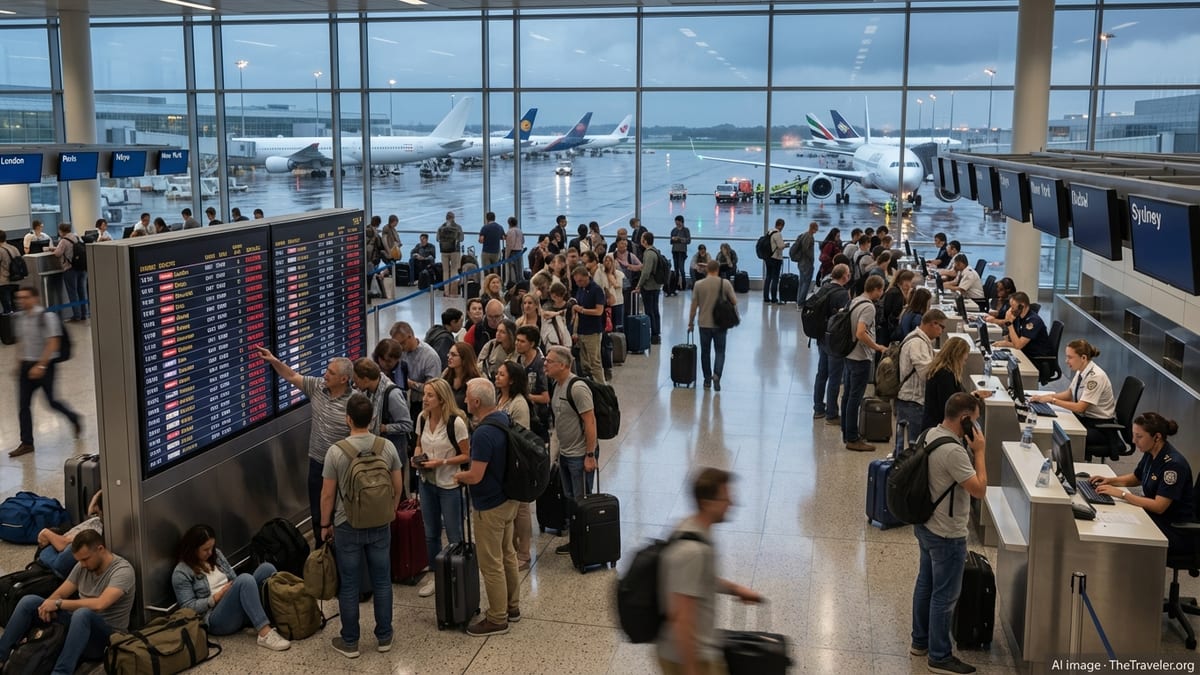
Airspace Lockdowns Ripple Through Global Networks
On March 1, airspace closures across key Middle Eastern corridors pushed the global airline system into crisis mode, with thousands of flights canceled, rerouted or forced into unplanned landings. Authorities in Iran, Israel, Iraq, the United Arab Emirates, Qatar, Kuwait, Syria and Bahrain have issued sweeping restrictions, effectively shutting down some of the world’s most vital east–west transit routes.
Major hubs such as Dubai, Abu Dhabi and Doha, normally among the busiest international connection points, saw operations sharply curtailed or halted entirely following U.S. and Israeli strikes on Iranian targets and subsequent retaliatory action. Analysts say the closures have broken the delicate rhythm of long-haul aviation, where aircraft and crews are scheduled in tightly coordinated rotations across continents.
Industry data indicate that more than 3,400 flights across the wider region have been canceled or diverted in a single 24-hour period, with cancellations by major Gulf carriers running into the hundreds. Airlines warn that even if airspace restrictions are eased quickly, network recovery will take days rather than hours as aircraft, crews and passengers are slowly repositioned.
For travelers, the disruption is being felt well beyond the Middle East. With transcontinental routes between Europe, Asia, Africa and the Americas forced to avoid closed flight information regions, journeys are lengthening by hours, duty-time limits for pilots and cabin crew are being breached, and knock-on cancellations are spreading through global schedules.
Austrian Airlines Evacuation Flight OS1005 Reaches Muscat
As the crisis deepened, Austrian Airlines deployed a special evacuation flight, OS1005, to Muscat in Oman on Sunday to retrieve stranded staff and crew who were unable to operate from Dubai amid the shutdown. The Vienna-origin service, typically a scheduled route to Muscat, has been repurposed to support the airline’s emergency repositioning plan in the Gulf.
Flight-tracking data showed OS1005 departing Vienna International Airport late on Sunday morning local time and heading south-east for Muscat, where it was scheduled to arrive in the evening with a delay of under one hour. The aircraft is expected to operate as a critical lifeline flight for Austrian personnel, part of a broader effort by European airlines to extract crews and safeguard assets marooned by the sudden airspace closures.
Austrian Airlines has also announced a fresh round of suspensions across its Middle East network. Services to Tel Aviv, Amman and Erbil are now halted until at least March 8, with flights to Dubai canceled until March 4 and Tehran off the schedule until the end of March. The carrier’s parent group Lufthansa, along with low-cost operator Wizz Air, has likewise suspended many routes into the affected region as security warnings intensify.
Aviation experts say these evacuation and ferry flights are a hallmark of large-scale disruption. Airlines must move crews back to home bases, return aircraft to maintenance and scheduling hubs, and rebuild their timetables step by step once safe routings become available again.
Egypt Declares “Maximum Readiness” for Diverted Flights
With airspace over much of the Gulf and Levant constrained, Egypt has emerged as a key safety valve for the region’s disrupted air traffic. Cairo’s Ministry of Civil Aviation announced that all Egyptian airports have been placed on a state of “maximum readiness” to receive unexpected diversions from airlines unable to operate their planned routes.
Officials said Egypt’s airspace remains fully open and that airports across the country stand ready to provide refueling, ground handling and passenger care for transit flights forced to land. Airports in Cairo, Hurghada, Sharm el-Sheikh and other cities have begun receiving a growing number of widebody jets arriving unscheduled, sometimes in the middle of the night, as carriers from Europe, Asia and North America seek safe alternate fields.
A total of 22 flights have already been diverted into Egyptian airports within hours of the initial closures, according to regional aviation sources, with authorities warning that the number is likely to rise if hostilities and airspace restrictions persist. Passenger terminals are preparing for surges of stranded travelers needing overnight accommodation, rebooking assistance and basic welfare support.
The declaration of maximum readiness underscores Egypt’s strategic role as one of the few remaining open gateways on the southern edge of the affected zone. It also highlights how national aviation authorities are being drawn directly into the operational front line of managing a fast-moving security crisis in the skies.
Regulators and Airlines Issue Heightened Safety Advisories
As the situation evolved over the weekend, regulators around the world responded with new safety directives aimed at steering civilian traffic away from conflict zones. India’s Directorate General of Civil Aviation advised airlines to avoid 11 separate flight information regions across West Asia, including Tehran, Tel Aviv, Beirut, Jeddah, Bahrain, Muscat, Baghdad, Amman, Kuwait, Emirates and Doha, at least through March 2.
The advisory cites the heightened risk posed by air defense systems, cruise and ballistic missiles, as well as the danger of misidentification of civil aircraft by military forces operating in crowded skies. It urges carriers to monitor NOTAMs continuously and to develop contingency plans for rapid rerouting, diversion and passenger handling as the security picture changes.
European, Asian and North American airlines are issuing their own travel alerts, warning customers of potential last-minute schedule changes and extended journey times as aircraft are re-routed hundreds or even thousands of kilometers around closed regions. Some long-haul flights have already been forced to return to their point of origin after departure when the airspace picture changed en route.
Freight operators are warning of potential knock-on effects for global supply chains, with key cargo corridors between Asia and Europe now squeezed into narrower lanes. Extended routings mean higher fuel burn and costs, while congestion in remaining open airspace increases the risk of air traffic control bottlenecks.
Travellers Face Uncertainty as Recovery Timeline Stretches
For passengers, the cascading disruption is translating into missed connections, improvised overnight stays in unfamiliar countries and lengthy queues at customer service desks. Travel industry analysts say there is little chance of an immediate return to normality, even if a ceasefire or de-escalation allows some airspace to reopen later this week.
Long-haul aircraft typically complete only one or two sectors per day, meaning each canceled or diverted leg creates a backlog that can take several rotations to unwind. Crew duty limitations further constrain recovery efforts, as pilots and cabin staff who have reached legal operating limits must be rested or replaced before services can resume.
Governments are now weighing larger-scale evacuation operations for their citizens based in or transiting through the affected region, similar to those mounted during previous geopolitical crises. The United Kingdom and other European states are reviewing contingency plans for chartering or tasking aircraft to bring home nationals who may be stranded for an extended period.
With the security situation fluid and airlines braced for more airspace notices at short notice, officials and industry leaders alike are advising travelers with upcoming itineraries through the Middle East to stay in close contact with their carriers, be prepared for significant disruption and avoid non-essential transit through the region wherever alternative routings exist.