

More news on this day
Escalating military strikes between the United States, Israel and Iran have triggered sweeping airspace closures across the Middle East, forcing airlines including Emirates, Etihad, Wizz Air, KLM, United Airlines and British Airways to cancel more than 2,000 flights and leaving passengers stranded from Dubai and Abu Dhabi to London, Hamburg, Boston, Dallas and New York.
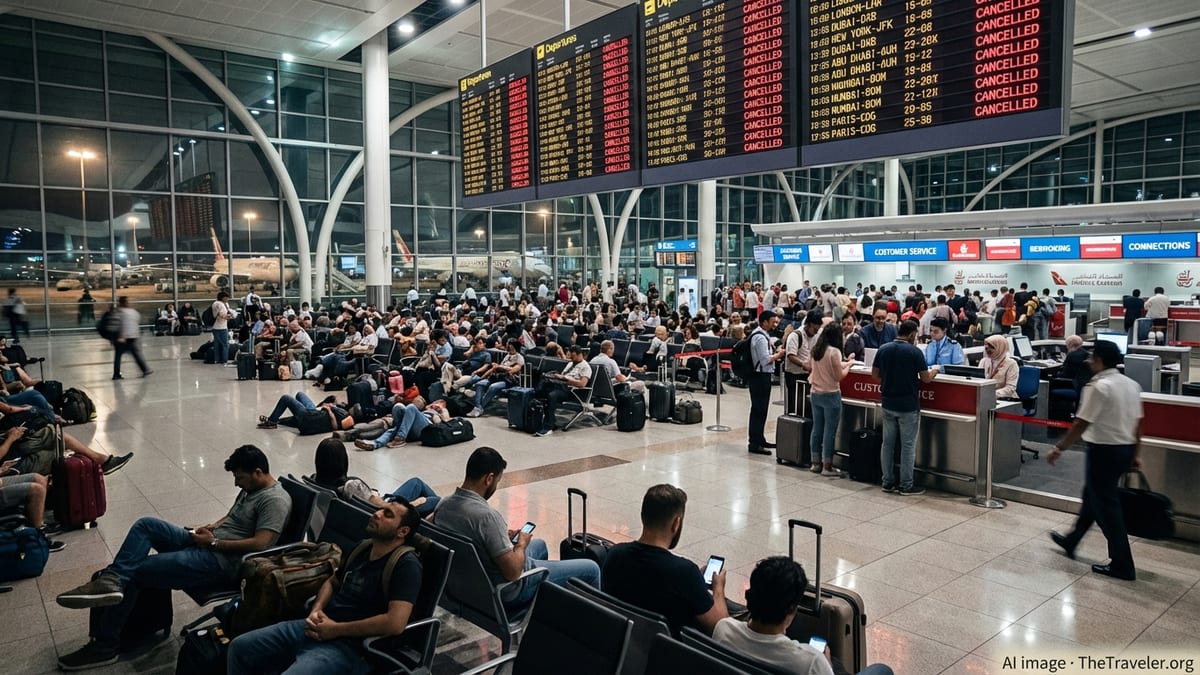
Airspace Shutdowns Paralyse Gulf Super-Hubs
The most severe disruption is centered on the Gulf, where authorities in the United Arab Emirates, Qatar, Bahrain and several neighboring states have partially or completely closed their skies following the latest round of strikes. Dubai International, Zayed International in Abu Dhabi and Hamad International in Doha, normally among the busiest long-haul transit hubs in the world, have seen large portions of their flight schedules wiped out over the weekend.
According to aviation analytics data cited by multiple industry outlets, nearly one in four flights scheduled to land in Middle Eastern countries on Saturday 28 February were cancelled, with total regional cancellations surpassing 1,800 once outbound services are included. A further wave of cuts on Sunday 1 March pushed the tally well beyond 2,000 as restrictions remained in place and airlines struggled to secure safe alternative routings.
Emirates and Qatar Airways have borne the brunt of the Gulf disruption, with hundreds of cancellations each as they halted the majority of their operations through Dubai and Doha. Etihad has also sharply reduced its schedules from Abu Dhabi, while regional carriers including FlyDubai, Gulf Air, Saudia, Royal Jordanian and Oman Air have reported extensive cancellations and delays as they navigate rapidly changing airspace directives.
Local authorities describe the measures as temporary and precautionary, but notices to pilots indicate that restrictions on flying over Iran and parts of Iraq, Israel, Qatar and the wider Gulf are expected to remain in force at least into the early part of the week, keeping core hub operations severely constrained.
Ripple Effects Reach Europe and North America
With Dubai, Abu Dhabi and Doha operating on a reduced basis, disruption has cascaded across airline networks in Europe and North America that rely on these hubs to connect traffic between continents. Flight tracking data shows aircraft grounded or rerouted at major airports including London Heathrow, London Gatwick, Amsterdam Schiphol, Paris Charles de Gaulle, Frankfurt and Hamburg as carriers unwind complex multi-leg itineraries that typically pass through Gulf and Levantine airspace.
European airlines such as KLM, Air France, Lufthansa and British Airways have suspended or sharply curtailed services not only to Tel Aviv, Dubai, Dammam, Riyadh and other Middle Eastern destinations, but also on routes to Asia and Africa that would ordinarily overfly the region. Some long-haul flights are operating on extended northerly or southerly routings, adding hours to journey times and putting additional pressure on aircraft availability and crew rosters.
In North America, United Airlines and other US carriers have halted flights to Tel Aviv and temporarily suspended select services into the Gulf, while also rerouting transatlantic and transpacific flights to avoid conflict-affected skies. Passengers in Boston, New York and Dallas have reported last-minute cancellations and diversions as aircraft that were due to operate onward sectors to the Middle East fail to reach their US departure points.
Analysts note that the regional closures arrive at a time of already tight global capacity. The need to fly longer, circuitous routes around the Middle East is consuming additional fuel and aircraft hours, which in turn leaves fewer jets available to cover standard schedules in Europe and North America. That dynamic is amplifying the impact of each individual cancellation on far-flung markets.
Passengers Stranded in Transit Hubs Worldwide
Across terminals from Dubai and Abu Dhabi to London, Hamburg, Boston and New York, scenes of crowded departure halls and improvised overnight camps have become common as travelers scramble for scarce alternatives. Many of those affected were mid-journey when the latest strikes and subsequent airspace closures were announced, arriving at hub airports only to discover that their onward flights no longer existed.
In Dubai, one of the world’s busiest international airports, departing passengers reported long queues at transfer desks as Emirates and FlyDubai staff worked through backlogs of missed connections. With hotel rooms around the airport quickly filling, some travelers were issued meal vouchers and blankets for use in terminal seating areas while they waited for rebooking options that might be days away.
Similar stories are emerging from Abu Dhabi and Doha, where Etihad and Qatar Airways have suspended large portions of their operations. At European gateways such as Heathrow and Schiphol, passengers booked on KLM, British Airways and other flag carriers found themselves stuck in London or Amsterdam after flights to Dubai, Tel Aviv and various Gulf cities were taken off the boards. In the United States, United Airlines customers reported being stranded in New York and Boston as the carrier cut Middle East services and repositioned aircraft away from affected corridors.
Airlines are generally offering rebooking on the next available flights, refunds or travel vouchers, but the sheer number of cancellations and the limited number of remaining safe routings mean that many customers face multi-day delays. Travel insurance providers are already reporting a surge in inquiries related to missed connections, additional accommodation costs and claims for disrupted itineraries.
Operational and Safety Pressures Mount for Airlines
Behind the scenes, operations control teams at major airlines are contending with an intricate puzzle of safety, regulatory and commercial considerations. Aviation authorities in Europe, North America and Asia have issued advisories instructing carriers to avoid Iranian, Iraqi and adjoining conflict-zone airspace, compelling network planners to redraw flight paths in near real time while ensuring compliance with evolving regulations.
Longer reroutes demand additional fuel and, in many cases, fresh crew pairings to comply with duty-time limits. That in turn forces airlines to rotate aircraft and staff away from other parts of their networks, often resulting in knock-on cancellations far from the Middle East itself. Slots at major airports are another complicating factor, as carriers attempt to secure new departure times for delayed or re-timed services.
Industry experts warn that even if tensions ease quickly, it could take days for airline schedules to normalize. Aircraft and crews are now scattered across atypical locations after diversions and emergency turn-backs, and bringing them back into position requires carefully staged adjustments. Any further deterioration in regional security conditions, or an extension of current airspace closures, would risk prolonging the disruption well into March.
Fuel prices and insurance premiums are also under scrutiny. With many carriers already operating on thin margins, sustained rerouting around the Middle East could raise operating costs significantly, potentially triggering surcharges or fare increases on affected long-haul routes if the crisis continues.
What Travelers Should Expect in the Coming Days
For travelers with bookings to, from or via the Middle East in the coming week, airlines and travel advisors are urging flexibility and close monitoring of schedules. Many carriers have introduced temporary waivers allowing customers to change dates or destinations without standard fees, provided travel remains within a specified window. Some have also expanded their use of digital channels and airport self-service desks to manage the surge in rebooking requests.
Passengers are being told to assume that schedules can change at very short notice, even for flights that do not directly serve the region, as ripple effects continue to move through global networks. Travelers embarking from cities such as London, Hamburg, Boston, Dallas and New York are advised to arrive early, keep contact details up to date within airline booking systems and monitor flight status notifications frequently on the day of departure.
While the immediate priority for carriers remains safety and regulatory compliance, the unfolding disruption has once again highlighted the central role that Gulf and Middle Eastern hubs play in connecting Europe, Africa, Asia and the Americas. As airspace restrictions and security assessments evolve in the days ahead, both airlines and passengers face a period of continued uncertainty before global schedules can stabilize.