

More news on this day
Air travel across the Middle East has been thrown into turmoil after U.S. and Israeli strikes on Iran triggered rapid airspace closures and flight suspensions across the United Arab Emirates, Saudi Arabia and Qatar on Saturday, forcing hundreds of cancellations and leaving travelers worldwide scrambling to rebook.
What Is Happening in Middle Eastern Skies Right Now
As of Saturday, February 28, 2026, aviation across the Gulf has slowed to a near standstill after coordinated U.S. and Israeli strikes on Iran and subsequent Iranian retaliation prompted governments to shut or severely restrict their airspace. Authorities describe the measures as precautionary responses to active military operations and the risk of missiles, debris or misidentification of civilian aircraft.
Flight tracking data shows vast sections of airspace over Iran, Iraq, Israel and key Gulf states suddenly empty of commercial traffic, with aircraft diverted hundreds or even thousands of miles to avoid the region. Travel analytics firm Cirium reported more than 260 flights canceled across the Gulf Cooperation Council and neighboring countries in a single day, with thousands more delayed or rerouted as airlines race to redraw their networks.
The impact extends far beyond the Middle East. Long haul services linking Europe, North America, Asia and Australasia that normally use Gulf hubs as refueling or transit points are being forced onto longer routings, adding hours of flight time and creating knock-on delays at airports around the world.
UAE: Dubai and Abu Dhabi Hubs Temporarily Grounded
The United Arab Emirates, home to some of the world’s busiest international airports, has imposed a partial but sweeping closure of its airspace. The UAE civil aviation authority confirmed that airspace restrictions were being introduced as a safety precaution, and Dubai Airports announced that all flights at Dubai International and Al Maktoum International are suspended until further notice.
Flag carrier Emirates, the largest long haul airline globally, has halted all operations to and from Dubai while the closure remains in effect. Sister low cost carrier flydubai has also suspended flights, following earlier cancellations and rerouting, including services to Iranian cities and Tel Aviv. Air Arabia has canceled a swathe of flights from its bases in Sharjah, Abu Dhabi and Ras Al Khaimah, while Etihad Airways said all departures from Abu Dhabi are paused until at least Sunday afternoon, with many inbound flights canceled or turned back.
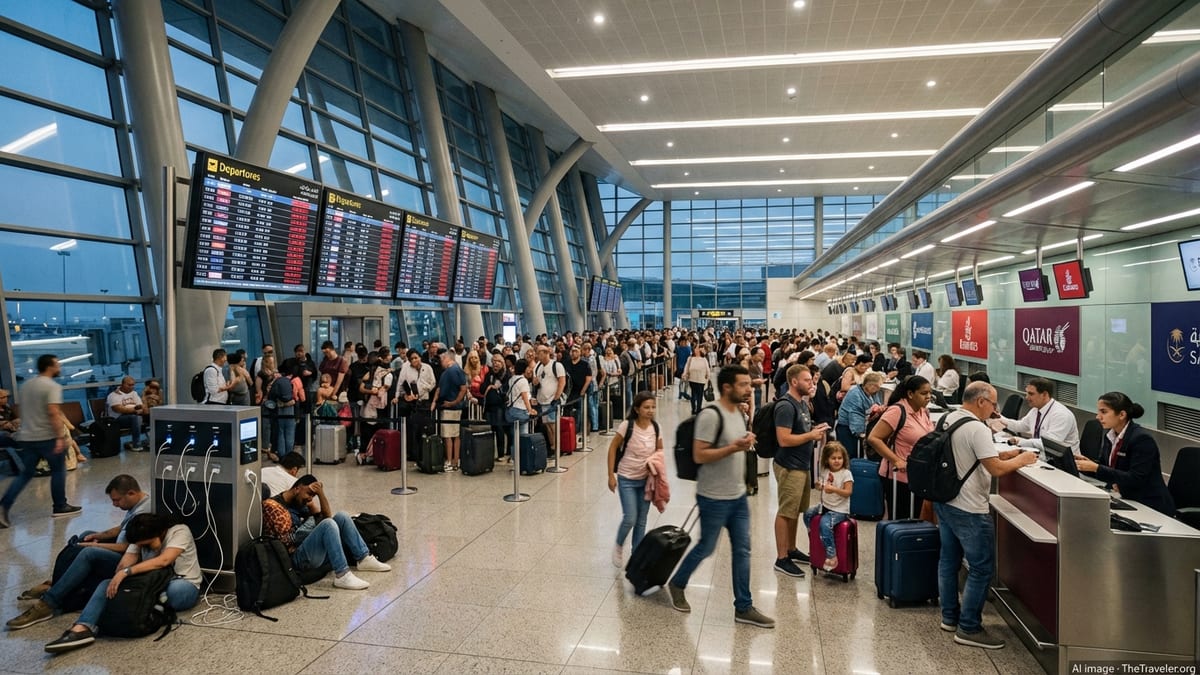
Travelers passing through the UAE are reporting crowded terminals, long queues at service desks and limited information about when flights will resume. Airlines are offering rebooking and refunds where possible, but with airspace still restricted and schedules in flux, passengers should be prepared for prolonged waits and last minute changes.
Saudi Arabia and Qatar Adjust Operations Amid Regional Closures
Saudi Arabia has stopped short of fully closing its airspace, but its national carrier Saudia has temporarily canceled a number of flights and rerouted others away from higher risk corridors. Regional and international services into major hubs such as Riyadh and Jeddah are operating on revised routings that avoid portions of Iranian and Iraqi airspace, adding flying time and stretching crew and aircraft resources.
Qatar has taken more drastic steps. Authorities in Doha have moved to fully suspend operations in Qatari airspace, leading Qatar Airways to halt all flights to and from Hamad International Airport. The closure has triggered disruptions as far away as Australia, where flights bound for Doha have been forced to turn back midair. Passengers scheduled to connect through Doha are being contacted with alternative routings where available, but capacity on remaining services is limited.
Neighboring Gulf states including Bahrain, Kuwait and Oman have also announced varying degrees of airspace restrictions or closures. Bahrain, which hosts significant U.S. military assets, has suspended all airspace operations, while Kuwait has shuttered its skies and halted flights to Iran. Oman has temporarily closed Muscat International Airport to many international services, intensifying the regional bottleneck.
How Airlines Worldwide Are Responding
Across the globe, airlines are activating emergency operation centers and revising flight plans in real time. Carriers based in Europe, Asia and North America are canceling or diverting flights that usually traverse the Middle East, with some opting to route far to the south over the Arabian Sea or to the north via Turkey and Central Asia where airspace remains open.
Major Gulf carriers are among the hardest hit, as their hub and spoke models depend on uninterrupted access to regional corridors. Emirates, Etihad, Qatar Airways, flydubai, Air Arabia and Saudia are all offering flexible rebooking and refund policies, though the fine print and eligibility differ by airline and fare type. Many airlines are also warning of longer term schedule adjustments if airspace restrictions persist, which could have knock on effects for summer and autumn travel plans.
Aviation analysts note that the disruption comes on top of existing constraints linked to the continuing closure or limitation of Russian airspace for many Western airlines. With key Middle Eastern corridors now also affected, Europe to Asia traffic faces reduced routing flexibility, raising costs, stretching aircraft utilization and increasing the likelihood of delays and missed connections across networks.
What Travelers Need to Do Now
For travelers currently in the UAE, Saudi Arabia, Qatar or other affected states, the most important step is to stay closely in touch with the operating airline. Passengers should check their booking status through airline apps or websites, ensure contact details are up to date and avoid heading to the airport unless the flight is explicitly confirmed as operating. With many call centers overwhelmed, digital channels and push notifications are likely to provide the fastest updates.
Those due to transit through Middle Eastern hubs in the coming days should assume that their itineraries may change. Even if flights are not formally canceled, rerouting around closed airspace can extend flight times and compress connection windows, increasing the risk of missed onward services. Travelers may wish to proactively contact airlines or travel agents to explore alternative routings that bypass the region altogether, particularly for time sensitive trips.
Governments in Europe, North America and Asia are updating travel advisories to reflect the evolving security and aviation picture, often recommending that citizens avoid non essential travel to directly affected countries. Travelers with upcoming trips should review both airline policies and travel insurance coverage, especially clauses related to war, civil unrest and airspace closures, which may limit compensation in some cases.
With the situation changing hour by hour, experts caution that there is no reliable timeline yet for the full reopening of airspace in the UAE, Saudi Arabia, Qatar and neighboring countries. For now, flexibility, patience and constant monitoring of official updates are essential for anyone traveling to, from or over the Middle East.