

More news on this day
Thousands of travelers remain stranded at Hamad International Airport and across key global hubs after a cascading wave of 496 Qatar-linked flight cancellations hit major routes to and from Doha, disrupting services by Qatar Airways, Gulf Air, IndiGo, EgyptAir, Royal Jordanian and other carriers.
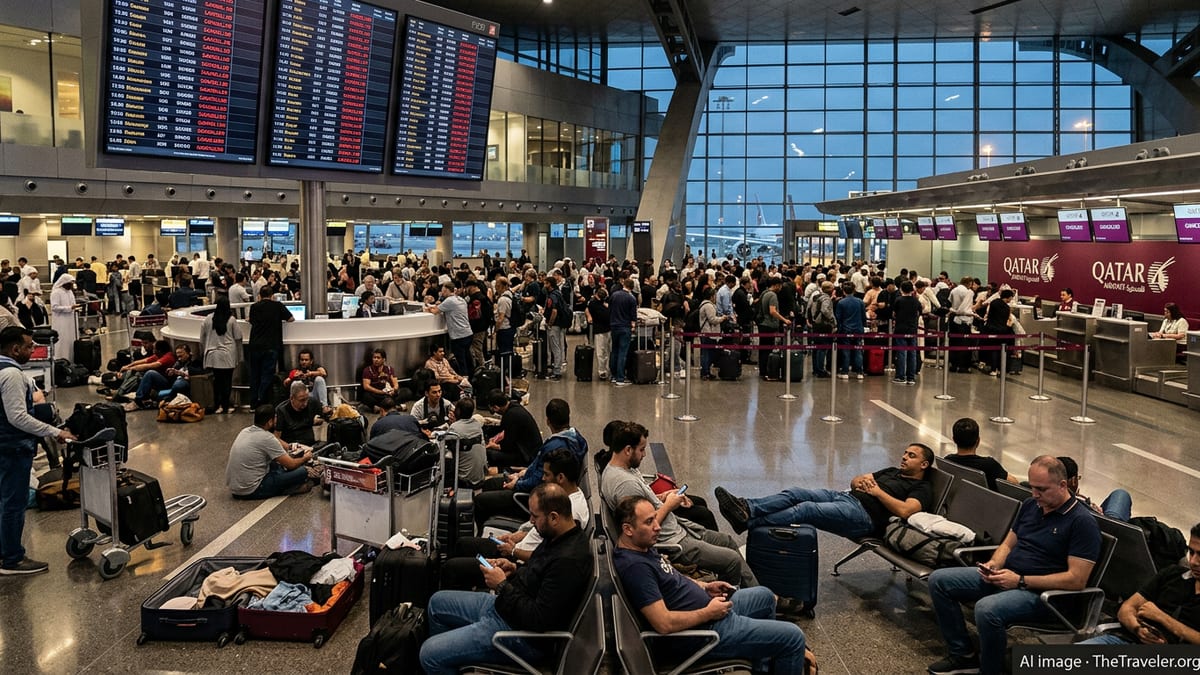
Airspace Closure Triggers Systemwide Disruption
The latest cancellations are part of a wider aviation crisis sparked by the ongoing closure and restriction of airspace across parts of the Middle East, which has effectively choked off normal operations at Doha’s Hamad International Airport. Qatar’s main gateway, typically one of the world’s busiest transit hubs, has seen the majority of scheduled passenger services suspended in recent days, according to official airport and airline updates.
Data compiled from flight tracking and industry sources indicates that nearly 500 commercial movements either originating in Doha or routed via the Qatari hub were cancelled in a 48-hour window, with ripple effects stretching from London and Jeddah to Bangkok and Dubai. Many of those flights were operated or codeshared by Qatar Airways, but disruptions have also hit Gulf Air, IndiGo, EgyptAir, Royal Jordanian and several European and Asian partners.
Authorities in Qatar have approved only a narrow operating corridor for limited repatriation and cargo flights. While this has allowed a small number of departures and arrivals to resume, the restricted capacity has done little to ease the mounting backlog of passengers whose itineraries relied on Doha as a critical connecting point between Europe, Asia, Africa and Australasia.
Officials have repeatedly urged travelers not to head to the airport unless they have been specifically contacted and rebooked on an authorized service, warning that crowding at the terminal complicates both safety and logistics.
Terminal Crowds, Long Queues and Patchy Information
Inside Hamad International Airport, scenes over the weekend and into Monday have reflected the strain on infrastructure and staff. Travelers report densely packed waiting areas, long lines at transfer desks and customer service counters, and limited seating or rest facilities for those forced to stay airside overnight while awaiting news of rebooked flights.
With most regularly scheduled departures absent from the boards, stranded passengers have described a stop-start pattern of announcements and gate changes as airlines try to assemble repatriation rotations to London, Frankfurt, Zurich and other key European cities. Many of the scarce seats are being prioritized for families, elderly travelers and those with medical needs, leaving other passengers uncertain about when they will be able to move on.
Ground handling and airline teams are working under tight operational constraints, juggling aircraft positioning, crew duty limits and rapidly shifting airspace permissions. While some travelers praise staff for efforts to provide meal vouchers and hotel rooms, others report inconsistent communication and difficulty reaching call centers or managing bookings online during peak disruption periods.
The airport has published general guidance addressing baggage issues, vouchers and entitlement to care, but in practice the experience varies widely between carriers and even between passengers on the same itinerary, depending on status, ticket type and onward connection options.
Major Routes to London, Jeddah, Bangkok and Dubai Hit Hard
The cancellations have been particularly acute on some of Qatar Airways’ and its partners’ most heavily trafficked corridors. Services linking Doha with London Heathrow and other major European gateways have been curtailed or converted into irregular repatriation flights, sharply reducing capacity on one of the world’s key Europe to Asia and Australasia trunk routes.
Flights to and from Jeddah, Riyadh and other Saudi gateways have also been affected, complicating travel for religious pilgrims and workers moving between the Gulf and South Asia. IndiGo and Gulf Air, which rely on regional connectivity through hubs in Doha, Manama and beyond, have each reported significant schedule cuts and diversions, further fragmenting a network that normally offers dense frequencies across the region.
Farther afield, Bangkok, Singapore and other Asian destinations that depend on Gulf connections for European and African traffic are experiencing sharp drops in inbound and outbound capacity, with passengers forced to reroute via alternative hubs in Turkey, Egypt or India where possible. Meanwhile, intra-Gulf links between Doha and Dubai, Kuwait and Muscat have seen wave after wave of cancellations as carriers adjust to changing airspace restrictions and operational risks.
Industry analysts warn that even if additional corridors reopen in the coming days, the backlog of displaced travelers and aircraft will take much longer to clear, especially on peak long-haul routes that are already operating close to capacity in normal times.
How Airlines Are Responding and What Passengers Can Expect
Qatar Airways has announced a limited schedule of special flights over the coming days, focusing on repatriating stranded transit passengers and citizens to key cities including London, Amsterdam, Berlin, Frankfurt and Zurich. Seats on these services are not being sold through normal channels; instead, the airline is directly contacting affected customers who already held tickets on previously cancelled flights and reallocating them where space and routing permit.
Gulf Air, EgyptAir, Royal Jordanian and other regional carriers are adopting similar strategies, consolidating demand into fewer rotations and coordinating with civil aviation authorities to operate via approved corridors. Some airlines are exploring reroutes over alternative airspace, but these can substantially lengthen flight times and may still be subject to short-notice changes if security assessments shift.
For many passengers, the immediate options remain limited. Airlines are broadly offering free rebooking on later dates or refunds for unused segments, but the scarcity of seats across the region means that the earliest alternatives may be days away. Travel agents report that securing new routings via secondary hubs such as Cairo, Muscat or Amman is possible in some cases, although fares on remaining inventory have surged and connection times can be long.
Consumer advocates emphasize that travelers whose flights have been cancelled should keep detailed records of all communication, receipts for meals and accommodation, and written confirmation of disruption from their carrier, as these may be necessary for claims under local passenger rights regimes or travel insurance policies.
Advice for Stranded and Soon-to-Depart Travelers
For those currently at Hamad International Airport, authorities advise remaining in close contact with airlines via official apps, email and staffed service desks, and avoiding unauthorised transfers or separate tickets that could void entitlements to care. Passengers are urged not to proceed to the airport unless they hold a confirmed seat on a specific, operating flight and have been told to travel.
Travelers yet to begin journeys that involve a Doha connection are being strongly encouraged to check the status of their flights at least 48 hours before departure and to consider alternative routings where feasible. Some carriers are temporarily allowing free changes to itineraries that avoid the affected hub, subject to availability, while global distribution systems show continuing waves of schedule updates as airlines refine their plans.
Industry observers note that the current disruption illustrates the vulnerability of hyper-connected hub-and-spoke networks to geopolitical shocks, especially in regions where a small number of airports handle the lion’s share of long-haul transfer traffic. The same connectivity that makes itineraries via Doha attractive in normal times also amplifies the scale of disruption when that hub is suddenly constrained.
With airspace conditions evolving daily, there is cautious optimism that more repatriation and regular flights will be added in the coming week. For now, however, thousands of travelers remain in limbo, caught in a complex web of cancellations that has rippled far beyond the Gulf and into departure halls from London and Paris to Bangkok and Sydney.