

More news on this day
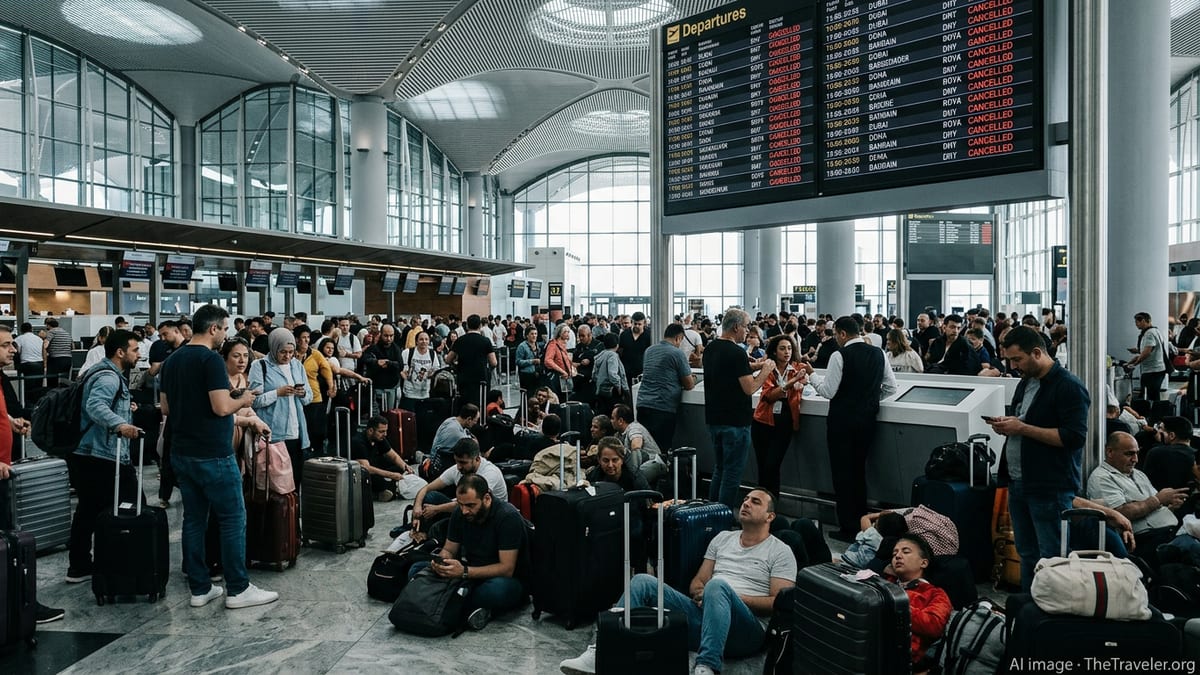
Passengers at Istanbul Airport are facing mounting disruption after more than 20 flights were canceled on Monday, as Turkish and Gulf carriers cut services to Dubai, Doha, Bahrain and other key Middle East hubs amid a rapidly escalating regional airspace crisis.
Turkey Tightens Restrictions as Regional Conflict Hits the Skies
Turkey has moved to sharply limit air links with the Gulf as conflict-driven airspace closures across the Middle East ripple through global aviation networks. While Turkish airspace and major airports such as Istanbul remain technically open, authorities in Ankara have ordered sweeping cancellations to destinations caught up in the crisis, severely constraining travel between Türkiye and key hubs in the United Arab Emirates, Qatar and Bahrain.
Transport and Infrastructure Minister Abdulkadir Uraloğlu said that flights by Turkish Airlines and other domestic carriers to Iran, Iraq, Syria, Lebanon and Jordan are suspended until March 6, with all scheduled services to Qatar, Kuwait, Bahrain and the UAE canceled until at least March 3. The measures come on top of widespread shutdowns of Gulf airspace following US and Israeli strikes on Iran and retaliatory attacks across the region.
The immediate impact at Istanbul Airport has been the cancellation of more than 20 departures and arrivals tied to Gulf routes, including services operated by Turkish Airlines, Emirates and flydubai, according to airport and airline advisories. Additional last minute changes remain likely as carriers continuously rework schedules around fast-moving airspace restrictions.
Officials stress that the decisions are driven by security considerations, with airlines ordered to avoid closed or high-risk corridors over Iran, Iraq and surrounding areas. Although some flights are being re-routed via longer northern tracks, most direct services between Türkiye and the Gulf’s busiest hubs have been frozen for now, leaving passengers with few immediate alternatives.
Istanbul Passengers Left Isolated From Gulf Hubs
For travelers in Istanbul, the cancellations have effectively severed one of the city’s key connective arteries to the wider world. Routes to Dubai, Doha and Bahrain normally function as vital links for both point-to-point passengers and those transiting on to Asia, Africa and Australasia via the Gulf’s mega-hubs.
On Monday, departure boards at Istanbul Airport showed a string of red notices for flights bound for Dubai International, Hamad International in Doha and Bahrain International Airport. Passengers who had already checked in for morning services reported being asked to return home or to nearby hotels, often with only limited clarity from call centers that were overwhelmed by demand.
Some travelers described feeling “isolated” in Istanbul, unable to reach onward connections to destinations as varied as Bangkok, Manila, Johannesburg and Sydney that are typically served through single-stop itineraries via the Gulf. With airspace over several Middle Eastern countries closed or heavily restricted, rebooking via alternative hubs such as Riyadh or Muscat has also become complicated, and often impossible on the same day.
Even those with flexible tickets are finding that the options are narrowing. As cancellations cascade through the system, remaining seats on indirect routings via Europe have grown scarce, pushing up prices and forcing many to delay or abandon trips altogether.
Emirates, Turkish Airlines, Flydubai and Others Slash Schedules
The disruption at Istanbul Airport is being driven by a combination of Turkish regulatory decisions and parallel moves by Gulf-based airlines. Emirates has temporarily suspended all regular operations to and from Dubai, citing multiple regional airspace closures that make normal schedules unworkable. The carrier has said only limited, specially approved flights will operate while restrictions remain in place, and that customers can rebook within a set window or request refunds.
Flydubai has likewise halted its Istanbul services as part of a broader suspension of all flights to and from Dubai until at least 15:00 UAE time on Tuesday, March 3. The low cost airline is working with authorities to adjust its timetable on a rolling basis and has warned of long waits on customer service lines as it processes changes for thousands of travelers.
On the Turkish side, Turkish Airlines has canceled services not only to the Gulf but also across a wide swath of the Middle East, including flights to Iran, Iraq, Jordan, Kuwait, Lebanon, Oman, Syria and the UAE. Other Turkish carriers such as Pegasus, AJet and SunExpress have implemented similar suspensions on routes that traverse or serve affected airspace.
Industry analysts say that while the number of cancellations directly tied to Istanbul’s Gulf routes currently stands in the dozens, the operational impact is far larger when factoring in missed connections, misaligned crew rotations and aircraft stranded at outstations around the region. Recovery, they warn, will be measured not in hours but in days, even if security conditions stabilize quickly.
Travelers Face Uncertainty, Limited Support and Longer Journeys
For passengers holding tickets between Türkiye and the Gulf, the near term outlook is marked by uncertainty. Airlines are generally offering fee free rebooking or refunds for flights canceled as a result of the regional crisis, but policies vary by carrier and fare class, and many travelers say they are struggling to obtain clear guidance.
Those needing to travel urgently to or from Dubai, Doha or Bahrain are being advised to stay in close contact with their airline, avoid going to the airport without a confirmed replacement itinerary, and consider alternative routings via European or North African hubs where available. However, capacity on those routes is limited and schedules themselves remain subject to change as airlines reroute around closed skies over Iran, Iraq and parts of the Gulf.
At Istanbul Airport, ground staff have set up additional help desks to manage queues of stranded passengers seeking hotel vouchers, meal coupons and information about next steps. Yet with disruptions affecting thousands of journeys concurrently, many travelers are being told to arrange their own accommodation and submit claims later, adding to frustration and costs.
Travel insurers, meanwhile, are beginning to face a surge in inquiries about coverage for cancellations and delays linked to conflict. Policy terms differ sharply, and some plans exclude disruptions caused by war or military action, meaning a significant number of passengers may find themselves bearing at least part of the financial burden of the crisis.
Outlook: Rolling Updates as Authorities Monitor Security
Turkish authorities have indicated that all restrictions will be reviewed daily in coordination with aviation regulators and security agencies. Flights to Saudi Arabia’s Riyadh, Jeddah and Medina, along with certain services to Oman, are currently allowed to resume under closely monitored conditions, offering a narrow but important release valve for regional travel.
However, with airspace over Iran, Qatar, Bahrain, Kuwait and the UAE still subject to closure or severe limitations, a rapid restoration of Istanbul’s traditional role as a bridge to the Gulf appears unlikely. Even if partial reopenings occur in the coming days, airlines will need time to reposition aircraft and crews, rebuild schedules and clear backlogs of displaced passengers.
For now, Istanbul Airport remains operational but at a diminished level for eastbound and southbound long haul connections, and travelers are being urged to treat all timetables as provisional. The situation underscores how quickly geopolitical shockwaves can disrupt the carefully choreographed global aviation system, turning one of the world’s busiest crossroads into a chokepoint for those trying to reach the Gulf and beyond.
Authorities and airlines say they will continue to issue rolling updates as the security picture evolves. Until then, passengers bound for Dubai, Doha, Bahrain and neighboring destinations face a wait for normality that could stretch beyond the current cancellation deadlines, depending on how the crisis unfolds.