

More news on this day
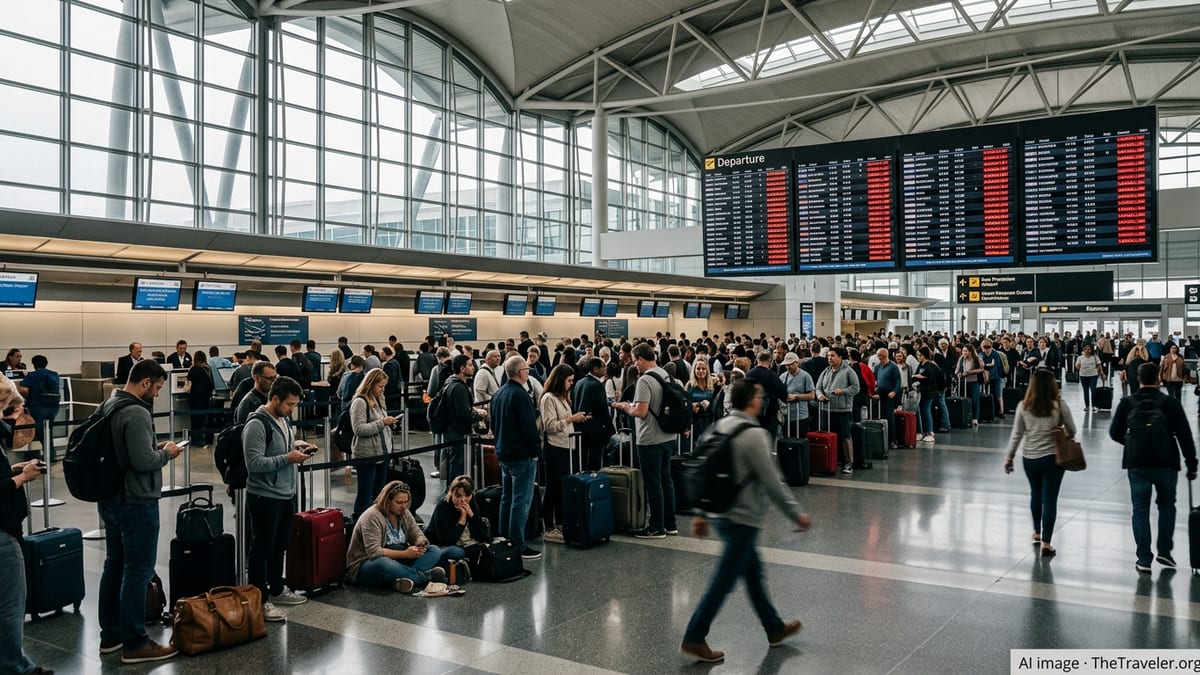
San Francisco International Airport is facing severe disruption as widespread Middle East airspace closures and airline suspensions ripple across global networks, triggering mass cancellations on routes to Dubai, Doha and key US destinations.
Get the latest news straight to your inbox!
Middle East Conflict Cascades Into Global Air Travel
Publicly available information indicates that flight operations across parts of the Middle East have been sharply curtailed since late February 2026, following the outbreak of a regional conflict that has led to repeated missile strikes and airspace restrictions. Aviation advisories describe closures and severe constraints affecting the skies over Qatar, the United Arab Emirates, Bahrain, Israel, Iran and Iraq, cutting off or complicating many of the most heavily used long haul corridors between North America, Europe, Asia and the Gulf.
Industry bulletins circulated to corporate travel clients in early March describe an unprecedented shutdown of normal operations for major Gulf carriers. Emirates temporarily halted services to and from Dubai, Etihad reduced departures from Abu Dhabi, and Qatar Airways suspended regular passenger flights as Qatari airspace was effectively closed except for limited evacuation and emergency traffic. These actions removed dozens of daily connections that underpin global transfer traffic linking cities such as San Francisco with hubs in Dubai and Doha.
The wide geographic scope of the airspace restrictions has forced airlines to cancel rather than simply reroute many flights. Long detours around the Gulf region can add hours of flying time, increase fuel burn and push aircraft and crews beyond operational limits. As a result, carriers have trimmed schedules, consolidated services and, in numerous cases, removed affected routes from sale altogether for portions of March.
Impact on SFO Routes to Dubai and Doha
While San Francisco International Airport does not host as many Gulf carrier departures as some East Coast gateways, its role as a major Pacific and North American hub means that any disruption to Dubai and Doha networks is quickly felt on the ground. Publicly available flight tracking data for mid March shows a string of cancellations on itineraries that would ordinarily connect through the Gulf, including tickets marketed by US and European airlines but operated via codeshare partners in Dubai and Doha.
Corporate travel advisories and airline notices reviewed in recent days show that services touching the Gulf have been suspended or heavily reduced by a range of carriers. European and Asian airlines have announced temporary halts to Dubai and Doha operations into early and mid March, while some North American airlines have suspended select Middle East routes or closed new bookings on impacted sectors. These measures have narrowed options for SFO based travelers seeking to reach South Asia, Africa and parts of the Middle East, where Dubai and Doha typically serve as primary connection points.
For passengers ticketed from San Francisco to destinations beyond the Gulf, the shutdown of normal operations in Dubai and Doha has translated into last minute reroutings, extended layovers and outright cancellations. According to published coverage, passengers have been advised to expect significant schedule changes, including rebooking through alternative hubs in Europe or Asia, and in some cases extended travel times of 12 hours or more compared with pre crisis routings.
Domestic Knock-on Effects Across the United States
The disruption is not confined to international departures. Airlines routinely use long haul demand to support domestic feeder services, and the loss of high yield connecting traffic has begun to reverberate across US networks. Schedule adjustments filed in recent days show capacity reductions on certain domestic routes feeding into San Francisco, as carriers attempt to match seat supply with sharply reduced onward demand to the Middle East and beyond.
Travel industry analyses note that the conflict and associated airspace closures are hitting at a time when US airlines were already managing a tight balance of aircraft availability and crew resources following the disruptive North American winter season. Carriers are now reallocating widebody aircraft that would ordinarily operate to the Gulf, deploying them on transatlantic or transpacific routes where airspace remains open, while trimming or consolidating domestic frequencies linked to disrupted international banks of flights at SFO.
This rebalancing has produced rolling cancellations across the United States, as aircraft and crew rotations are rewritten with little notice. Passengers on domestic routes that appear unrelated to the Middle East have reported same day cancellations or significant delays as planes and crews are repositioned to cover revised long haul schedules. Public information from airline customer advisories suggests that these changes are likely to continue as long as the Gulf airspace situation remains unstable.
Stranded Travelers, Rebooking Challenges and Limited Alternatives
Reports from passenger forums and travel advisory services describe long queues at rebooking counters, overloaded call centers and limited same week alternatives for travelers whose journeys relied on Dubai or Doha connections. With major Gulf carriers operating only a fraction of their normal schedules, rebooking options are constrained, particularly for those traveling in peak periods or to secondary destinations that are already served less frequently.
Airlines have generally activated disruption policies that allow affected travelers departing from San Francisco and other US cities to change dates or reroute without additional fees, subject to fare differences and seat availability. However, publicly posted guidance makes clear that in many cases alternative routings involve multiple connections, overnight stays in transit cities, or departures several days later than originally planned.
Some passengers are opting to cancel trips altogether, particularly for discretionary travel, as uncertainty over further airspace closures and potential escalation of the conflict make future schedules difficult to predict. Travel management companies are advising corporate clients to consider rerouting essential travel through European hubs where feasible, while pausing non critical trips that depend on Gulf connections until there is more clarity on the operating environment.
Uncertain Outlook for SFO and Global Networks
Aviation analysts note that the scale of the current airspace restrictions and the central role of Gulf hubs in global connectivity make it difficult to forecast a swift return to normal operations. Even if limited corridors remain open for evacuation and relief flights, commercial schedules from Dubai and Doha are expected to remain significantly reduced until regional security conditions improve and regulators provide clearer guidance on long term overflight permissions.
For San Francisco International Airport, the near term outlook points to continued volatility. Airlines are updating schedules in short increments, sometimes day by day, as they navigate changing risk assessments and evolving regulatory notices. Passengers booking new trips from SFO that involve the Gulf are being urged, in publicly available advisories, to monitor itineraries closely, build in additional connection time and remain prepared for potential last minute changes.
Industry observers highlight that the current disruption may also prompt longer term strategic shifts. Carriers could accelerate plans to diversify routings away from heavily constrained corridors, while some travelers and corporate buyers may reassess their reliance on single hub connectivity models through Dubai or Doha. For now, however, San Francisco International Airport remains a visible example of how a regional airspace crisis can rapidly cascade into travel chaos across continents.