

More news on this day
A widening airspace crisis across the Middle East is rippling through global aviation, forcing Emirates, Lufthansa and other major carriers to slash flights, reroute long-haul services and upend tourism flows at the start of the northern summer travel season.
Get the latest news straight to your inbox!
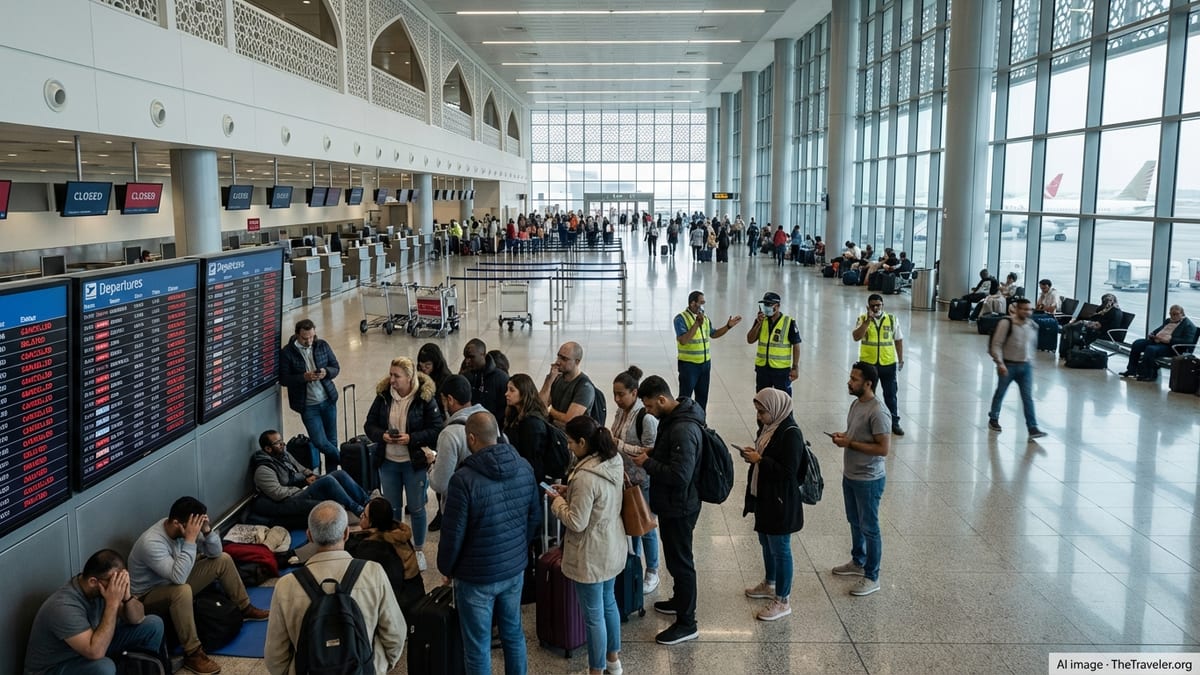
Airspace Closures Turn Key Hubs Into Bottlenecks
From late February 2026, successive missile and drone strikes linked to the Iran war prompted sweeping airspace restrictions across the United Arab Emirates, Iran, Iraq, Qatar, Israel, Bahrain and parts of the wider Gulf. Flight-tracking data cited in published coverage shows normally dense corridors over the region reduced to a fraction of usual traffic, as authorities curtailed access to conflict-affected skies and airlines activated contingency plans.
Dubai, Doha and Abu Dhabi, three of the world’s most important intercontinental hubs, have borne the brunt of the disruption. Reports indicate periods of full or partial closure at these airports, with congestion, delays and diversions persisting even as limited operations resume. Industry advisories describe the situation as the most acute aviation shock since the pandemic, with airlines struggling to maintain predictable schedules while avoiding conflict zones.
Regional travel bulletins and corporate risk updates highlight Saudi airspace as one of the few relatively stable east–west corridors, channelling unprecedented volumes of rerouted traffic. The resulting bottlenecks have lengthened flying times between Europe, Asia and Africa, driving up fuel burn and operational costs and reducing the number of rotations carriers can operate each day.
The European Union Aviation Safety Agency’s conflict zone advisory, extended on 9 April 2026, underscores the scale of concern. The bulletin urges airlines to avoid large swathes of Middle Eastern and Gulf airspace, reinforcing decisions by European and Asian carriers to divert or halt flights that would normally cross the region.
Emirates Cuts Capacity as Dubai Hub Staggers
Emirates, which relies on Dubai as a mega-hub connecting Europe, Africa, Asia and Australasia, has moved from a temporary shutdown of many services to what it describes in public communications as a “reduced flight schedule.” Travel advisories show the airline operating fewer frequencies to more than 100 destinations, while offering rebooking and refund options for passengers scheduled to travel between 28 February and mid-April, and in some cases into May.
Industry reporting indicates that Emirates has been progressively restoring services as specific corridors reopen, with planned ramp-up periods through late March and April. Yet even as more flights appear on the schedule, the carrier continues to warn that timings and routings remain subject to last-minute changes as airspace restrictions evolve. Airlines operating via Dubai are also balancing inbound demand with outbound capacity constraints, which can leave aircraft and crew out of position.
Tourism operators in Dubai report a sharp drop in new international bookings alongside a rise in short-notice cancellations and trip deferrals. Luxury hotels and beach resorts that typically rely on long-haul visitors from Europe and Asia are said to be increasing promotional offers and pivoting to domestic and regional staycation campaigns to fill rooms. Analysts note that this shift mirrors strategies used during the pandemic, when Gulf destinations focused on local residents while borders and air links were restricted.
While the United Arab Emirates has worked to keep core infrastructure functioning despite intermittent attacks, repeated suspensions at Dubai International Airport have shaken traveller confidence. Travel forums and agency advisories urge passengers to avoid tight connections through the hub and to build in significant buffer time for any itineraries that still rely on Middle Eastern transit points.
Lufthansa and European Carriers Extend Suspensions
For European airlines, the Middle East crisis has translated into a mix of outright route suspensions and costly detours. Public statements from the Lufthansa Group show flights to Tel Aviv suspended through early April and services to Dubai, Abu Dhabi, Amman, Erbil and Beirut halted until at least late March, with further adjustments flagged as likely. The group continues to avoid Iranian and Iraqi airspace and has scaled back night operations to Israel for safety and operational reasons.
Travel industry reports indicate that Lufthansa, together with other European carriers such as Air France, British Airways and KLM, is reconfiguring networks to route traffic away from affected hubs. This includes adding capacity on alternative city pairs in Europe, North America and Asia to compensate partially for lost Middle East connectivity. However, longer routings and higher overflight charges are pushing up operating costs at a time when fuel prices are already elevated by the wider conflict.
The EU conflict zone advisory has also complicated insurance and risk calculations for airlines that might otherwise have considered limited operations through the Gulf. According to aviation risk analyses, some carriers are facing pressure from insurers and corporate clients to steer clear of airspace near active missile and drone trajectories, even when basic overflight permissions technically exist.
As a result, Europe–Asia traffic that once moved efficiently through Dubai, Doha or Abu Dhabi is increasingly being funnelled through hubs such as Istanbul, Athens and various Central Asian gateways. These airports are gaining transit traffic but also experiencing strain as they absorb passengers and aircraft displaced from the Gulf.
Tourism Flows Rewired Across Regions
The immediate impact on tourism has been most visible in Middle Eastern destinations that depend heavily on long-haul air connectivity. Travel trade publications report that inbound leisure demand for Dubai, Abu Dhabi, Doha and several Red Sea resorts has fallen sharply since late February, with group tours postponed and cruise itineraries modified to avoid disrupted ports and airports.
Tour operators in Europe, Asia and Africa are reshaping packages in response. Some are steering clients toward Mediterranean, Indian Ocean or Southeast Asian destinations that can be reached without passing through conflict-affected skies. Others are substituting regional city-breaks or rail-based itineraries for long-haul trips that now carry higher perceived risk and the likelihood of last-minute changes.
Travel analytics firms note that booking data for March and April shows a pronounced shift away from itineraries that involve Gulf transits. Secondary hubs in Europe and Asia are capturing some of this traffic, but overall long-haul leisure demand appears to be softening as would-be travellers adopt a wait-and-see approach.
The crisis is also affecting outbound tourism from the Middle East. With residents in the Gulf facing fewer flight options and greater uncertainty, regional tourism boards are increasing marketing in neighbouring countries to capture short-haul demand that can be served on remaining routes. However, until airspace restrictions ease more broadly, the region’s role as a global connector for tourism remains severely constrained.
Travellers Face Higher Fares, Longer Journeys and Ongoing Uncertainty
For individual travellers, the most immediate consequences of the airspace crisis are cancellations, missed connections and extended journey times. Airline and travel agency advisories emphasise the importance of checking flight status repeatedly before departure, as schedules continue to be adjusted with limited warning. In some cases, passengers have been rebooked on circuitous routings that add several hours to journeys between Europe, Africa and Asia.
Capacity reductions by Emirates, Lufthansa and other major carriers, coupled with the need to fly alternative, longer routes, are putting upward pressure on airfares. Analysts suggest that even where base fares have not yet risen substantially, the loss of discounted inventory and promotional seats is making it harder for travellers to find low-cost options on affected corridors.
Corporate travel managers are reassessing trip approvals to the region, with many organisations reportedly deferring non-essential travel to Gulf and Levant destinations. Where travel proceeds, companies are seeking more flexible ticket conditions, additional insurance coverage and clearer contingency plans from airlines and travel providers.
With no rapid resolution to the wider security situation in sight, aviation experts caution that disruptions may extend well into the summer season. The evolving Middle East airspace crisis is reshaping global travel patterns in real time, forcing airlines, tourism operators and passengers to adapt to a more complex, fragmented network in which traditional hubs can no longer be taken for granted.