

More news on this day
Thousands of air passengers across the Middle East and Europe remain stranded after widespread airspace restrictions in the Gulf prompted carriers to ground 352 flights and delay a further 326, disrupting routes for airlines including EgyptAir, Emirates, KLM and Air France and affecting major hubs from Dubai and Seeb to Paris and Vienna.
Get the latest news straight to your inbox!
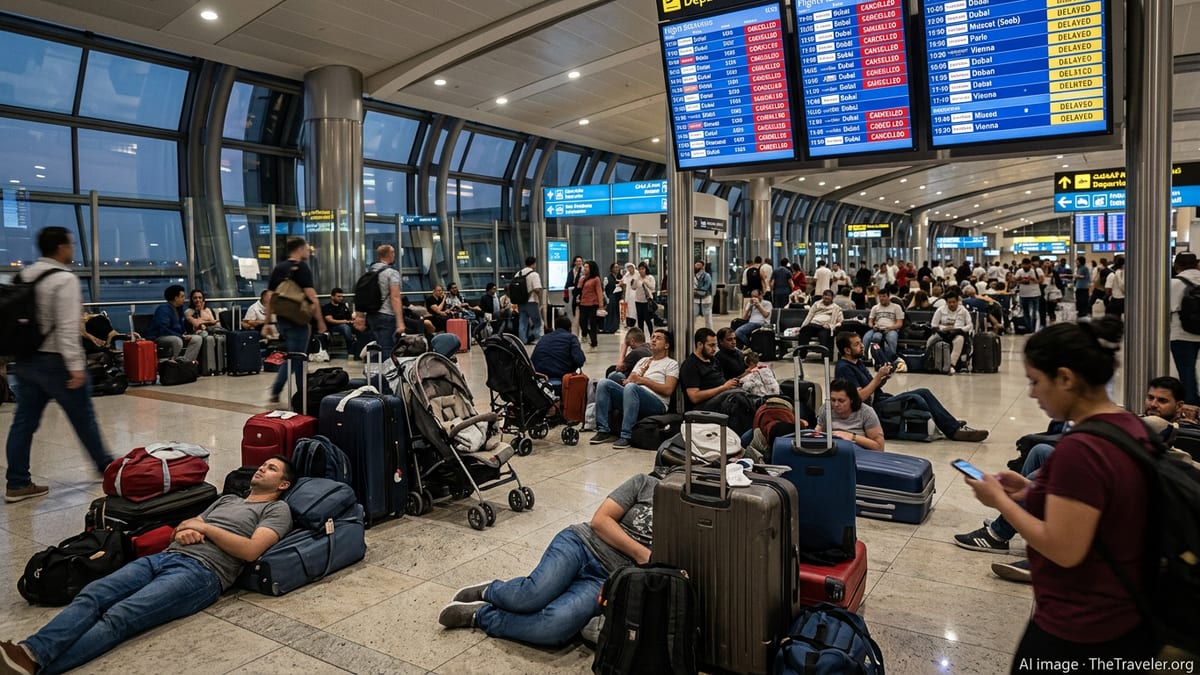
Airspace Restrictions Ripple Across Gulf and European Hubs
Travel disruption escalated sharply in recent days as airspace restrictions across the United Arab Emirates, Bahrain, Kuwait, Saudi Arabia and several neighboring states forced airlines to cancel or delay hundreds of services. Publicly available operational data and travel advisories show that carriers have cut or rerouted flights traversing key Gulf flight information regions, leading to bottlenecks across the wider network.
The European Union Aviation Safety Agency has extended conflict zone guidance for large portions of Middle East airspace, including the flight information regions covering Bahrain, Kuwait, Oman, Qatar, Saudi Arabia and the UAE. The agency’s conflict zone bulletin advises operators to avoid affected areas at all altitudes, prompting many airlines to suspend or significantly curtail overflying activity and point to point services between Europe, the Gulf and South Asia.
While some domestic and regional operations within individual countries continue on limited schedules, the combined effect of airspace closures and rerouting has cascaded into major long haul markets. Aircraft and crew have become out of position, causing secondary delays and cancellations as far away as Western Europe, where Paris Charles de Gaulle and Vienna International are among the airports experiencing knock on impacts.
Dubai and Seeb at the Center of Operational Upheaval
Dubai International Airport, normally one of the world’s busiest long haul hubs, has seen large portions of its schedule suspended or sharply reduced. Travel management advisories and airline updates indicate that Emirates has temporarily operated on a restricted basis in and out of Dubai, focusing capacity on evacuation style and repatriation services for stranded travelers while regular commercial frequencies remain curtailed.
Muscat’s Seeb International Airport has faced parallel stress as airlines adjust to changing conditions in Omani airspace and along southern rerouting corridors. Flight tracking data and traveler accounts describe waves of diversions and cancellations at Seeb, which is being used both as an alternate routing waypoint and as a staging point for limited outbound flights to Europe, Africa and South Asia when conditions permit.
Passengers transiting through these hubs have reported long waits inside terminals and repeated schedule changes as carriers attempt to consolidate demand onto a shrinking list of operational services. With aircraft unable to overfly key portions of the Gulf, even flights that do depart often take longer, more circuitous routes, cutting into available crew duty time and forcing further rotations to be canceled or delayed.
EgyptAir, Emirates, KLM and Air France Curtail Schedules
The disruption has hit both regional and global airlines that rely on Gulf airspace as a primary corridor between continents. Published coverage and airline communications show that Egypt’s flag carrier EgyptAir has suspended or reduced a number of services touching Gulf destinations, while also grappling with rerouting challenges on flights between Cairo and European cities that would normally pass through the affected region.
Emirates, based in Dubai, has shifted from a dense global network to a skeleton operation on select routes, prioritizing flights that can safely navigate available corridors and that relieve pressure on stranded passenger backlogs. Informal evacuation style schedules from Dubai to European cities such as Paris and Vienna have appeared in operational updates, often framed as one off or short notice departures rather than a return to normal timetables.
European carriers KLM and Air France, which typically operate multiple daily services into Gulf hubs and rely on overflight rights for connections onward to Asia and East Africa, have also significantly reduced their schedules. According to recent reporting on the broader Middle East airspace crisis, both airlines have canceled or rerouted services, with some flights terminating in alternative hubs and others removed from timetables entirely while the situation remains fluid.
Knock On Effects for Passengers Across Regions
The immediate impact for travelers has been felt in crowded terminals and prolonged journeys. Passengers booked through Dubai or Seeb report being held in transit zones for extended periods while airlines attempt to secure onward travel options. Limited hotel availability, visa restrictions and constrained airport ground services have compounded difficulties for those whose itineraries were built around now canceled Gulf connections.
In Europe, the reduction in direct Gulf services and safe overflight paths has affected schedules at Paris Charles de Gaulle and Vienna International, where certain inbound flights from Asia and Africa have been delayed, rerouted via southern or northern detours, or canceled outright. Flight data snapshots and on the ground accounts describe aircraft arriving off schedule, missed connections and baggage handling backlogs as airports and carriers rework their daily plans.
The disruption is also rippling into secondary markets. Travelers from South and Southeast Asia heading to North America or Europe via the Gulf are being forced to rebook through alternate hubs in Türkiye, North Africa or southern Europe where capacity is already constrained. In some cases, passengers face waits of several days for available seats, driving up demand on unaffected routes and contributing to higher last minute fares.
Uncertain Timeline for Full Restoration of Services
Industry analyses of the current Middle East airspace situation highlight the uncertainty around when full commercial operations will resume. Economic assessments of the evolving regional conflict note that airspace closures in the UAE, Qatar, Kuwait, Bahrain and other Gulf states have already led to thousands of daily flight cancellations, affecting hundreds of thousands of passengers and cutting deeply into tourism and transit traffic.
Travel risk consultancies are advising businesses and leisure travelers to expect continued volatility in schedules over the coming days, even if some restrictions are eased. Airlines must reposition aircraft and crew, clear passenger backlogs and rebuild reliable connection banks at their hubs before announcing a meaningful return to previous frequencies.
For now, publicly available information indicates that travelers bound for or transiting through Dubai, Seeb, Paris and Vienna should monitor airline communications closely, consider flexible routings that avoid the most heavily constrained corridors, and be prepared for significant changes to their plans as carriers and regulators navigate one of the most complex airspace disruptions the region has seen in years.