

More news on this day
Air travel across the Middle East has entered its most severe crisis in decades, as Bahrain joins a rapidly expanding list of countries closing or restricting airspace in response to escalating cross-border strikes by Iran, Israel and the United States.
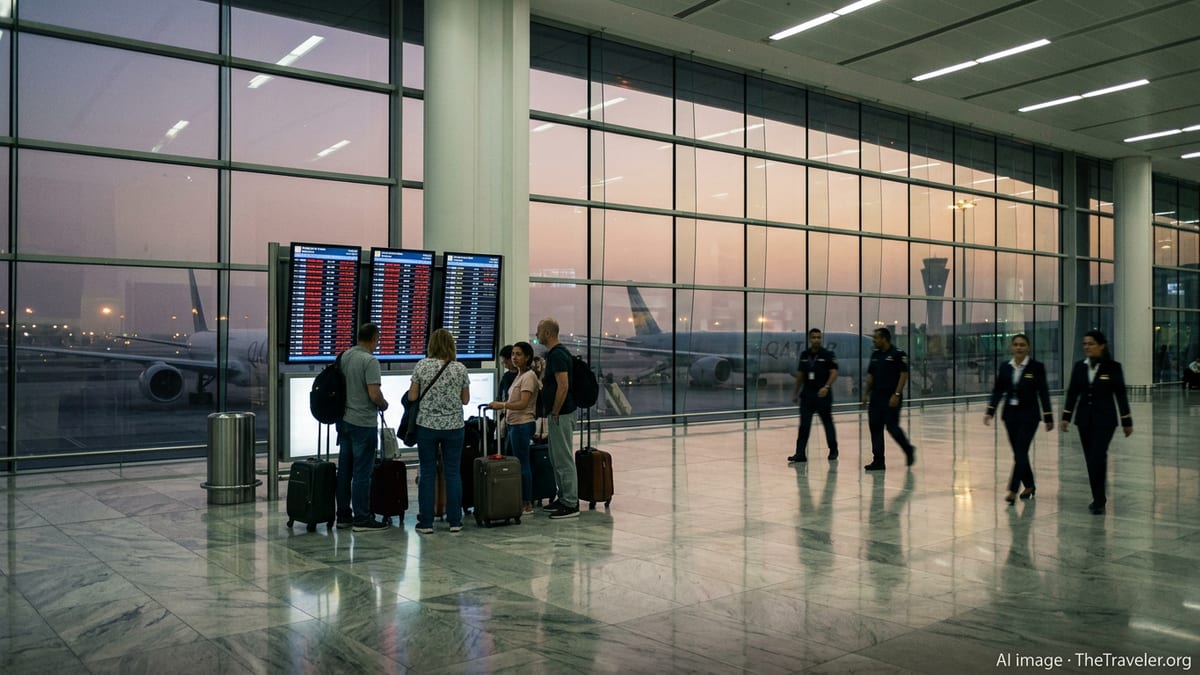
Regional Skies Fall Silent As Conflict Escalates
Bahrain has fully closed its airspace to commercial traffic, aligning with sweeping restrictions that now stretch from Iran and Iraq to Qatar, Kuwait and the United Arab Emirates, according to aviation and logistics bulletins issued since the weekend. Neighboring Saudi Arabia and Jordan have imposed partial closures and tight security corridors, while Lebanon is operating under highly constrained conditions as military exchanges intensify across multiple front lines.
The clampdown follows coordinated US and Israeli strikes on targets inside Iran beginning February 28, and subsequent Iranian missile and drone attacks on US-linked facilities and partners across the Gulf. Flight-tracking data shows large swathes of regional sky effectively emptied of civilian traffic, rerouting Europe Asia corridors that typically funnel through hubs in Dubai, Abu Dhabi and Doha.
Operational updates compiled by airlines and freight forwarders indicate that Iran, Israel, Iraq, Qatar, Bahrain, Kuwait and Syria are either fully closed to routine overflights or functionally unavailable to standard commercial routes. The United Arab Emirates and Saudi Arabia, while not entirely shut, remain under stringent restrictions that sharply limit airspace capacity and force extensive detours for long haul services.
Security advisors warn that as long as military operations remain active in and around Iran and along the eastern Mediterranean, there is a high risk environment for civil aviation in any country that hosts US or Israeli assets or sits beneath potential missile and drone flight paths.
Thousands Of Flights Cancelled, Global Networks Rewired
The impact on scheduled air travel has been immediate and global. Aviation analytics firms estimate that nearly one quarter of all flights into the wider Middle East were cancelled on the first full day of strikes and counterstrikes, with Bahrain and Israel recording cancellation ratios above 50 percent and Qatar and Iraq approaching 40 percent. Additional waves of cancellations have continued into this week as carriers extend suspensions and await clearer security guidance.
Major Gulf carriers Emirates, Etihad, Qatar Airways, Saudia and Flydubai have suspended or drastically curtailed operations across their networks, grounding much of the traffic through Dubai, Abu Dhabi and Doha. Regional low cost operators and smaller flag carriers, including Air Arabia and Kuwait Airways, have followed suit, while national aviation regulators warn that any remaining schedules are subject to last minute change.
International airlines from Europe, North America and Asia including British Airways, Lufthansa, Air France KLM, Turkish Airlines, Air India, IndiGo, American Airlines, Air Canada and others have cancelled flights to destinations such as Tel Aviv, Doha, Dubai, Kuwait City, Amman, Beirut and Riyadh or rerouted services to avoid affected airspace entirely. With Russian skies already off limits to many Western carriers, the loss of Middle Eastern corridors further complicates Europe Asia routing, adding hours to flight times, inflating fuel burn and driving up costs.
Industry analysts say that if the current pattern of closures and diversions persists beyond a short window, airlines face structurally higher operating expenses and tighter aircraft utilisation, increasing pressure on fares at a time when demand for long haul travel had only recently recovered to near pre pandemic levels.
Evacuations Begin As Governments Urge Citizens To Leave
As commercial options shrink, governments are stepping in to extract citizens from a region now designated by many foreign ministries as a high risk or do not travel zone. The US State Department has issued an urgent advisory calling on Americans in a broad swathe of Middle Eastern countries, including Saudi Arabia, the United Arab Emirates, Iraq and Israel, to depart as soon as practicable as the security situation deteriorates.
Limited evacuation and charter flights have begun operating from relatively less restricted hubs in the UAE and Egypt, though capacity remains far below demand. European governments, alongside Asian nations such as the Philippines, are assembling their own repatriation operations, drawing on military transport aircraft and contracted charters to move tourists, students and expatriate workers out of affected areas.
In Lebanon, where Israeli airstrikes on Hezbollah positions have intensified and spillover skirmishes continue along the border, Western embassies have urged their nationals to leave while commercial flights remain intermittently available. Consular sections have scaled back or suspended routine services to focus on crisis response as they warn that airport access and outbound seats could vanish with little warning if hostilities expand further.
Travel risk consultancies now classify large portions of the Middle East as extreme or high risk for non essential travel, citing both the threat of direct attacks and the possibility of being stranded for an extended period amid rolling closures, communication outages and pressure on essential services.
Tourism Flows Collapse From Gulf Hubs To Mediterranean Shores
The sudden dislocation has rippled quickly into the tourism economies of the Gulf, Levant and beyond. Dubai and Abu Dhabi, which together handled close to 100 million international passengers last year, have seen passenger operations pause or contract sharply, cutting off a critical transit bridge for leisure travelers headed between Europe, Africa, Asia and Australasia.
In Bahrain, where operations at the island kingdom’s main airport are effectively suspended, hotels report a flood of cancellations as corporate meetings, events and weekend leisure stays are shelved indefinitely. Similar patterns are emerging in Doha, Kuwait City and major Saudi destinations, where inbound tour operators and destination management companies are scrambling to refund bookings and rework itineraries for clients who can no longer reach the region.
Along the eastern Mediterranean, Lebanon’s already fragile tourism rebound has been dealt a severe blow as airlines slash capacity to Beirut and cruise operators reconsider port calls. Jordan’s carefully rebuilt visitor economy, anchored by Petra and the Wadi Rum desert, faces the double hit of airspace restrictions and traveler anxiety about proximity to active fronts, even where local conditions remain calm.
Tourism boards and private sector leaders across the region acknowledge that even a relatively brief aviation shutdown can cast a longer shadow, with tour operators and travel agents in key outbound markets likely to steer customers toward alternative destinations in Europe, North Africa or Southeast Asia for upcoming peak seasons.
Travelers Stranded, Costs Rise And Recovery Timeline Unclear
For travelers already in the region, the crisis has created a patchwork of uncertainty. Tens of thousands of passengers are believed to be stranded at airports, hotels and cruise ships from the Gulf to the Levant, many holding tickets for flights that no longer exist or transits that can no longer be completed. Airline call centers and digital channels are overwhelmed as customers seek refunds, new routings or basic information on when service might resume.
Those able to secure alternative paths home are often facing multi stop itineraries that loop far south through Africa or north through Europe and Central Asia, adding considerable time and expense. With war risk insurance premiums and operating costs rising, industry observers warn that fares on any remaining or restored routes through the region are likely to trend higher, at least in the near term.
Business travel has also been sharply curtailed as multinational companies activate contingency plans, restrict staff movements and shift meetings to virtual formats. Corporate security teams are monitoring evolving airspace notices, missile activity and embassy advisories, often instructing employees to avoid transiting the broader Persian Gulf and Eastern Mediterranean altogether.
Despite growing pressure from tourism and aviation stakeholders, officials and airline executives concede that normalization of regional airspace will depend on a de escalation of the underlying military confrontation between Iran, Israel and the United States. Until there is a durable reduction in cross border strikes and a clear relaxation of security warnings, the Middle East’s role as a central crossroads of global air travel will remain severely diminished.