

More news on this day
Widespread airspace closures across the Middle East, triggered by the escalating conflict involving the United States, Israel and Iran, are cascading through the global aviation system and threatening to derail travel plans well beyond the region.
Get the latest news straight to your inbox!
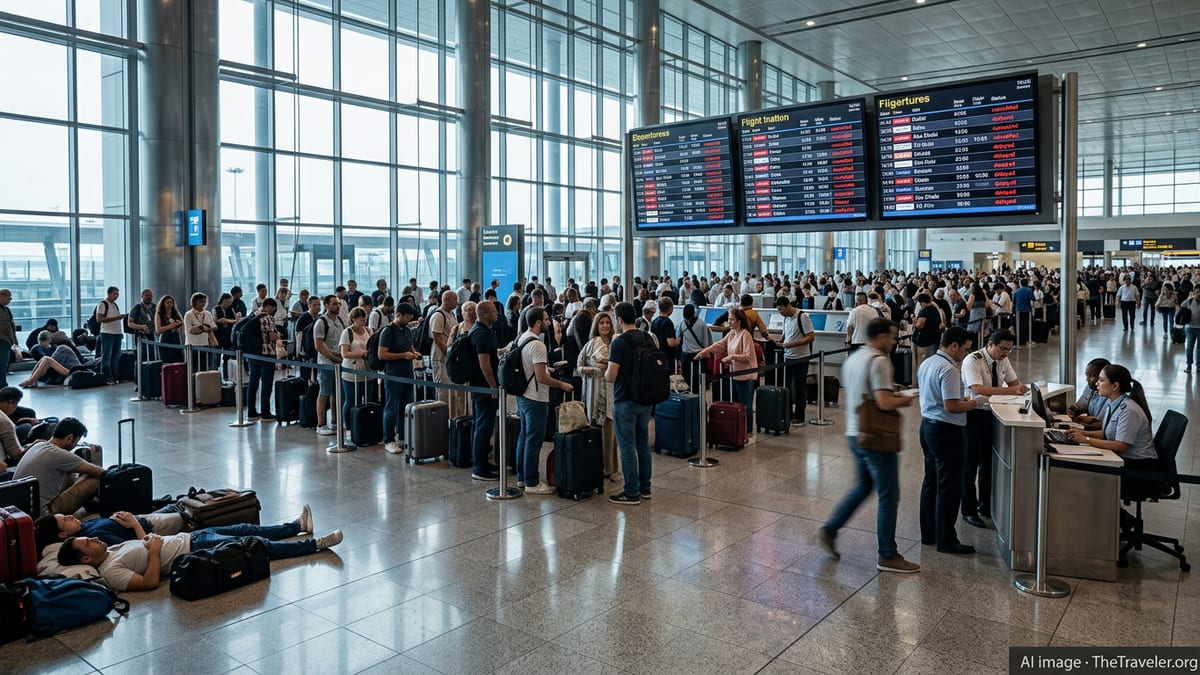
Airspace Closures Turn a Regional War Into a Global Flight Crisis
The latest wave of disruption began on February 28, 2026, when the Iran war sharply escalated and multiple Middle Eastern states moved to close their skies to civilian traffic. Publicly available information indicates that Iran and Iraq effectively shut their airspace, while Qatar, Kuwait, Jordan, Bahrain and Israel imposed sweeping restrictions or closures. Several Gulf hubs, including Qatar and the United Arab Emirates, have at times halted or severely limited operations as missile and drone activity intensified.
Reports from aviation trackers and regional advisories show substantial sections of airspace over Iran, Iraq and surrounding flight information regions now effectively off limits to commercial carriers. A March advisory circulated to shipping and aviation clients described most Gulf airspace as closed or highly restricted, with knock-on effects for crew changes and passenger movements even in states where airports remain technically open.
The closures have choked off key east–west corridors that airlines rely on to link Europe with Asia, Africa and Australasia. According to recent coverage summarizing airline schedules, more than half of all flights planned in the Middle East since the start of the conflict have been cancelled, turning a regional security crisis into one of the most severe shocks to global aviation since the Covid-19 pandemic.
Even where airports are reopening, activity remains constrained. Israel’s Ben Gurion Airport, for example, has resumed operations on an extremely limited basis, with outbound passenger numbers reportedly capped and some aircraft damaged during Iranian missile attacks, complicating efforts to restore normal schedules.
Hubs From Dubai to Doha Struggle as Aircraft and Crews Pile Up
The impact is being felt most acutely at major Gulf and Levant hubs that usually function as global connection points. Reports collating airport and airline notices describe Dubai, Abu Dhabi, Doha, Kuwait City and Tel Aviv as experiencing severe congestion, with stranded aircraft and displaced crews crowding stands and limiting the capacity to relaunch services quickly.
Dubai International, one of the world’s busiest transit airports, has intermittently suspended operations and diverted traffic amid missile interceptions and airspace restrictions. Public reporting and passenger accounts point to long lines, ad hoc terminal closures and waves of cancellations as airlines repeatedly adjust schedules in response to changing safety assessments.
Qatar’s Hamad International Airport has also faced significant disruption following the temporary closure of Qatari airspace in late February. Coverage citing the Associated Press notes widespread cancellations and diversions, with a limited number of repatriation flights authorized along narrowly defined safe corridors to major European capitals.
Lebanon’s Beirut airport technically remains open, but regional closure patterns have gutted connectivity. Local coverage and airline announcements show Middle East Airlines cancelling numerous flights to Gulf destinations and Iraq because neighboring countries’ airspace is closed, even as a reduced schedule continues to operate where routings remain viable.
Rerouted Long-Haul Flights Mean Longer Journeys and Fewer Seats
One of the most disruptive effects for travelers outside the region is the forced rerouting of long-haul flights that previously transited the Middle East. With the traditional Gulf and Iran corridors cut or heavily restricted, carriers are being pushed north via Central Asia or south via Africa, adding hours to flight times, burning more fuel and tightening already stretched crew duty limits.
Industry analysis cited in recent coverage warns that detours of six to ten additional flight hours are becoming common on some Europe–Asia and North America–South Asia routes when operators avoid the conflict zone. These extended routings dramatically increase operating costs at a time when jet fuel prices are already under pressure from parallel disruption in the Strait of Hormuz.
As aircraft spend more time in the air and crews time out more quickly, the effective capacity of the global fleet shrinks. A KPMG travel advisory focused on the Middle East notes that aircraft and crews are stranded at outstations from London and Paris to Southeast Asia as jets divert, terminate early or are unable to use their planned hubs. This has limited airlines’ ability to mount rescue flights or add extra rotations, even on routes that remain in high demand.
The reduction in usable airspace is also causing air traffic control bottlenecks in neighboring regions. Reports indicate that controllers in alternative corridors are now handling significantly more aircraft than usual, forcing greater spacing between flights and limiting the number of movements airlines can schedule through the remaining open routes.
Mass Cancellations and Tight Waiver Windows Hit Spring Travelers
For passengers, the most immediate consequence has been an avalanche of cancellations and schedule changes. Aviation data cited in regional reporting suggests that on some peak days, roughly a quarter of all flights touching the Middle East have been scrubbed, with tens of thousands more operating with major delays or diversions.
Major Middle Eastern carriers such as Emirates, Qatar Airways and Etihad Airways have suspended or radically reduced regular services to numerous destinations in Iran, Iraq, Jordan, Lebanon and Israel. European and Asian airlines have followed suit, either pausing flights into the region entirely or extending flexible rebooking policies and free-refund windows for itineraries touching affected countries through late March and into April.
Travel advisories shared by corporate risk consultancies emphasize that rebooking options are limited because capacity on unaffected routes is already constrained. With aircraft and crews out of position, some carriers can only offer new dates weeks later, while others are opting to provide refunds rather than alternative flights. Travelers with multi-leg itineraries are in some cases finding that one cancelled segment invalidates their entire ticket, forcing full itinerary redesigns.
There is growing concern that the crunch could spill over into the broader spring and early summer peak. As airlines block additional time on schedules for detours and build in slack to cope with potential short-notice airspace changes, the total number of seats available on some long-haul markets is expected to fall, even if demand remains strong.
What This Means for Upcoming Trips Beyond the Middle East
While the epicenter of the disruption is the Middle East, the consequences are radiating far beyond the region. Travelers flying between Europe and Asia, or between North America and destinations in South or Southeast Asia, may find their itineraries unexpectedly tangled with the crisis even if they never intended to set foot in the Gulf.
Publicly available guidance from airlines and travel risk firms recommends that passengers scheduled to transit through hubs such as Dubai, Doha, Abu Dhabi, Kuwait City or Tel Aviv over the coming weeks consider proactively reviewing their options. Some carriers are advising customers to switch to alternative routings via Europe, Central Asia or Africa where space permits, while warning that fare differences and limited inventory may apply.
Travel insurance policies and credit card protections are also coming under scrutiny. Many standard policies exclude war-related disruption, meaning that travelers may have to rely on airline waivers or flexible booking rules to avoid penalties. Risk advisories urge passengers to examine the fine print carefully, document any airline communications about cancellations or involuntary changes, and keep receipts for extra accommodation or transport costs in case partial reimbursement is available.
With safety-driven airspace decisions subject to rapid change, analysts caution that conditions can shift with little warning. For now, publicly reported assessments from industry groups suggest that the system is operating in a fragile, stopgap mode. Unless the regional security picture improves and key airspace corridors reopen, travelers planning long-haul trips in the coming months may need to build in extra flexibility, longer connection times and the possibility that their next journey will look very different from the one they originally booked.