

More news on this day
Rapidly escalating tensions between the United States, Israel and Iran have triggered urgent airspace closures across the Middle East, forcing airlines to cancel flights from Pune to Dubai and Abu Dhabi and shutting down major Gulf transit hubs, stranding and rerouting hundreds of thousands of travelers worldwide.
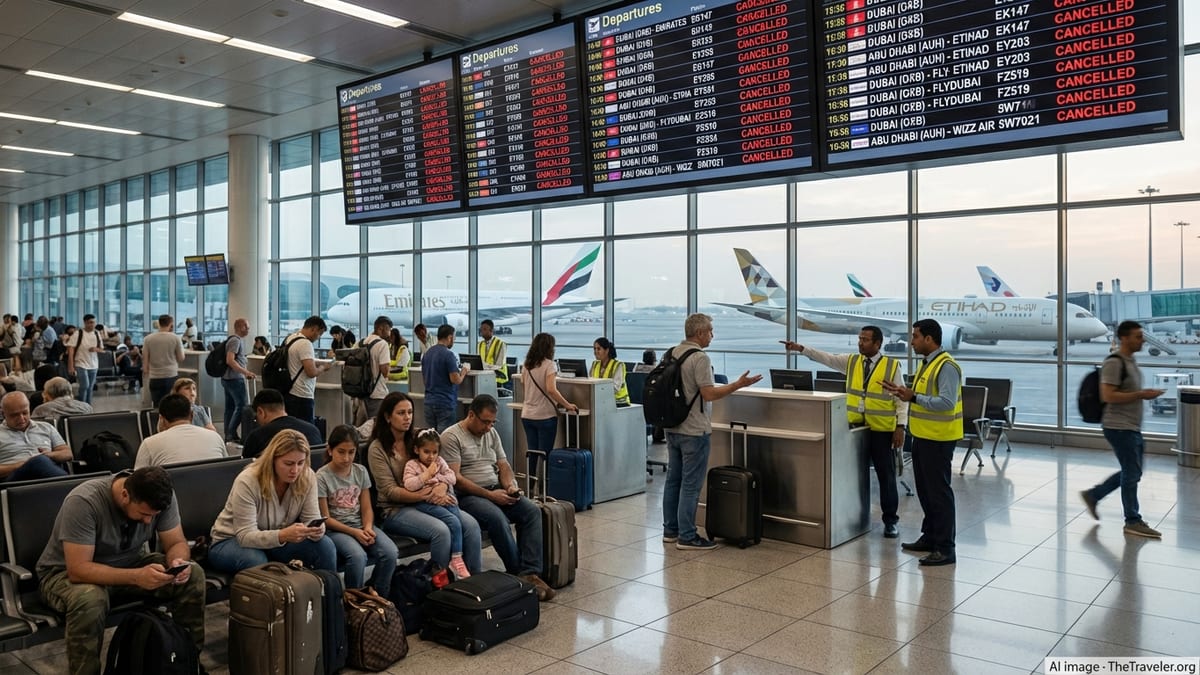
Flights from Pune to Dubai and Abu Dhabi Abruptly Cancelled
International connectivity from Pune took a direct hit over the weekend as multiple services to the United Arab Emirates were pulled from schedules with only a few hours’ notice. Airport officials confirmed that three key flights linking Pune with Dubai and Abu Dhabi were cancelled on Saturday after airspace over parts of West Asia was closed due to the worsening conflict.
Among the affected services were SpiceJet flight SG 51 from Pune to Dubai, Air India Express flight IX 283 from Pune to Abu Dhabi, and IndiGo flight 6E 1484/1483 on the Dubai–Pune–Dubai route, which had been due to operate overnight into Sunday, March 1. Passengers were informed by airlines via messages and airport announcements, but many still arrived at the terminal to find their plans abruptly derailed.
Pune Airport officials said the cancellations were a direct result of the deteriorating security situation and associated restrictions on airspace across the region, rather than local operational issues. Travellers holding tickets on the affected flights have been advised to contact their airlines for rebooking options or refunds, with carriers warning that alternative routings may remain limited while airspace closures stay in place.
Dubai and Abu Dhabi Hubs Hit by Temporary Shutdowns
The cancellations in Pune are part of a much larger disruption radiating outward from the Gulf’s busiest aviation hubs. Authorities in the United Arab Emirates temporarily closed portions of national airspace after U.S. and Israeli strikes on Iran and subsequent regional retaliation, prompting major carriers based in Dubai and Abu Dhabi to halt operations for significant parts of the weekend.
Emirates suspended all flights to and from Dubai until midafternoon on Sunday, March 1, citing multiple regional airspace closures and the need to ensure passenger and crew safety. Low cost carrier flydubai also paused services into and out of Dubai for several hours, while Air Arabia cancelled operations across its UAE bases. Passengers faced long queues at Dubai International and Dubai World Central as departures screens filled with red cancellation notices.
In Abu Dhabi, home carrier Etihad Airways halted all departures from Zayed International Airport until at least 2 p.m. UAE time on Sunday. The airline said many inbound flights would be cancelled or forced to return to their origin points, with schedules under constant review. Airport officials in the capital acknowledged delays, diversions and cancellations across a wide range of destinations as they implemented evolving airspace directives.
Collectively, the shutdowns at Dubai, Abu Dhabi and other Gulf gateways severed some of the world’s busiest east–west air corridors, interrupting the usual flow of passengers connecting between Europe, Africa, Asia and Australasia. Aviation analytics firms estimated that hundreds of flights and tens of thousands of seats were affected in a single day, with ripple effects expected to continue into the week.
Airspace Closures Ripple Across the Middle East
The immediate trigger for the disruption was the decision by several Middle Eastern countries to close their airspace following U.S. and Israeli military strikes on Iran and related missile activity. Authorities in Iran, Israel, Iraq, Qatar and other states restricted overflights on safety grounds, while the UAE announced a temporary and partial closure that effectively halted most commercial movements through its main hubs.
Flight tracking data showed unusually empty skies across swathes of the region on Saturday and Sunday. International carriers were forced either to cancel services outright or to design lengthy detours around closed airspace. Journeys that would normally transit the Gulf were rerouted south over Saudi Arabia or north over Turkey and the Caucasus, adding time, fuel costs and operational complexity.
Analysts noted that while airlines and air navigation authorities have extensive contingency plans for conflict zones, the scale of the current closures is unusual because it involves multiple interconnected hubs simultaneously. Industry experts said that even a partial reopening of airspace will require careful coordination between military planners and civil aviation regulators to ensure that risk levels are acceptable for commercial traffic.
Stranded Passengers and Global Travel Chaos
For travelers on the ground, the closures translated into missed connections, overnight airport stays and rapidly shifting itineraries. At Middle Eastern hubs, passengers queued for hours at airline service desks to secure new routings or accommodation vouchers as flight after flight disappeared from departure boards. Many foreign visitors in the Gulf found themselves stranded with limited information on when normal services would resume.
In India and Europe, knock-on effects have been severe. Airports reported cancelled or heavily delayed Gulf-bound departures, while long haul flights connecting through Dubai, Abu Dhabi and Doha were withdrawn from sale or temporarily zeroed out from schedules. Some airlines advised passengers not to travel to the airport unless they had received confirmation that their flight was operating.
Travelers already airborne faced diversions to secondary airports or returns to their point of origin, with crews reaching duty-time limits and aircraft ending up out of position. Industry observers warned that it could take several days for airlines to rebalance fleets and crews once airspace begins to reopen, meaning that residual delays and cancellations are likely to persist beyond the initial crisis period.
What Travelers from India and Beyond Should Expect Next
For passengers booked to travel from Indian cities such as Pune to the Gulf and onward to Europe or North America, the coming days are expected to remain uncertain. Airlines are issuing broad travel waivers, allowing date changes without penalties and, in some cases, full refunds for journeys scheduled during the peak of the disruption. However, rebooking options may be constrained by limited seat availability and ongoing schedule cuts.
Industry experts advise travelers to monitor airline advisories closely, keep contact information updated in bookings and rely on official airline and airport channels for the latest information. Those with nonessential travel plans to or through the affected region are being encouraged to postpone journeys where possible until there is clarity on airspace status and operational safety assessments.
Aviation analysts suggest that once military tensions ease, authorities may move to reopen selected air corridors in phases, prioritizing routes deemed safest based on intelligence and risk evaluations. Even then, carriers will need time to rebuild complex global networks that hinge on the smooth functioning of Gulf mega-hubs, meaning travelers could encounter longer routings and altered schedules for some time.
For now, the cancellations in Pune, the shutdowns in Dubai and Abu Dhabi, and the broader Middle East airspace closures highlight how quickly geopolitical flashpoints can ripple through global travel. With the United States, Israel and Iran locked in a rapidly evolving confrontation, airlines and passengers alike are bracing for a protracted period of uncertainty in one of the world’s most critical aviation regions.