

More news on this day
Thousands of travelers across the Middle East and beyond are stranded or rerouted as escalating regional tensions trigger sweeping airspace closures, forcing carriers in the United Arab Emirates, Bahrain, Oman, Jordan, Kuwait, Israel and neighboring states to ground or delay more than a thousand flights in a fast-moving disruption that is rippling through global aviation networks.
Get the latest news straight to your inbox!
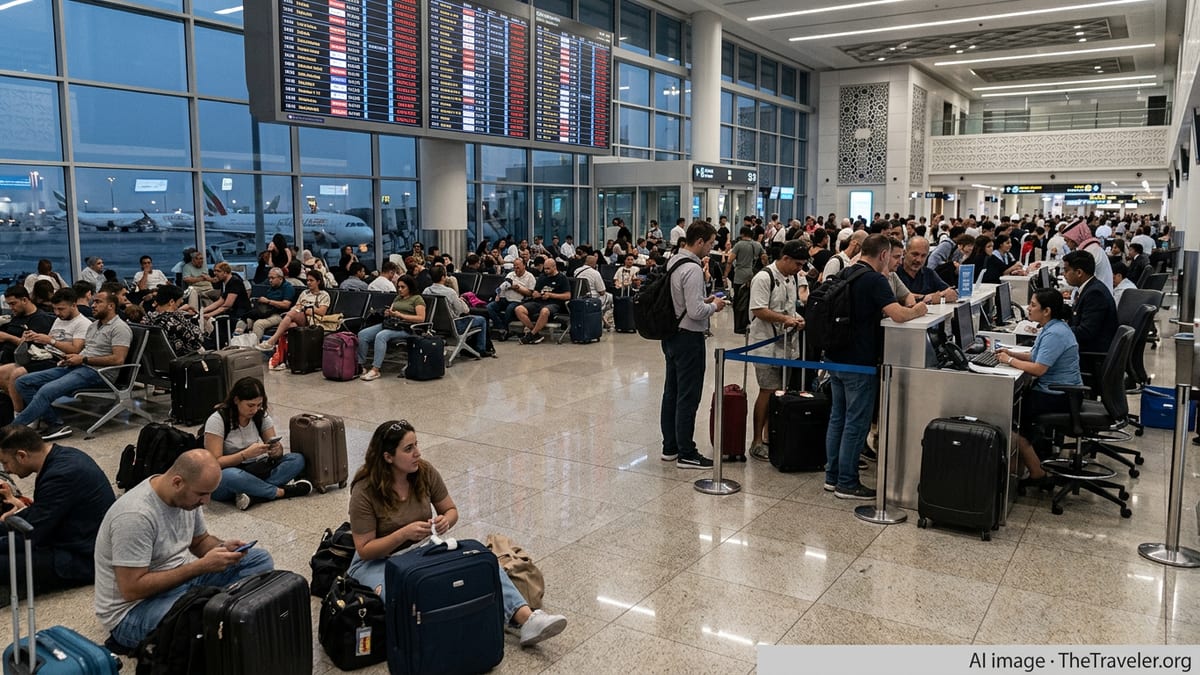
Widespread Groundings as Airspace Closes Over Key Hubs
Authorities in several Middle Eastern states have shut or severely restricted portions of their airspace in response to heightened geopolitical tensions, prompting airlines to cancel or delay hundreds of services in and out of regional hubs. Aviation sources and carrier statements indicate that at least 708 flights have been grounded and a further 302 delayed in recent days, as air traffic controllers limit movements over conflict-adjacent corridors that connect Europe, Asia and Africa.
Airports in the United Arab Emirates, Qatar, Kuwait and Israel have been among the most heavily affected, with operators prioritizing safety and compliance with government orders. Dubai, Abu Dhabi, Doha and other Gulf gateways, which normally handle hundreds of thousands of passengers a day, have seen large parts of their scheduled operations suspended or sharply curtailed. Passengers have reported terminal departure boards filled with cancellations and rolling delay notices.
The closures have also constrained overflight options for airlines that normally cross the region en route between Europe and Asia or between North America and South Asia. With standard flight paths unavailable, carriers are being forced to consider longer routings that add hours of flying time, strain crew duty limits and contribute to congestion in alternative air corridors.
In some cases, regional civil aviation regulators have authorized limited "relief" or repatriation flights on carefully defined corridors, allowing a small number of services to operate under strict risk assessments. However, these special operations account for only a fraction of normal capacity, leaving the majority of commercial schedules suspended.
Global Carriers Scrap Routes to Jeddah, Sharjah and Beyond
Among the hardest-hit airlines are the Middle East’s largest network carriers, including Qatar Airways and Saudia, whose business models rely on dense transfer traffic through Doha, Jeddah and other Saudi and Gulf airports. Travelers bound for cities such as Jeddah, Riyadh and Dammam have reported last-minute cancellations, diversions and multi-day layovers as airlines scramble to reposition aircraft and crew around the closures.
Secondary hubs such as Sharjah in the United Arab Emirates and Muscat in Oman have also been drawn into the disruption. While some airports remain technically open, their ability to operate normal schedules is constrained by regional airspace restrictions, aircraft and crew availability and the knock-on effects of earlier cancellations. Passengers who had planned to use Sharjah as a convenient link to Saudi Arabia and onwards to destinations in Europe and Asia are now facing lengthy detours or extended stays.
The chaos is not confined to regional carriers. European airlines including Air France and KLM have adjusted or suspended services to Gulf and Levant destinations, complicating travel plans for passengers connecting through Paris and Amsterdam. Flights touching Israel, Jordan and Kuwait are under close review, with many services cancelled outright and others operating on altered routings or timings that avoid sensitive areas.
Long-haul routes far from the immediate conflict zone are feeling the strain. Travelers heading to or from Barcelona, Munich, Houston and other major cities via Middle Eastern hubs have seen itineraries unravel as key connecting sectors disappear from schedules. In some cases, carriers have attempted to rebook passengers via alternative hubs in Europe or Asia, but high demand and limited spare capacity mean that many remain stuck.
Stranded Passengers Face Long Waits, Patchy Information
For individual travelers, the operational decisions playing out in airline control centers and government offices translate into long waits, crowded terminals and often confusing communication. Social media posts from Doha, Dubai and Muscat in recent days describe families sleeping on terminal floors, passengers queueing for hours at service desks and repeated rebookings that later fall through as conditions change again.
Several passengers on Qatar Airways, Saudia and other Gulf carriers have reported being diverted to secondary airports and then left with few clear options to reach their original destinations. Some described being put in hotels while awaiting scarce seats on relief flights, while others said they were advised to buy new tickets on alternative routes at their own expense and seek reimbursement later.
Travelers connecting from Europe and North America have faced particular uncertainty, as flights that appeared to be operating at the time of booking were later downgraded to cargo-only operations or withdrawn entirely. With many airlines still finalizing contingency schedules day by day, departure boards and mobile apps can change with little warning, and automated notification systems have not always kept pace with rapid adjustments.
Consumer groups and travel agents in key source markets have urged airlines to provide clearer, more proactive information, particularly on passengers’ rights to refunds, hotel accommodation, and re-routing. While many carriers are waiving change fees and offering open-dated tickets, the time and effort required to secure a workable itinerary has left many travelers frustrated.
Network Rewrites and Emergency Corridors Reshape Routes
Behind the scenes, airline network planners and operations teams are engaging in a complex, real-time rewrite of global routings as they attempt to keep at least part of their systems running. With direct overflights of certain Middle Eastern airspaces temporarily off-limits, carriers are exploring longer detours that skirt affected regions, sometimes adding refueling stops in southern Europe or Central Asia.
These emergency routings bring their own challenges, from securing slot times at already busy alternative airports to keeping pilots and cabin crew within legal duty limits. Some airlines have introduced technical stops on flights between India and North America, for example, while others have consolidated frequencies to free aircraft for repatriation services from stranded hubs.
Limited authorizations for so-called safe corridors have allowed Qatar Airways and other operators to mount small numbers of repatriation flights to major European cities, helping to clear some of the backlog of stranded passengers. Yet with normal commercial flights still largely on hold, demand far outstrips the seats available on these exceptional services.
Aviation analysts warn that even once airspace restrictions begin to ease, airlines will need days, if not weeks, to fully restore their networks. Aircraft and crew are scattered across multiple continents, maintenance checks have been thrown off schedule, and passenger itineraries will require extensive re-accommodation before normal patterns return.
What Travelers Should Do As Disruption Persists
With the situation still evolving as of mid March, travel experts recommend that anyone planning to transit the Middle East in the coming days treat their itineraries as provisional. Passengers are advised to monitor airline apps and text alerts closely, confirm the status of both outbound and return flights, and avoid heading to the airport without a firm departure confirmation.
Those already stranded in regional hubs are being urged to stay in close contact with their airline or booking agent, document all expenses and keep records of communications that may be relevant for later claims. In some cases, travelers with urgent needs have succeeded in persuading airlines to reroute them on alternative carriers or via distant hubs, though such options are subject to availability and may change as conditions evolve.
Travel planners note that overland options within the Gulf and Levant are limited by borders and security conditions, meaning that waiting for a confirmed air seat is often the only realistic path home for tourists and business travelers. As relief flights continue to operate on a restricted basis, priority is likely to go to those who have already been stranded for several days or who have missed onward connections.
Until governments in the region relax the current airspace measures and airlines can safely restore normal operations, the disruption is expected to ripple across timetables worldwide. For now, the safest assumption for travelers is that journeys involving the Middle East will be longer, more complex and far less predictable than usual.