

More news on this day
Fresh travel warnings and widespread airspace closures across the Middle East have triggered a wave of flight suspensions and diversions by British Airways, Virgin Atlantic, Air France, Turkish Airlines, Emirates, Etihad and many others, unleashing chaos for travellers as tensions spiral following new strikes on Iran.
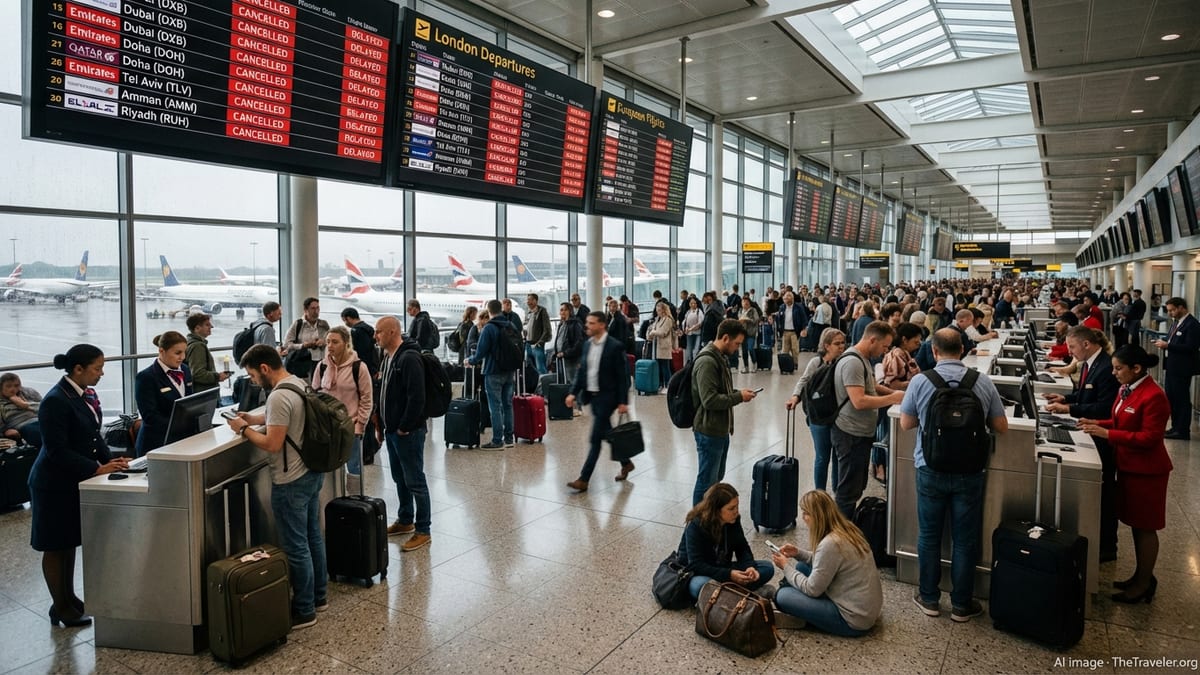
Major Airlines Pull Back From a New Conflict Zone
The joint United States and Israeli strikes on Iran on February 28, followed by retaliatory missile and drone attacks, have rapidly turned much of the Middle East into a no-go zone for civil aviation. Within hours, aviation data showed roughly a quarter of all flights to the broader Middle East cancelled, with disruption particularly acute on routes to Israel, Qatar and Kuwait.
European and Gulf carriers have moved in lockstep. British Airways has halted services to Tel Aviv and Bahrain and scrubbed a swathe of other Middle East flights, while allowing affected customers to rebook or seek refunds over the coming days. Virgin Atlantic is among a long list of global airlines that have paused operations to key regional gateways as safety concerns mount.
Gulf mega-hubs have been hit especially hard. Emirates and Etihad have cancelled large portions of their schedules and temporarily suspended services to and from Dubai and Abu Dhabi, with Qatar Airways also cutting flights from Doha. Turkish Airlines, Air France, Lufthansa Group carriers and a raft of Asian and Indian airlines have announced suspensions or severe curbs on services to destinations across Iran, Iraq, Israel, Jordan, the Gulf and the wider region.
The latest withdrawals come on top of continuing restrictions on Russian airspace due to the war in Ukraine, leaving airlines with shrinking options for safe, efficient routings between Europe and Asia and sharply raising operating costs.
Airspace Closures Create a Choke Point for Global Aviation
A cascading series of airspace shutdowns has turned the Middle East, normally one of the world’s busiest transit corridors, into a bottleneck. Iran, Israel, Iraq, Jordan, Qatar, Bahrain, Kuwait and the United Arab Emirates have all announced at least partial closures of their skies, with Syria limiting access over parts of its south. Aviation analytics suggest that more than 3,000 flights across key Gulf airports have been cancelled in just a couple of days, affecting hundreds of thousands of passengers worldwide.
Dubai International and Dubai World Central have suspended all flights until further notice, while Zayed International in Abu Dhabi and Hamad International in Doha have also seen widespread cancellations and diversions. Incidents linked to the strikes have been reported at airports in the UAE and Kuwait, prompting authorities to keep terminals locked down and passengers away unless specifically instructed to travel.
Europe’s aviation safety regulator has issued a conflict zone bulletin warning of a high risk to civil aviation across much of the region and advising airlines not to operate in affected airspace. Industry security experts say carriers and passengers should be prepared for closures to remain in place for some time, given the scale of the military action and the risk of further retaliation.
With traditional northbound routes over Russia still restricted for many airlines, the loss of Middle Eastern corridors has left long haul operators flying lengthy detours via the eastern Mediterranean, North Africa or Central Asia. The result is longer flight times, higher fuel burn, tighter crew schedules and growing pressure on fares and capacity.
How British Airways, Virgin Atlantic and Others Are Handling Bookings
For travellers holding tickets on affected routes, the immediate question is what happens next. British Airways has confirmed that flights to Tel Aviv and Bahrain are suspended until at least early March, alongside selected cancellations to Abu Dhabi, Amman, Doha and Dubai. Customers booked between London Heathrow and these cities over the coming days are being offered fee-free changes to later dates or alternative destinations, with those due to travel sooner also able to request refunds in many cases.
Virgin Atlantic, which relies heavily on partner connections over Gulf hubs, has joined other international carriers in cancelling or rerouting services that would normally overfly the affected region. While its direct Middle East network is more limited, knock-on effects are being felt on itineraries to India, Southeast Asia and Australia that connect via codeshare partners in Dubai, Abu Dhabi and Doha.
Air France and Lufthansa Group airlines have paused flights to Tel Aviv, Beirut, Amman, Tehran and several Gulf capitals, and in some cases are avoiding the entire airspace of Israel, Lebanon, Jordan, Iraq, Qatar, Iran and the United Arab Emirates for at least the first week of March. Finnair, Norwegian and other European carriers have temporarily halted flights to Dubai and Doha, while Turkish Airlines has cancelled services to a long list of Middle Eastern cities as it reshapes its network around the closures.
Middle Eastern and Asian airlines, from Emirates, Etihad and Qatar Airways to Air India, IndiGo and Pakistan International Airlines, have published rolling updates of flight suspensions to and from the Gulf, Saudi Arabia, Israel and beyond. Most are offering free rebooking or vouchers, and in some cases full refunds, even as they warn that call centres and airport help desks are overwhelmed by demand.
What This Means if You Are Due to Travel Through the Region
Travellers with imminent plans to fly to, from or via the Middle East are being urged not to cancel their trips unilaterally. Consumer advocates point out that passengers who choose to abandon journeys on their own may lose entitlement to airline-provided refunds, vouchers or alternative routings, especially where flights are still technically scheduled but subject to late operational changes.
Instead, the advice is to check flight status constantly via official airline apps or customer service channels and to wait for confirmation that a flight is cancelled before making any decisions. Where services are suspended, many airlines are automatically rebooking passengers on later dates or via different hubs, though the shortage of available seats means some travellers are likely to face multi day delays.
Travel insurance is offering limited relief. Policies often exclude war and related disruptions, treating them as force majeure events outside normal coverage. That leaves airlines as the primary source of redress, and travellers are being encouraged to keep detailed records of all communications, receipts and delay related expenses in case of future claims or goodwill gestures.
For those already stranded in Gulf or Levant hubs, governments are beginning to respond. The United Kingdom is preparing contingency plans to assist tens of thousands of its citizens in the region, particularly in the United Arab Emirates, where British residents and tourists are heavily concentrated. Other countries have upgraded travel advisories and are liaising with airlines on possible evacuation or relief flights once conditions permit.
Key Steps Travellers Should Take Now
While the situation remains fluid, there are practical measures travellers can take. Anyone booked on Middle East routes in the coming days should verify their contact details with airlines to ensure they receive real time notifications of cancellations, schedule changes or automatic rebookings. Monitoring trusted news outlets for updates on airspace status and airport reopenings is also essential.
Passengers with flexible plans might consider rerouting via alternative hubs in Europe, North Africa or East Asia that avoid the conflict zone, though this may come at higher cost and with longer journey times. Those whose trips are not time sensitive may opt to postpone entirely and take advantage of change fee waivers currently offered by many airlines.
Above all, travellers are being told to expect uncertainty. Airline executives and aviation analysts warn that until the scale and duration of the military confrontation become clearer, timetable stability will be elusive. Schedules are likely to change at short notice as carriers respond to new security assessments and regulatory guidance.
With the Middle East once again at the centre of a geopolitical shock to aviation, passengers planning to cross the region over the coming weeks should build in extra time, remain flexible and stay closely engaged with their airline for the latest information.