

More news on this day
Global travel was thrown into turmoil this weekend as a sweeping shutdown of Middle East airspace forced Dubai, Doha and Abu Dhabi to halt most Sunday flights, with Emirates, Qatar Airways and Etihad scrambling to cancel or divert services and warn passengers of prolonged disruption.
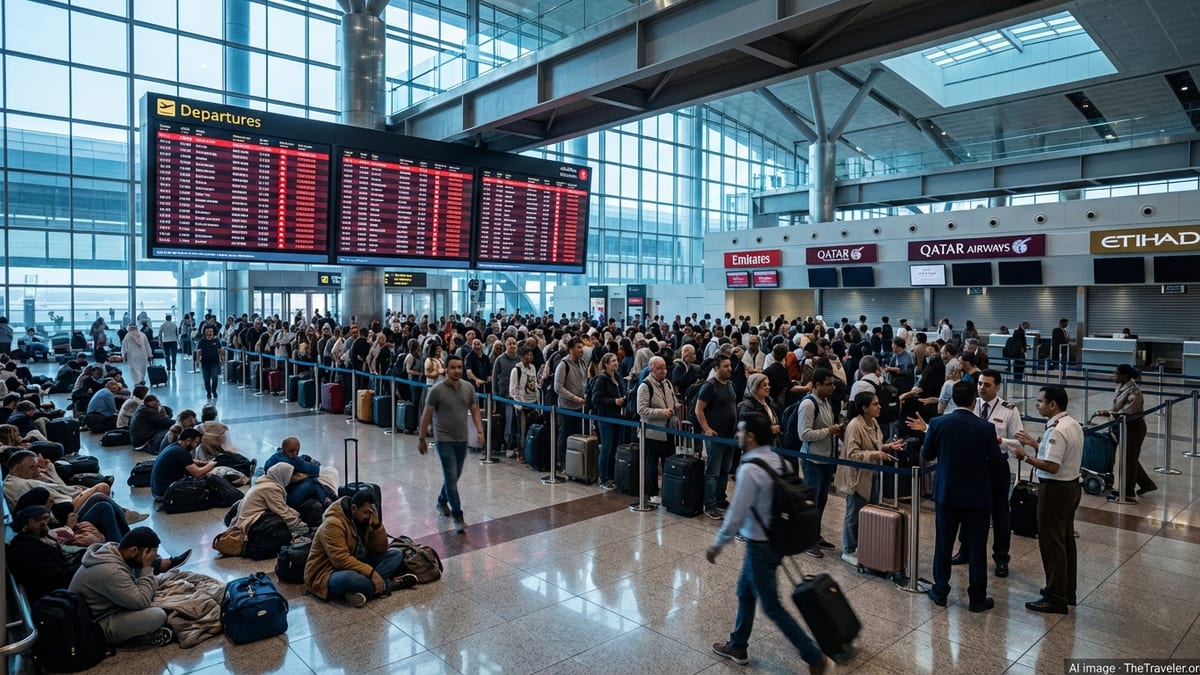
Gulf Mega-Hubs Fall Silent After Regional Airspace Closes
Hours after coordinated United States and Israeli strikes on Iran on February 28, at least eight countries across the Middle East, including Qatar and the United Arab Emirates, announced the closure of their airspace, triggering a cascading halt to civil aviation across one of the world’s busiest transit corridors.
Dubai International, the world’s largest international hub, and nearby Al Maktoum International suspended all flights on Saturday and moved into Sunday with only skeleton operations, according to airport and airline statements. Vast swathes of sky above Iran, Israel, Iraq, Jordan, Qatar, Bahrain, Kuwait and the UAE appeared nearly empty on flight-tracking platforms as carriers rushed to reroute or ground aircraft.
In Abu Dhabi, Zayed International Airport reported widespread disruption, with inbound and outbound flights delayed, diverted or cancelled. To the west, Doha’s Hamad International also saw departures frozen as Qatari authorities shut national airspace, forcing state carrier Qatar Airways to pause operations at its home hub.
Aviation analytics firm Cirium estimated more than 1,800 flights to and from the wider Middle East were cancelled on Saturday alone, with hundreds of thousands of passengers affected and knock-on delays spreading across Europe, Asia, Africa and North America into Sunday.
Emirates, Qatar Airways and Etihad Slash Sunday Schedules
Dubai-based Emirates, the world’s largest long-haul airline, confirmed it had suspended all operations to and from its hub as multiple regional airspace closures took effect. While a handful of aircraft continued flying on routes not touching the Gulf, the vast majority of its global network has been effectively frozen, upending the plans of tens of thousands of travelers who rely on Dubai as a key connection point.
In Doha, Qatar Airways announced the temporary suspension of flights to and from the Qatari capital, citing the closure of national airspace and pledging to resume services once regulators give clearance. The airline has warned of substantial delays and a messy restart phase, even after restrictions ease, as crews and aircraft are repositioned and backlogs cleared.
Etihad Airways issued one of the starkest operational updates, halting all departures from Abu Dhabi until 14:00 UAE time on Sunday, March 1, and cancelling all arrivals scheduled before that time. Flights expected to land later in the day are tentatively planned to operate, but only if conditions allow, with the carrier stressing that the situation remains highly dynamic.
Other Gulf and regional airlines, including flydubai, Gulf Air and Air Arabia, have also suspended large parts of their schedules or cancelled flights to affected destinations. Far beyond the Gulf, carriers such as Air India, Indigo, Lufthansa, British Airways, Delta, United and Turkish Airlines have scrubbed or rerouted services that cross the region’s now-closed skies.
Travelers Stranded Worldwide as Disruption Spreads
The abrupt shutdown has left airport terminals from Dubai to Delhi and London to Johannesburg filled with stranded passengers sleeping in departure halls, queuing at transfer desks and searching for scarce hotel rooms. Many had already been in the air when airspace closures were announced, only to see their aircraft divert to alternate airports or turn back to their origin.
Flight-tracking data and airline statements show long-haul services originally bound for Dubai, Abu Dhabi or Doha diverting to cities such as Cairo, Jeddah, Riyadh, Hamburg and Athens. One Emirates flight from Seattle to Dubai diverted to Hamburg, while at least one Qatar Airways service from Dallas returned to the United States after the Gulf corridor closed.
In India, airports including Chennai reported a wave of cancellations and diversions on routes to Dubai, Abu Dhabi, Doha, Muscat and other West Asian destinations between late Saturday and early Sunday. Local carriers Air India and Indigo suspended their West Asia services, while Gulf and regional airlines issued urgent travel advisories to customers in South Asia, Europe and Africa.
With hotel inventory around Gulf hubs quickly snapped up, many travelers have been left to wait in terminals for fresh instructions. Airport operators and airlines have deployed additional staff to manage crowds, provide food vouchers where possible and rebook disrupted passengers onto future flights.
Security Fears Drive Precautionary Closures
The airspace shutdown follows a sharp escalation in regional tension after US and Israeli forces launched large-scale strikes on Iran on February 28, targeting what they described as military and strategic infrastructure. Iran has vowed a forceful response and has already fired missiles and drones at targets in Israel and at US-linked facilities across the Gulf, heightening fears of further cross-border attacks.
Regulators and aviation security agencies have responded by designating parts of the Middle East as high-risk conflict zones for civil aviation. Europe’s aviation safety watchdog has warned of a significant threat to commercial flights in affected skies, advising carriers to avoid airspace where military activity and potential retaliatory strikes are expected.
Gulf governments have framed the closures as precautionary and temporary, aimed at protecting passengers and crews while the immediate security picture remains volatile. However, the breadth of the shutdown, spanning multiple neighboring states and critical air corridors between Europe and Asia, has created an unprecedented operational challenge for airlines already constrained by long-standing restrictions over Russia and Ukraine.
Aviation analysts say that if the closures persist for more than a few days, carriers will face sustained increases in fuel burn and operating costs as they are forced into longer detours around the region, with knock-on effects for ticket prices and route viability in the busy Europe to Asia and Africa markets.
What Sunday’s Shutdown Means for Travelers
For passengers holding tickets on Emirates, Qatar Airways, Etihad and other airlines transiting the Gulf on Sunday, industry guidance is unequivocal: do not travel to the airport without checking the status of your flight. Carriers are urging customers to monitor official apps and customer portals, where rolling updates on cancellations, rebookings and future schedules are being posted.
Most affected airlines have introduced flexible policies allowing free rebooking or refunds for trips touching the Middle East during the disruption period. Some are prioritizing passengers with urgent travel needs or those already mid-journey, while advising others to postpone non-essential trips until the situation stabilizes.
Travel agents report a surge in demand for alternative routings that avoid the Gulf entirely, such as connections via European or Asian hubs. However, these options are limited and often more expensive, and in many cases involve significant detours as carriers work around overlapping airspace bans.
Experts expect that when airspace does begin to reopen, it will likely happen in phases, with strict route controls and potential curfews. That means irregular operations, rolling delays and last-minute schedule changes could continue well into the coming week, even if the most acute security risks ease after the weekend.
Outlook: Gradual Reopening or Prolonged Crisis?
Industry planners are preparing for multiple scenarios as Sunday unfolds. In one, regional authorities begin reopening airspace in tightly controlled corridors, allowing Gulf hubs to ramp up operations gradually while keeping aircraft away from sensitive areas. In another, any further exchange of strikes could prolong or even widen the closures, forcing airlines to redesign schedules more fundamentally.
Aviation consultants note that Middle East hubs have grown even more central to global travel in recent years, as other regions grapple with capacity constraints and lingering operational challenges. That makes the current crisis especially disruptive compared with past conflicts that were more geographically contained.
For now, airline executives insist their focus remains on safety and on getting stranded customers moving again as soon as conditions allow. But behind the scenes, route planners and network strategists are weighing the possibility that a protracted conflict and recurring airspace closures could reshape how the world flies between continents, with ripple effects for travelers, tourism industries and global trade far beyond the Gulf.