

More news on this day
Thousands of travelers across Europe, Asia and Africa were stranded or forced into long detours this weekend as escalating tensions involving the United States, Israel and Iran triggered sweeping airspace closures over the Gulf, leading to more than 1,200 flight cancellations and hundreds of delays at key hubs in Dubai, Abu Dhabi and Doha.
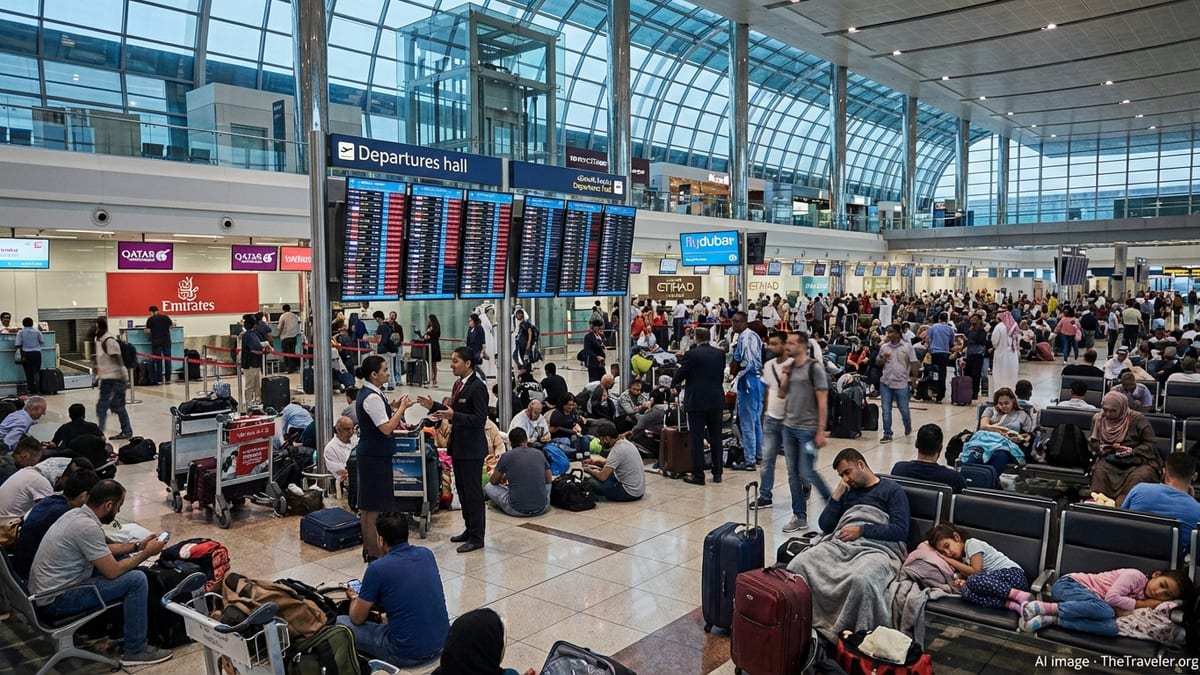
Region-Wide Airspace Closures Cripple Gulf Mega-Hubs
What began as targeted military strikes quickly cascaded into a near-total shutdown of some of the world’s busiest air corridors. Authorities in Israel, Iran, Iraq, Qatar, Kuwait, Bahrain and the United Arab Emirates moved to close large portions of their airspace to civilian traffic, forcing airlines to halt or divert flights with little warning. Flight-tracking maps showed vast stretches of sky over the region suddenly empty, a stark illustration of how quickly geopolitical tensions can paralyze global aviation.
Dubai International Airport and Abu Dhabi’s Zayed International Airport, which together handle well over 100,000 passengers a day, reported more than 1,000 combined cancellations in less than 24 hours, according to airport and flight-data tallies. Doha’s Hamad International Airport, another critical transfer point between Europe, Africa and Asia, also saw waves of cancellations and delays as Qatar temporarily closed its airspace and airlines scrambled to reposition aircraft and crews.
Aviation analytics from regional and global data firms indicate that across affected Middle Eastern destinations, well over 1,800 flights were canceled and more than 1,000 delayed within hours of the escalation, with the tally continuing to climb into Sunday. Within that broader picture, industry sources estimate that at least 1,286 flights have been called off and another 218 delayed at and around the Gulf hubs alone since the latest round of strikes, underscoring the concentration of disruption in Dubai, Abu Dhabi and Doha.
Regulators have warned that the risk to civil aviation in conflict-adjacent airspace remains high while military operations and potential retaliatory strikes continue. Europe’s aviation safety authorities have reiterated guidance for airlines to avoid specified conflict zones and adjacent flight information regions, pushing already congested long-haul routes onto longer, more circuitous paths.
Emirates, Qatar Airways, FlyDubai and Etihad Bear the Brunt
The four Gulf super-connectors that dominate east–west long-haul traffic have been among the hardest hit. Emirates temporarily suspended its operations to and from Dubai after UAE authorities restricted national airspace, grounding a significant portion of the carrier’s global network and forcing numerous aircraft to divert back to origin airports mid-route. Sister carrier FlyDubai likewise halted most departures as Dubai Airports ordered all flights at Dubai International and Al Maktoum International suspended until further notice.
In Abu Dhabi, Etihad Airways suspended all departures from Zayed International Airport until early Sunday afternoon local time, cancelling inbound flights scheduled to arrive before that window and advising that only services operating after the suspension is lifted would proceed, subject to conditions. Aircraft already en route to Abu Dhabi were turned back or diverted to alternate airports, adding further stress to crew rosters and aircraft rotations.
Qatar Airways confirmed it had halted flights to and from Doha as Qatari airspace closed. The airline said it was working with government authorities and airport operators to manage stranded passengers and reposition aircraft, but warned that even once restrictions ease, knock-on delays and schedule changes would persist for days as it rebuilds its global timetable.
The combined impact on these carriers, which routinely funnel tens of thousands of passengers per day through their hubs, has rippled far beyond the Middle East. Flights between Europe and South Asia, Southeast Asia, Australia and parts of Africa routinely rely on connections via Dubai, Abu Dhabi and Doha. With those hubs curtailed, passengers as far away as North America and India have seen itineraries abruptly cancelled or rerouted.
Stranded Passengers Face Uncertainty, Long Detours and Packed Terminals
For travelers caught mid-journey, the crisis has produced scenes of uncertainty and fatigue in terminals from Dubai to Dublin. At Dubai International, passengers reported being asked to disembark shortly before departure as last-minute operational updates came through, then queuing for hours to rebook, seek hotel vouchers or secure refunds. Others found their aircraft turning back after several hours in the air when flight paths through the Gulf abruptly closed.
In Abu Dhabi, where all departures have been temporarily halted, departure halls quickly filled with stranded passengers sleeping on luggage, sitting on the floor near charging stations and lining up at airline service desks. Etihad has urged customers not to travel to the airport unless they have confirmed rebooked itineraries and has warned of limited same-day options because aircraft and crew are out of position across multiple continents.
Doha’s Hamad International Airport, itself operating under tight constraints, has deployed additional ground staff to manage crowds and provide information, but many passengers still report unclear timelines for when they can continue their trips. With other regional airports also restricting operations or receiving diversions, conventional rerouting options are constrained, forcing airlines in some cases to send passengers back to their origin cities rather than onward to final destinations.
Travelers connecting through third countries have likewise been caught out. European, Indian and North American airports have seen a growing number of turnbacks and unscheduled arrivals as aircraft abandon intended routes. Some passengers have been advised to expect multi-day delays, especially on heavily booked long-haul sectors where spare seats are scarce.
Global Airlines Scramble to Adjust Networks and Routes
The shock to Gulf operations has prompted rapid adjustments from airlines around the world. Carriers in India, Europe and North America have suspended or curtailed services to affected destinations, citing both airspace closures and security assessments that now classify large parts of the Middle East as high-risk. Airlines that continue to fly long-haul services between Europe and Asia have begun plotting longer detours over the Caspian Sea, Central Asia or Egypt, significantly increasing flight times and fuel burn.
For some operators, the Gulf shutdown comes on top of pre-existing route constraints linked to the ongoing closure of Russian airspace for many Western carriers. The resulting squeeze on viable long-haul corridors has left schedulers with little flexibility, further complicating crew rostering, aircraft utilization and maintenance windows. Aviation analysts warn that, if prolonged, the combined impact could erode margins and strain already stretched global capacity.
Observers note that cargo flows are equally disrupted. The Gulf mega-hubs serve as key transit points not only for passengers but also for high-value air freight, from electronics and pharmaceuticals to time-sensitive e-commerce shipments. With freighter and bellyhold capacity grounded or rerouted, logistics providers are bracing for delays, higher rates and potential bottlenecks at secondary airports that are not optimized for sudden surges in transit traffic.
While some airlines emphasize that demand for travel remains robust, especially on core intercontinental routes, they acknowledge that irregular operations, lost productivity and elevated insurance and war-risk premiums could weigh more heavily on finances than the fuel costs associated with longer routings. The ultimate impact will depend on how quickly airspace restrictions are eased and whether further military escalation forces additional closures.
What Travelers Need to Know as the Crisis Continues
With flight schedules in flux and conditions varying by hour, aviation authorities and airlines are urging passengers to double-check their itineraries before leaving for the airport and to expect extended disruption over the coming days. The most immediate advice for travelers booked on Emirates, Qatar Airways, FlyDubai or Etihad is to monitor official airline communication channels and rebooking tools, as many call centers and airport desks are overwhelmed.
Passenger rights and compensation rules differ by jurisdiction and ticket type, but airlines across the region have broadly committed to offering fee-free rebooking, travel vouchers or refunds on cancelled services. However, the sheer scale of the disruption means that re-accommodating everyone quickly is unlikely. Industry specialists caution that travelers heading to or transiting through Dubai, Abu Dhabi or Doha should be prepared for last-minute changes, overnight stays and potential rerouting via alternative hubs far from their original path.
Travel risk consultants advise that, in addition to airline notices, passengers should pay attention to government travel advisories, which may evolve as the security situation develops. Some governments have already warned citizens to avoid non-essential travel to the wider region and to remain in close contact with embassies if already on the ground.
While there is cautious optimism among some aviation experts that airspace could reopen in stages if tensions ease, there is as yet no clear timeline for a full resumption of normal services. Until that clarity emerges, the simple reality for many would-be flyers is that the Middle East’s biggest transit hubs, normally symbols of near-frictionless global connectivity, have become chokepoints in a fast-moving geopolitical crisis.