

More news on this day
Global air travel was plunged into chaos on March 1 as widespread airspace closures across the Middle East forced airlines to cancel or divert thousands of flights, stranding hundreds of thousands of passengers and severing some of the world’s busiest long-haul routes.
Major Hubs Go Dark as Conflict Escalates
Countries including Iran, Iraq, Israel, Bahrain, Kuwait, Jordan, Qatar and the United Arab Emirates imposed sweeping airspace restrictions after coordinated United States and Israeli strikes on Iran and subsequent Iranian retaliatory attacks. The closures have effectively shut down key aviation corridors that connect Europe and North America with Asia, Australasia and Africa.
Flagship Gulf hubs in Dubai, Abu Dhabi and Doha, normally among the busiest transfer points for international passengers, have been forced to halt or sharply curtail operations after nearby missile and drone strikes and official orders to keep skies clear. Operators at Dubai International Airport reported damage to at least one concourse and injuries to staff after debris from intercepted projectiles fell on airport grounds, underscoring the risks that prompted authorities to suspend regular traffic.
Data from global flight trackers and aviation analytics firms show a sudden, steep collapse in regional traffic over the weekend, with large sections of airspace above the Gulf and Levant virtually empty. The shock has rippled far beyond the immediate conflict zone, as long-haul routes that normally overfly the region are rerouted around closed skies, adding hours to flight times or prompting outright cancellations.
Thousands of Flights Canceled, Hundreds of Thousands Stranded
Aviation data indicates that over the weekend more than 3,000 flights to and from the Middle East were canceled, on top of tens of thousands of delays across the global network as airlines scrambled to replan routes. Industry estimates suggest that between 150,000 and 200,000 passengers were stranded or forced into diversions within the first 24 hours alone, with that figure expected to climb as disruption continues into the new week.
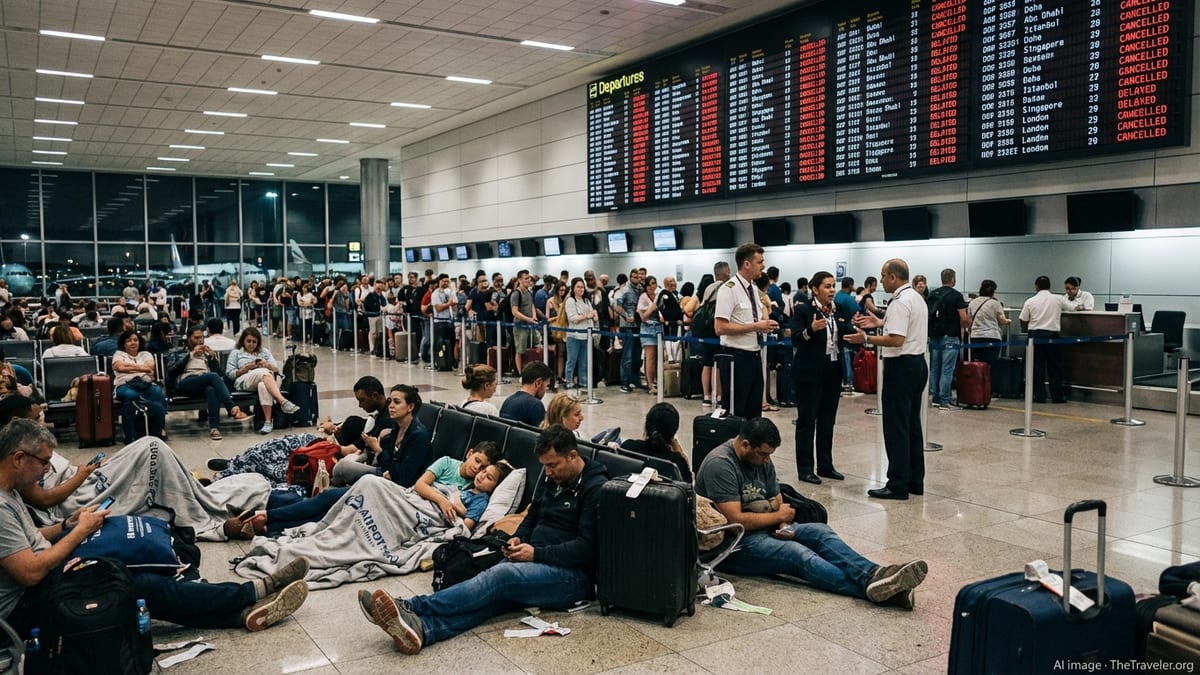
In Dubai, Abu Dhabi and Doha, images and witness accounts describe terminal floors crowded with travelers sleeping on luggage, families camped in corners of departure halls and queues stretching the length of concourses as passengers wait for information or rebooking. With nearby hotels quickly filling, airport seating and gate areas have become makeshift overnight shelters for those unable to secure accommodation.
The impact is equally visible thousands of miles away. In European and Asian hubs from London and Frankfurt to Mumbai and Singapore, departure boards showed long columns of canceled services to Gulf and Levant destinations. Some passengers only learned of the shutdown when they arrived at check in, while others found their aircraft turning back mid flight after airspace closures were extended while they were already in the air.
With aircraft and crew now badly out of position, carriers warn that schedules will remain unstable even after some airspace begins to reopen, as airlines work through backlogs and reposition planes and staff where they are needed.
Airlines Scramble to Reroute and Reassure
Major Middle Eastern carriers such as Emirates, Qatar Airways and Etihad have temporarily suspended most services through their hubs, issuing rolling operational updates and promising flexible rebooking policies once authorities permit more movements. International airlines including British Airways, Lufthansa, Air France and Air India have halted services into the region and are rerouting select long haul flights over alternative corridors to the north and south where possible.
For many airlines, alternative routings are constrained by capacity limits, overflight agreements and fuel considerations. Detours that avoid the Gulf, Iran and Iraq can add several hours to journeys between Europe and Asia or Australasia, significantly increasing fuel burn and disrupting tightly timed aircraft rotations. Some carriers have opted to cancel rather than reroute, particularly on overnight services where crew duty limits are harder to accommodate.
Airlines have urged passengers not to travel to the airport without confirmed rebookings and to monitor official channels for updates as call centers and digital platforms face heavy demand. Industry groups say they are coordinating with national regulators and air navigation authorities to establish safe corridors once the security situation allows, but caution that any reopening is likely to be gradual and subject to sudden reversals if the conflict escalates.
Behind the scenes, operational control centers are working around the clock to rebuild schedules, track aircraft stranded on the ground at closed airports and identify opportunities to operate one off recovery flights. Some carriers are positioning widebody aircraft to secondary airports outside the conflict zone in anticipation of eventual humanitarian and repatriation missions.
Governments Launch Evacuations and Issue Warnings
Governments whose citizens are trapped in the region have begun planning or activating large scale evacuation and assistance efforts. British officials are preparing what could be one of the country’s biggest peacetime airlifts to support tens of thousands of nationals, many of them tourists in the United Arab Emirates, who have found themselves unable to leave. Other European states, as well as Australia and Asian governments, are working with airlines to identify stranded citizens and secure seats on any available outbound flights.
Foreign ministries from North America, Europe and Asia have issued advisories against non essential travel to affected countries throughout the Gulf and wider Middle East, while embassies on the ground are urging residents and visitors to register their details, follow local security guidance and be prepared for rapidly changing conditions. Some diplomatic missions have reduced staffing levels or relocated personnel away from high risk areas, adding another layer of uncertainty for travelers seeking assistance.
Security agencies are also reviewing the risk profile of airports and aviation infrastructure in the region after missile and drone strikes near or on airport grounds. Operators have increased patrols, restricted non essential access to airside zones and stepped up inspection of terminal areas, even as regular passenger operations remain largely suspended. Officials emphasize that any phased reopening will depend not only on airspace decisions but also on confidence that ground facilities can be protected.
The cascading effects extend beyond passenger traffic to air cargo. Freight operators that rely on Gulf hubs for east west transfers are rerouting shipments or placing them on hold, raising concerns about delays to time sensitive goods and potential knock on effects for supply chains already under strain.
Travelers Face Uncertainty, Extra Costs and Long Detours
For individual travelers, the crisis has translated into a mix of confusion, financial stress and emotional strain. Tourists in resort destinations around the Gulf have seen vacations extended unexpectedly as outbound flights disappear from schedules. Business travelers have missed meetings and contract deadlines, while migrant workers on tightly scheduled leave face the prospect of overstaying visas or missing return dates for jobs in other countries.
Passengers report difficulty reaching airline hotlines and inconsistent information at airports, as ground staff struggle to keep pace with rapidly changing restrictions. Many are unsure whether to book alternative itineraries at their own expense, wait for official recovery flights or seek refunds that may take weeks to process. Travel insurers are still assessing how policies apply in what is clearly a conflict driven disruption, leaving some customers uncertain about the scope of their coverage.
Those who do manage to secure alternative routes often face lengthy itineraries involving multiple stops, overnight layovers and journeys that skirt around the entire Middle East. Flights between Europe and South or Southeast Asia that would normally pass over Iran or the Gulf are being sent over Central Asia, the Caucasus or Africa where possible, increasing journey times and further congesting already busy airspace.
With no clear timeline for the restoration of normal traffic flows, industry analysts warn that this sudden aviation shock could have lasting consequences, both for traveler confidence in using Gulf hubs as transit points and for airlines whose business models are built on seamless east west connectivity through the region.