

More news on this day
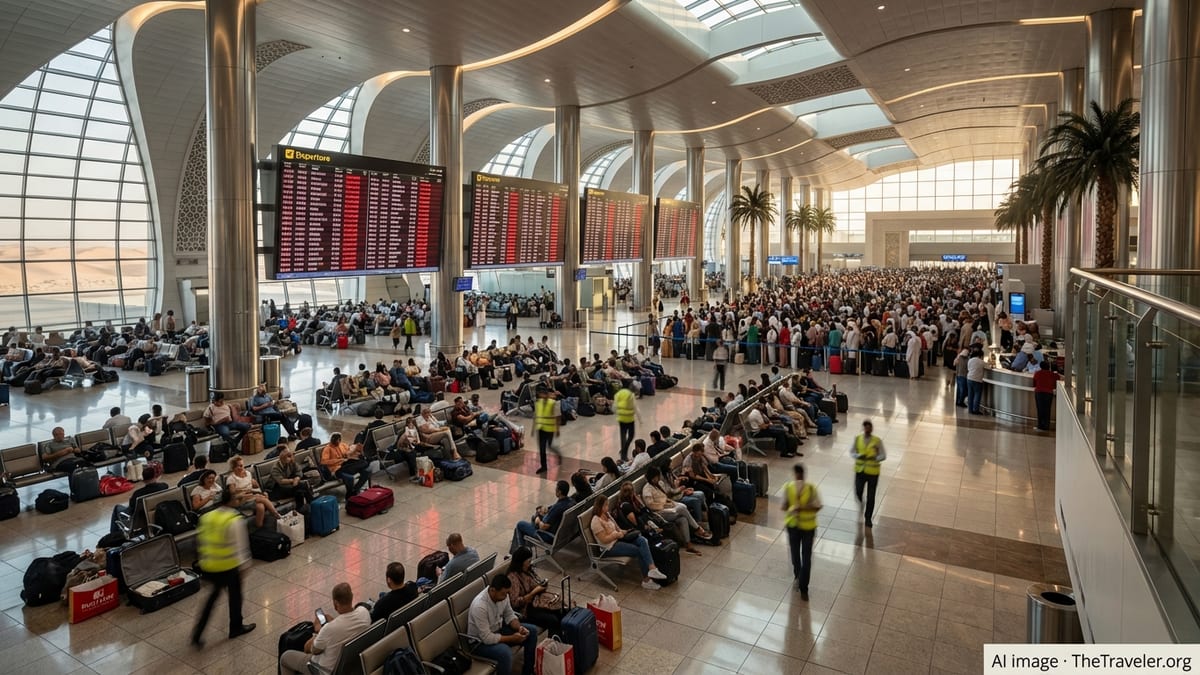
Thousands of passengers were left sleeping on terminal floors at Dubai International Airport on Sunday after a sweeping Middle East airspace shutdown triggered 1,121 flight cancellations and at least 117 delays, crippling services by Emirates, Flynas, Airblue, SpiceJet, Qatar Airways and other carriers amid escalating US-Israel tensions with Iran.
Regional Airspace Closures Paralyse Key Global Hubs
The mass disruption followed joint US and Israeli strikes on Iran on February 28, prompting Iran and several neighboring states to close their skies and triggering a cascade of suspensions at some of the world’s busiest transit hubs. Authorities in the United Arab Emirates, Qatar, Israel, Iran, Iraq, Kuwait, Bahrain and Syria closed or heavily restricted airspace, effectively shutting down the primary east west corridor linking Europe with Asia.
Dubai International, which normally handles more international passengers than any other airport, halted most departures and arrivals after the closures, while nearby Abu Dhabi also scaled back operations. In Qatar, Hamad International in Doha sharply reduced movements as Qatar Airways temporarily suspended flights to and from the capital following the shutdown of Qatari airspace.
Further afield, knock on effects were felt in Cairo and Tel Aviv, where schedules were repeatedly revised amid shifting security assessments and changing overflight permissions. Airlines rerouted aircraft over Saudi Arabia where possible, but capacity on alternative corridors was quickly saturated, adding hours to long haul journeys and forcing last minute diversions to secondary airports in Europe and the eastern Mediterranean.
Global flight tracking data showed more than a thousand cancellations concentrated across Dubai and Doha alone, with total worldwide delays running into the tens of thousands as crews, aircraft and passengers were left out of position. Industry analysts warned that timetable instability is likely to persist for days even if some airspace begins to reopen.
Passengers Stranded in Dubai as Emirates and Regional Carriers Freeze Operations
At Dubai International, the abrupt halt left thousands of travelers stranded in transit, many without guaranteed hotel rooms as nearby properties quickly filled. Long queues formed at transfer desks and ticket counters as Emirates and other carriers tried to rebook passengers or issue travel waivers, while airport staff distributed water, snacks and basic amenities in congested concourses.
Operational data compiled by aviation analysts indicated that Emirates alone accounted for nearly half of the disruptions at Dubai, with hundreds of cancellations as its long haul network through the Gulf hub ground to a near standstill. Low cost and regional operators including Flydubai, Saudia, Flynas, Air India Express, IndiGo and SpiceJet also slashed services, particularly on high density South Asia and Middle East routes.
Among foreign carriers using Dubai as a key gateway, Pakistan based Airblue reported disrupted rotations on routes linking the Gulf with Karachi, Lahore and Islamabad, while Indian budget airlines curtailed flights to cities such as Kochi, Thiruvananthapuram and Mumbai. The cancellations left migrant workers, tourists and business travelers alike scrambling for options, with some opting to return to city hotels and others remaining inside the terminals in hopes of securing early rebookings.
Airport authorities in Dubai said emergency plans were in effect, with additional ground staff deployed to manage crowds and assist vulnerable travelers. Medical teams were on standby as passengers endured lengthy waits, and security was visibly tightened around key infrastructure following reports of minor damage to one concourse and injuries to several staff members.
Doha, Cairo and Tel Aviv Feel the Shockwaves
In Doha, Qatar Airways moved from selective cancellations to a full suspension of flights to and from the Qatari capital once authorities ordered airspace closed for civilian traffic. Hamad International, normally a major connector for routes between Europe, Africa and Asia, saw departure boards dominated by red cancel notices as aircraft were held on the ground or diverted mid flight to alternative airports.
The disruption quickly spread to neighboring hubs. In Cairo, Egypt’s primary gateway, airlines operating eastbound services toward the Gulf and Iran revised or cancelled flights, citing uncertainty over available routings and crew duty times. Some northbound flights from African capitals were forced to terminate early in Cairo instead of continuing through to Gulf destinations, adding another layer of complexity for passengers already in transit.
In Tel Aviv, Ben Gurion Airport authorities intermittently paused operations as air defense alerts sounded and security assessments shifted. Several international airlines suspended services entirely pending clearer guidance, while Israel based carriers consolidated remaining flights to essential routes. Travelers bound for Tel Aviv from Europe reported unplanned diversions to Athens, Larnaca and Rome, followed by overnight hotel stays and uncertain onward connections.
Across the region, passengers described a patchwork of communication, with some airlines pushing app notifications and text messages about cancellations, while others were slower to update schedules. Travel agents and corporate travel departments fielded a surge in calls from stranded customers seeking alternative routes that avoided closed airspace.
Global Airlines Reroute Around a New Conflict Zone
The sudden loss of overflight rights across large swathes of the Middle East has forced airlines on Europe Asia and Europe Australia routes to draw up entirely new routing plans. Many carriers shifted to longer paths over Saudi Arabia, the Red Sea and parts of North Africa, adding significant flying time and fuel burn to sectors that were already operating close to operational limits.
Major European and Asian airlines, including full service and low cost operators, announced temporary suspensions of services to Dubai, Doha and Tel Aviv, while maintaining some flights to secondary regional airports that could still be reached without entering closed airspace. Long haul services from cities such as London, Frankfurt, Paris, New Delhi and Singapore were among those most affected, given their heavy reliance on Gulf hubs for connections.
Industry experts noted that the aviation system is particularly vulnerable when high density airspace around central hubs is suddenly removed. Aircraft and crew scheduling software is not designed for such rapid, wide ranging changes, leading to rolling disruptions as equipment and staff become misaligned with published timetables. Even airlines not serving the Gulf directly have been hit by congestion and rerouting on alternative corridors, compounding global delays.
Logistical pressures are also mounting for cargo operators that normally use Dubai and Doha as key transshipment points. Freight forwarders reported delays for time sensitive shipments, with some consignments diverted to airports in Turkey and southern Europe to avoid the conflict zone, often at higher cost and with longer transit times.
Uncertain Timeline and Rising Costs for Travelers
Officials and airline executives said it was too early on Sunday to predict when normal operations might resume, as governments and military planners weigh security risks against the economic fallout of prolonged closures. While there is cautious optimism that some restricted corridors could reopen in stages, carriers are planning for several days of disruption and are advising customers to defer non essential travel to the region.
For passengers, the chaos is translating into mounting costs and logistical headaches. Those stranded in Dubai, Doha, Cairo and Tel Aviv are facing additional hotel nights, visa complications in some jurisdictions and challenges rebooking during peak demand periods. Travel insurers are receiving a wave of claims, though coverage varies depending on policy language around war and geopolitical events.
Analysts warn that the shutdown is likely to push fares higher on remaining routes as capacity tightens and airlines seek to recover increased fuel and operational expenses associated with longer detours. Corporate travel managers are reassessing routing policies for staff, and some multinational companies have temporarily suspended non critical trips to and through the Gulf until the security situation stabilizes.
For now, airlines are prioritizing communication efforts, urging customers to check their flight status frequently, use official apps and contact centers, and expect significant waiting times. With key hubs in Dubai and Doha operating at a fraction of their usual capacity, the region that once epitomized seamless global connectivity has become the epicenter of aviation uncertainty.