

More news on this day
Thousands of travelers across the Middle East and beyond remain stranded today as partial airspace closures in the United Arab Emirates, Israel, Bahrain, Qatar and other Gulf states delay at least 77 flights and cancel more than 1,400 services, disrupting operations at major hubs including Dubai International and Doha’s Hamad International Airport.
Regional Conflict Triggers Sudden Aviation Shutdown
The latest wave of disruption follows a sharp escalation in the conflict involving the United States, Israel and Iran, which prompted rapid airspace restrictions across much of the Gulf. Authorities in Bahrain, Israel, Qatar and the UAE moved to close or severely limit their skies for commercial traffic, forcing airlines to ground aircraft or divert routes at short notice as safety concerns mounted.
Key transit hubs such as Dubai International, Abu Dhabi’s Zayed International, Sharjah and Doha’s Hamad International have borne the brunt of the closures. Aviation analytics and flight-tracking data indicate that more than 2,000 flights to and from seven major Gulf airports were cancelled in just 24 hours at the start of the crisis, with cumulative cancellations now running into the thousands as the shutdown drags on.
While some military and emergency operations were prioritized, commercial schedules rapidly unraveled. By early Tuesday, industry data collated from regional authorities and tracking platforms pointed to at least 77 flights officially delayed and around 1,402 cancelled across impacted Middle Eastern markets, with further disruption likely as carriers reassess safety and routing options.
Analysts describe the shock to global aviation as the most severe since the height of the Covid-19 pandemic, noting that the Middle East’s role as a bridge between Europe, Asia, Africa and Oceania means any prolonged closure in the Gulf quickly reverberates around the world.
Major Gulf Carriers Forced to Ground and Reroute
Flag carriers at the heart of the region’s hub-and-spoke model have been among the hardest hit. Emirates, based at Dubai International, temporarily suspended all operations to and from its main hub as airspace restrictions tightened, with only a limited number of repositioning and special services permitted as authorities reviewed the security picture.
In Abu Dhabi, Etihad Airways has focused on select repatriation, cargo and repositioning flights while keeping the bulk of its commercial network grounded. The airline continues to coordinate closely with UAE regulators, offering free rebooking to affected passengers with tickets issued before the latest escalation and advising customers not to travel to the airport unless directly contacted.
Qatar Airways, operating from Doha’s Hamad International Airport, extended a temporary suspension of flights in and out of the Qatari capital, stating that regular services will resume only once the national aviation authority declares the airspace safe to reopen. With all aircraft movements at Hamad halted, the airline has been unable to accommodate the thousands of transit passengers who would typically flow through its network each day.
Other regional operators, including Bahrain’s Gulf Air and low-cost carriers such as Flydubai, have also curtailed or suspended services on multiple routes, particularly those crossing closed or restricted airspace. International airlines from Europe, Asia and North America have joined the exodus, cancelling flights to destinations including Dubai, Doha, Tel Aviv, Bahrain and key cities in Saudi Arabia while they explore longer and more costly alternate routings.
Hubs in Dubai and Doha Turn Into Makeshift Waiting Rooms
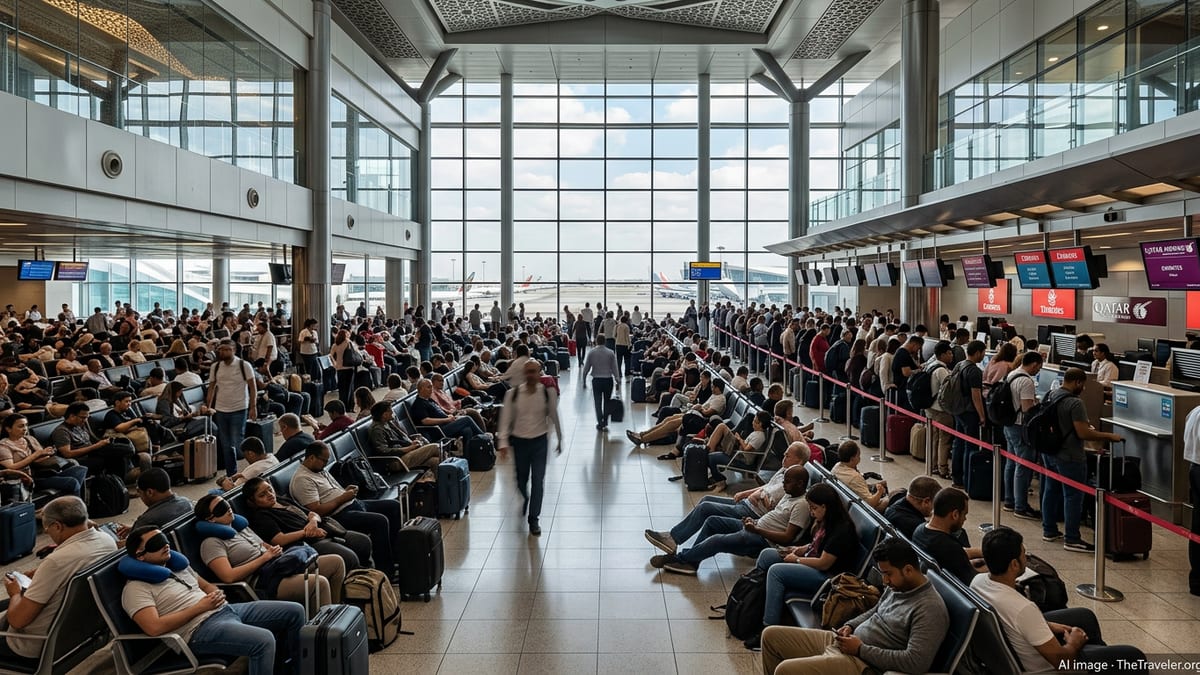
With normal operations suspended, terminal buildings at Dubai and Doha have effectively turned into vast waiting rooms. Social media posts and eyewitness accounts describe long queues at transfer desks, crowded seating areas and passengers attempting to sleep on the floor as they wait for news of rescheduled flights or emergency departures.
At Hamad International, Qatari officials have acknowledged that thousands of transit passengers are stranded in the country. Many had been en route between Europe and Asia or Africa and the Americas when their connecting flights were cancelled, leaving them stuck in the terminal with limited options to continue their journeys.
In Dubai, travellers reported confusion as the situation evolved from temporary delays to blanket suspensions. Airport authorities have urged passengers not to travel to the terminals unless they have received confirmation that their flight is operating, in an effort to prevent further overcrowding and to prioritize those already in the system.
Across the wider region, scenes of stranded passengers have been repeated from Beirut and Kuwait City to major European and Asian gateways where flights to the Gulf were abruptly pulled from departure boards. Travel agents and airline call centres are facing overwhelming volumes of requests for refunds, rebookings and welfare assistance.
Knock-On Effects for Global Travel and Tourism
The grounding of flights through Dubai, Abu Dhabi, Doha and Bahrain is rippling far beyond the Middle East. These hubs are central to long-haul travel between continents, meaning their sudden effective closure has severed key connections for business travellers, tourists and migrant workers alike. Airlines that relied on overflying Gulf airspace have been forced to adopt longer detours, adding hours to journey times and driving up fuel costs.
Tourism-dependent economies that count on Gulf carriers to deliver high-spending visitors are already feeling the impact. Destinations in Southeast Asia, the Indian Ocean and southern Europe are reporting a spike in no-shows and last-minute cancellations as travellers abandon or postpone trips that depended on connections through the Middle East.
Industry experts warn that even a brief closure can take days, if not weeks, to unwind. Aircraft and crew are scattered away from their usual bases, schedules require complete rewrites and airport slots must be renegotiated once airspace reopens. For now, most carriers are offering flexible rebooking policies and travel waivers, but with little clarity on when full schedules can safely resume.
Insurance providers and regulators are also under pressure, as many passengers discover that conflict-related disruptions often fall outside standard compensation regimes. Consumer advocates are urging affected travellers to document expenses carefully, stay in close contact with airlines or travel agents and avoid cancelling tickets unilaterally, which could jeopardize eligibility for refunds or alternative travel arrangements.
Limited Departures Offer Glimmers of Hope
Despite the scale of the disruption, a small number of flights have begun to depart from some Gulf hubs, offering a tentative sign that evacuation and relief efforts are gathering pace. Etihad and Emirates have operated select services from the UAE, primarily focused on clearing backlogs of stranded passengers and repositioning aircraft to less affected airports.
Travel consultants say these initial departures are being tightly managed, with priority given to passengers whose trips were interrupted mid-journey and those facing urgent personal or medical needs. Governments in Europe, Asia and Oceania are also coordinating with regional carriers to organize special flights for their nationals, although capacity remains far short of demand.
For now, aviation authorities caution that the situation remains highly fluid. Further delays and cancellations are expected as the security environment evolves and as airlines decide whether revised routings are economically and operationally viable. Travellers with upcoming itineraries involving Dubai, Doha, Abu Dhabi, Bahrain or Israel are being urged to monitor airline communications closely and to consider alternative routes through unaffected hubs where possible.
With more than 1,400 flights already cancelled and dozens more delayed across the Gulf region, the coming days will determine whether this remains a short, sharp shock to the global travel system or develops into a prolonged crisis for airlines and passengers alike.