

More news on this day
Israel has joined Syria, Qatar, Iran, Iraq, Kuwait and Bahrain in closing or severely restricting its airspace after US-Israeli strikes on Iran, triggering mass flight cancellations and leaving thousands of UK holidaymakers and business travellers stranded across the Middle East and beyond.
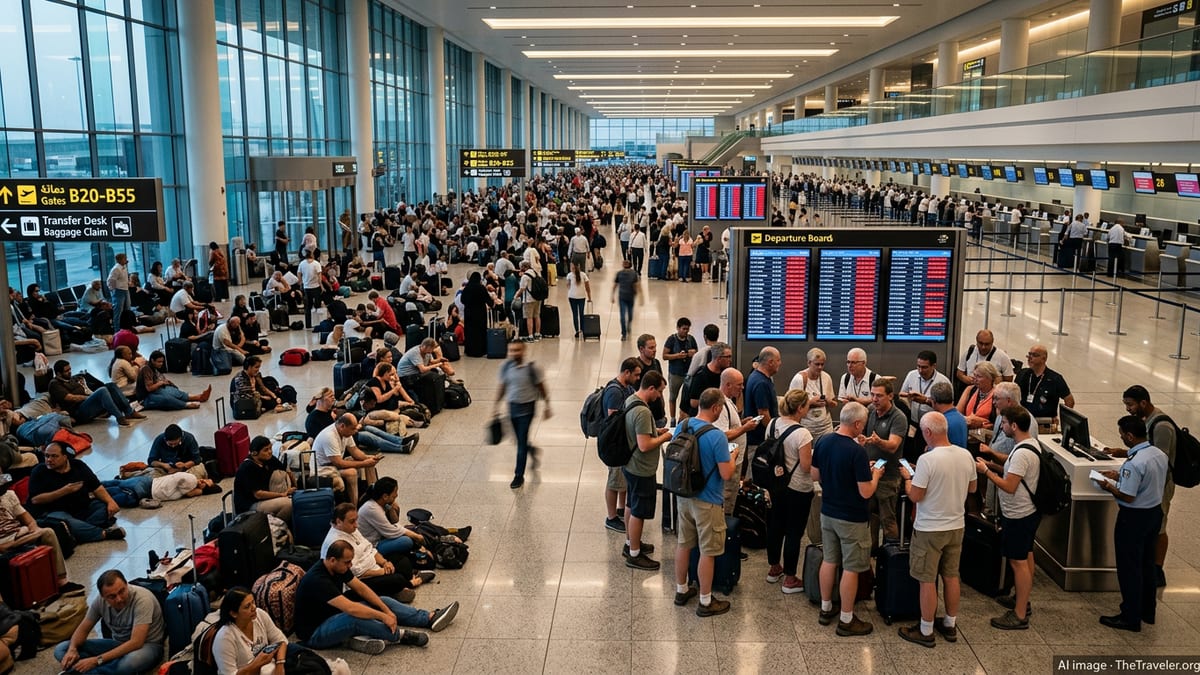
Escalating Conflict Triggers Regional Airspace Closures
The rapidly widening confrontation, which began with coordinated US-Israeli strikes on Iranian targets late last week, has prompted an unprecedented wave of airspace shutdowns across the Middle East. Aviation authorities in Iran, Iraq, Israel, Syria, Qatar, Kuwait and Bahrain have all announced complete or near-complete closures, citing security risks from missiles and drones transiting the region’s busy skies.
Analysts say the scale of disruption now rivals the immediate aftermath of the September 11 attacks and the early days of the Covid pandemic. Flight-tracking data shows skies over large swathes of the Gulf and Levant effectively emptied over the weekend, with commercial aircraft diverted around the conflict zone or cancelled outright. Partial restrictions in the United Arab Emirates and Saudi Arabia, along with route adjustments by airlines worldwide, have added further strain to global networks.
Officials in several Gulf states reported missile and drone interceptions near major urban centres, including areas close to key aviation hubs. In Qatar and Kuwait, authorities confirmed that shrapnel and debris had fallen near critical infrastructure, prompting strict safety protocols that left runways silent and terminals crowded with stranded passengers.
Israel’s government ordered its airspace closed as part of a wider emergency posture, grounding domestic operations and stopping international arrivals and departures. National carrier El Al has cancelled multiple services while preparing recovery flights to repatriate citizens if conditions permit later this week.
UK Travellers Caught in “Worst Chaos Since Covid”
The shutdowns have dealt a particularly heavy blow to British travellers, who rely on Middle Eastern hubs for both holidays in the Gulf and long-haul connections to Asia, Australasia and Africa. Travel industry insiders describe the situation as the worst bout of air travel chaos since pandemic-era border closures, with thousands of UK citizens stuck in airports from Dubai and Doha to Bangkok and Singapore as onward connections collapse.
British Airways has suspended flights to Tel Aviv and Bahrain until at least early March and warned that services to Abu Dhabi, Doha and Dubai are subject to late-notice cancellation. Passengers with bookings over the coming fortnight have been offered the option to rebook or seek refunds, but many already overseas are struggling to secure seats on the limited flights still operating around the region.
Other European carriers heavily used by British customers, including Lufthansa Group airlines, KLM and Air France, have halted services to key Middle Eastern destinations and are rerouting long-haul routes away from closed airspace. Low-cost and leisure airlines that funnel UK holidaymakers into the Gulf and Red Sea resorts have also suspended numerous rotations, placing additional pressure on alternative routes via Turkey, Egypt and southern Europe.
Consumer advocates in the UK note that, while passengers are unlikely to qualify for statutory compensation because the disruption is caused by an external security crisis, airlines still owe travellers duty of care. That includes providing accommodation, meals and rebooking where possible, though the sheer volume of cancellations means many stranded Britons are relying on travel insurance or personal funds to tide them over.
Global Flight Networks Upended as Carriers Skirt Conflict Zone
The Middle East has long served as a crucial crossroads for global aviation, with hubs in the Gulf connecting Europe and the UK to Asia, Africa and Australasia. With Iran, Iraq, Israel, Qatar, Kuwait, Bahrain and Syria off-limits, and airspace in neighbouring states constrained, airlines are now relying on narrow corridors over the eastern Mediterranean, the Caucasus and parts of North Africa to keep long-haul services running.
Industry experts warn that these detours add significant time and fuel costs to many routes, forcing some carriers to schedule technical stops in Europe or Central Asia that were previously non-stop services. Longer flight times are reverberating through timetables, leading to missed connections and tight crew-rostering challenges, which in turn generate further cancellations far from the conflict zone.
For UK travellers, the impact is being felt not only on direct or connecting flights to the Middle East but also on journeys to India, Southeast Asia and Australia. Routes that typically pass over Iran or Iraq are being reconfigured overnight, sometimes leaving passengers informed of major schedule changes only hours before departure. Travel agents in London, Manchester and Birmingham report being inundated with calls from customers seeking alternative routings or clarity on whether their holidays can go ahead.
Budget-conscious travellers, who often piece together complex itineraries across multiple airlines, are among the worst affected. Where carriers are waiving change fees on their own tickets, passengers may still face penalties or non-refundable segments on separate bookings, prompting calls from consumer groups for airlines and online travel agents to adopt more flexible policies during the crisis.
Limited Evacuation Flights Offer Lifeline from Gulf Hubs
Despite widespread closures, a trickle of special services is beginning to move stranded travellers out of the region. In the United Arab Emirates, where Dubai and Abu Dhabi briefly halted all movements before allowing tightly controlled operations, flagship carriers have started operating select departures to major European capitals, including London, under enhanced security coordination.
One Etihad Airways service from Abu Dhabi to London successfully carried a mix of British tourists, business travellers and expatriate workers on Monday, after the airline secured clearance to operate via adjusted flight paths. Emirates and FlyDubai are similarly mounting limited flights, though seats are scarce and prioritised for those with urgent medical or humanitarian needs, or whose original journeys were cancelled at short notice.
Tour operators with large UK customer bases in the Gulf, Red Sea and Indian Ocean are negotiating with airlines and local authorities for additional evacuation capacity. However, with multiple states maintaining firm airspace closures and warning that further missile exchanges remain possible, aviation regulators are resisting pressure to reopen skies until risk levels fall significantly.
Travel advisers are urging Britons currently in affected countries to register with the UK government’s foreign travel service, maintain close contact with airlines and tour companies, and avoid making speculative onward bookings until clearer guidance emerges. In many destinations, hotels are extending stays at discounted rates, but availability is tightening as fresh arrivals from unaffected regions add to the pressure.
What UK Travellers Need to Know Now
For those yet to travel, the message from airlines and tour operators is to check booking portals and email communications regularly, as schedules are being updated on an hour-by-hour basis. Many carriers have introduced flexible policies allowing free date or destination changes for customers due to travel to or via the Middle East in the coming days.
Travel lawyers caution that, although the extraordinary circumstances limit compensation rights, passengers are still entitled to clear information and prompt refunds where flights are cancelled outright. They advise UK travellers to keep detailed records of receipts and communications, which may support claims under travel insurance policies once they return home.
Meanwhile, aviation authorities and security experts continue to monitor the evolving situation. A phased reopening of some airspace is possible if tensions ease and the risk to civilian aircraft diminishes, but industry insiders warn that a full return to pre-crisis routings could take weeks. Until then, UK travellers should brace for longer journeys, packed rebooked flights and a level of uncertainty not seen in global air travel for several years.
With core Middle Eastern hubs partially offline and frontline states such as Israel, Qatar, Iran, Iraq, Kuwait, Bahrain and Syria keeping skies largely closed, the ripple effects on the UK’s holiday and business travel market are likely to be profound. For now, patience, flexibility and meticulous pre-departure checks are the watchwords for anyone planning to fly.