

More news on this day
Airspace closures across parts of the Middle East, triggered by the escalating war involving Iran, the United States and Israel, have plunged global aviation into turmoil, leaving thousands of travellers stranded as airlines race to reroute or cancel flights across key intercontinental corridors.
Get the latest news straight to your inbox!
Airspace Closures Create a Patchwork of No-Fly Zones
Since the joint United States and Israeli strikes on Iran at the end of February 2026, a series of rapid airspace closures has transformed the Middle East’s skies into a complex patchwork of no-fly zones and heavily restricted corridors. Publicly available flight data and aviation notices indicate that Iran, Iraq and Israel moved early to shut or severely limit their skies, with Qatar, Kuwait, Bahrain and Jordan also imposing sweeping restrictions as missile and drone attacks intensified.
Reports from regional outlets describe state aviation authorities issuing notices to air missions that effectively halt most commercial overflights in the Gulf and Levant. In several cases, authorities have not declared an indefinite ban, but short-term rolling closures and tight risk thresholds have left airlines treating the skies as closed for practical planning purposes. These decisions are being driven by the risk of long-range strikes, debris hazards and the need to keep military corridors clear.
Airports that normally act as major transit hubs have been hit particularly hard. Doha’s Hamad International, Dubai International and Abu Dhabi International have all experienced significant operational disruptions, from temporary ground stops to damage from nearby strikes and air defence activity. While some facilities have reopened for limited movements, carriers remain highly cautious about sending aircraft and crew into what many risk advisories now classify as conflict-zone airspace.
The result is a rapidly shifting map in which some countries maintain partially open airports but are surrounded by closed or high-risk neighbouring airspace. That makes consistent scheduling extremely difficult and forces airlines to make day-by-day judgments about whether individual routes can be flown safely.
Thousands Stranded as Cancellations Ripple Worldwide
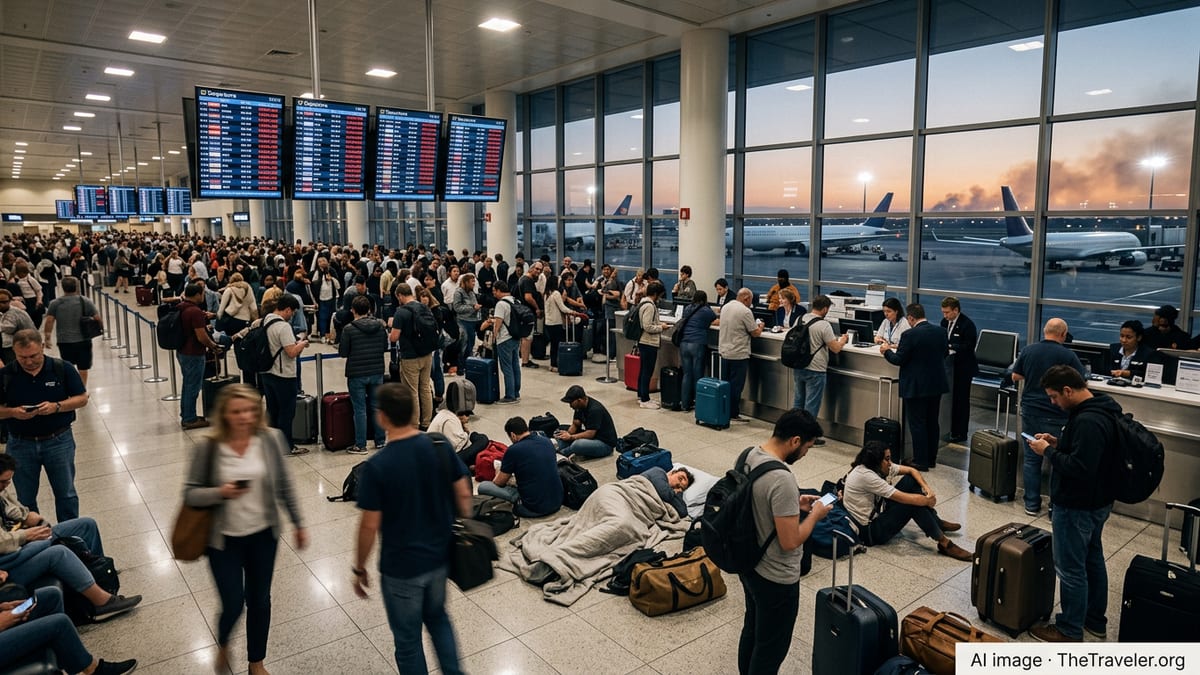
The immediate human impact is visible in airports from the Gulf to Europe and Asia, where travellers have found themselves unexpectedly grounded. Published coverage from regional news organisations and travel advisories describes passengers sleeping on terminal floors in Doha, Dubai and Amman after last-minute cancellations severed onward connections to Africa, Asia, Europe and the Americas.
Data from aviation analytics firms cited in recent media reports points to thousands of flights cancelled or heavily delayed since the first wave of strikes. On the opening weekend of the conflict, roughly a quarter of all flights touching the Middle East were reportedly cancelled, with long-haul sectors particularly affected. As the fighting has spread to targets in Lebanon, Saudi Arabia and the wider Gulf, further waves of disruption have followed, leaving many passengers with rebookings several days or more into the future.
Evacuation efforts layered on top of commercial disruption are intensifying the pressure. European governments, including France, have accelerated organised departures for their nationals from Lebanon and other affected states, chartering aircraft and buying blocks of seats on remaining services. Travel industry groups in Southern Europe warn that the wider war, combined with airspace closures, is already triggering mass cancellations of spring and summer trips to the broader region, compounding the chaos for airlines and tour operators.
On social platforms and travel forums, individual accounts describe missed connections, unexpected diversions and itineraries stretching from a few hours into multi-day odysseys. Some long-haul passengers report being rerouted via secondary hubs in Central Asia, North Africa or Southern Europe to bypass the block of closed skies between Europe and South or Southeast Asia.
Global Flight Paths Redrawn as Airlines Skirt the Conflict
With large portions of Middle Eastern airspace now off-limits, airlines are redrawing long-established routes that linked Europe and North America with Asia, Africa and Australasia. Publicly accessible flight-tracking maps show wide detours that arc north across Turkey, the Caucasus and Central Asia, or south over the Red Sea and East Africa, to avoid Iranian, Iraqi, Israeli and Gulf airspace.
These longer routes add hours of flying time on some intercontinental journeys, increasing fuel burn and crew duty times. Aviation analysts note that carriers which already contended with Russian airspace restrictions after the invasion of Ukraine now face a second major geographic bottleneck. For certain city pairs, especially between Western Europe and India or Southeast Asia, there are few efficient paths that do not cross either Russian or Middle Eastern conflict zones, forcing difficult operational and commercial choices.
Some Asian and European airlines have temporarily suspended services to the Gulf altogether, focusing instead on routes that can bypass the region. Others are adopting a hub-bypass strategy, strengthening direct links that avoid traditional stopovers in Doha, Dubai or Abu Dhabi. Low-cost carriers with thinner margins are particularly exposed, as added distance and fuel costs rapidly erode profitability on routes that were viable only via the shortest Gulf corridors.
The rerouting is also affecting cargo flows. Freighter operators and bellyhold cargo on passenger jets are facing the same detours, driving up costs and slowing the movement of time-sensitive goods between Asia, Europe and Africa. Logistics firms warn that if the closures persist, supply chains for high-value products ranging from electronics to pharmaceuticals could experience sustained delays and higher freight rates.
What Travellers Need to Know Right Now
For travellers with existing bookings, publicly available airline statements and travel advisories emphasise one message above all: do not assume your flight is operating simply because a ticket exists. Many carriers are making rolling schedule adjustments, sometimes with only a few hours’ notice, as new airspace restrictions, military developments or risk assessments emerge. Passengers are being urged to check their booking status repeatedly in the 24 to 48 hours before departure using official airline apps and channels.
Most major airlines are offering some combination of fee-free rebooking, route changes or vouchers for trips touching affected countries or overflying the region. However, high demand on remaining safe corridors means that seats can be scarce, especially in peak travel periods and on routes between Europe and Asia. Travellers may find that the quickest way home involves accepting a significantly longer routing via an unexpected hub, or even splitting the journey across carriers.
Travel insurance conditions vary, and consumer organisations advise reading policy wording carefully. Some policies treat war-related disruption and government-ordered airspace closures as excluded events, limiting reimbursement for additional hotel nights or alternative transport. Others provide limited coverage for travel delays or missed connections even in conflict scenarios. Passengers are encouraged to document all expenses and communications with airlines to support any later claims.
Experts in travel risk management also suggest that anyone currently in or near the affected region keep a “Plan B” in mind, such as alternate departure cities reachable by land or sea if a primary airport shuts unexpectedly. At the same time, travellers are urged to prioritise personal safety over speed of departure, avoiding border areas, military facilities and large crowds inside terminals where tensions may be heightened.
Outlook: How Long Could the Aviation Turbulence Last?
The duration of the current aviation upheaval hinges on the trajectory of the conflict and the perceived risk to civilian aircraft. Historical precedents, such as earlier Gulf wars and other regional crises, show that partial normalisation of flight patterns can begin within weeks once hostilities ease and risk advisories are downgraded. However, analysts note that the 2026 Iran war is already having broader knock-on effects than many previous episodes, given simultaneous constraints over Russia and ongoing tensions in adjacent regions.
Industry forecasts referenced in recent economic analyses suggest that even if some airspace reopens in the coming weeks, cautious risk assessments by airlines, insurers and regulators could keep key routes closed or heavily restricted for much longer. That would lock in higher operating costs on many intercontinental services, with potential fare increases for passengers and reduced capacity on some of the world’s busiest long-haul corridors.
Tourism-dependent economies across the Mediterranean and Gulf are bracing for a difficult year. Early modelling by travel and hospitality associations in Europe points to billions in potential lost revenue if the war and airspace restrictions extend into the peak summer season, as travellers pivot to destinations perceived as safer or more reliably accessible. Cruise operators, tour companies and hotel chains tied to Middle Eastern and Eastern Mediterranean itineraries are already revising forecasts and contingency plans.
For now, the only certainty for travellers is continued uncertainty. As airspace notices, risk bulletins and airline schedules shift day by day, flexibility and vigilance have become essential tools for anyone planning to fly across or near the Middle East. Until the conflict de-escalates and the region’s skies reopen in a predictable way, global aviation is likely to remain in a state of rolling turbulence.