

More news on this day
Thousands of South African travelers face days of uncertainty after sweeping Gulf airspace closures forced Emirates and Qatar Airways to halt most services through Dubai and Doha, severing a major corridor between southern Africa, Europe, Asia and North America.
Get the latest news straight to your inbox!
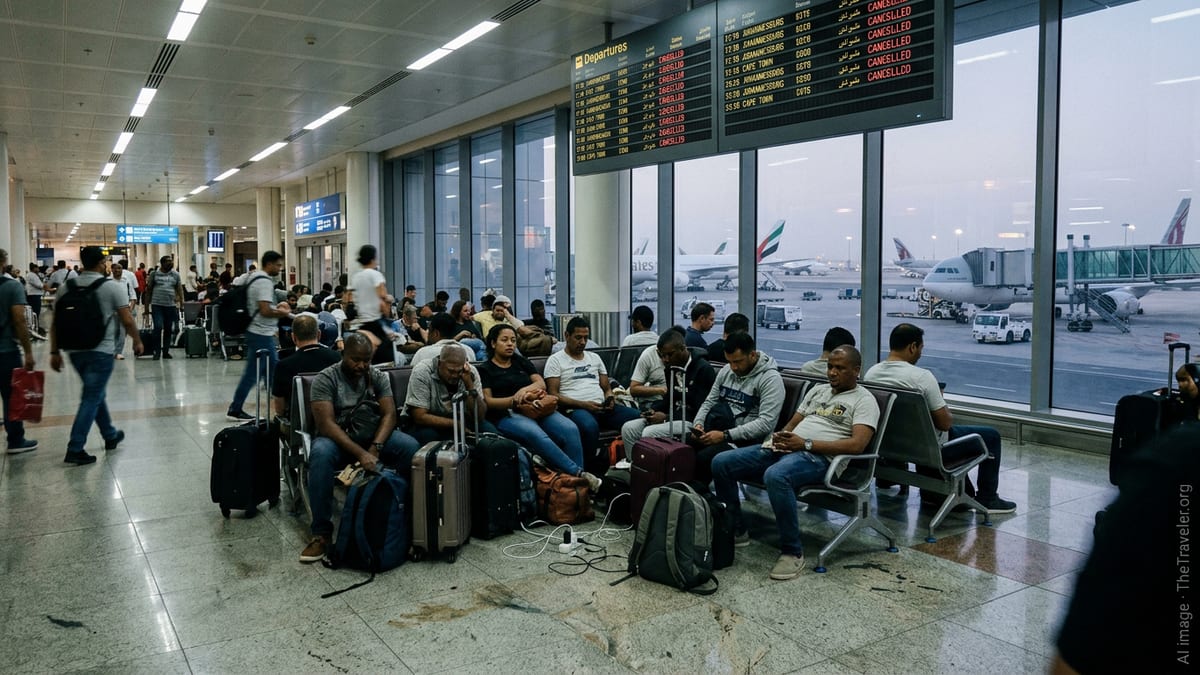
Gulf Airspace Closures Ripple Through Global Routes
The latest phase of the Iran war, including missile and drone attacks across the Gulf, has prompted authorities in the United Arab Emirates, Qatar, Kuwait and several neighboring states to restrict or close large portions of their airspace. Publicly available advisories indicate that from 28 February 2026, air traffic in and out of key hubs such as Dubai International Airport and Hamad International Airport plunged as airlines grounded or diverted flights for safety reasons.
Travel risk bulletins and industry notices state that by 2 March, airspace across much of the UAE was effectively shut for regular commercial traffic, with similar measures in Qatar after strikes and interception activity near major airports. Airlines were forced to suspend or sharply curtail operations, with thousands of flights cancelled or rerouted around the Gulf, lengthening flight times and reducing capacity on already busy intercontinental corridors.
For South African travelers, the timing is particularly disruptive. Emirates and Qatar Airways have become dominant players on routes linking Johannesburg, Cape Town and Durban with Europe and Asia via Dubai and Doha. When those hubs are compromised, large numbers of passengers who rely on one-stop connections through the Gulf suddenly lose their primary path in and out of the country.
Emirates and Qatar Airways Cut Schedules, Prioritize Relief Flights
Network updates from travel management firms and airline communiqués show that Emirates temporarily suspended all operations to and from Dubai at the height of the closures, before tentatively restarting a reduced schedule on select routes. Even after that partial restart, the carrier has been operating far below normal capacity, with many aircraft grounded and long-haul schedules rebuilt day by day.
Qatar Airways, facing a full closure of Qatari airspace after missile activity around Doha, initially halted almost all passenger flights. Published advisories describe a gradual shift toward limited relief and repatriation services, with special flights operating under tightly controlled corridors to major European hubs and a handful of other destinations. These flights have been pre-allocated to stranded travelers deemed most vulnerable, leaving many others on long waiting lists.
Both airlines continue to emphasize safety and compliance with airspace restrictions. However, their constrained fleets and routing options mean that regular commercial schedules between South Africa and the Gulf remain heavily disrupted. South African passengers transiting via Dubai or Doha are among the most affected, as many had onward connections to Europe, North America, the Middle East or Asia that have been cancelled or indefinitely postponed.
South African Passengers Stranded in Dubai, Doha and Beyond
Accounts shared through social media, travel forums and local media coverage describe South African nationals stuck not only in Dubai and Doha but also in secondary locations where flights were diverted as airspace closures spread. Some travelers report being rerouted to Muscat, Abu Dhabi or airports further afield, only to find onward services fully booked or cancelled as the disruption cascaded through airline networks.
Reports indicate that crowds have built up in terminals across the region, with passengers queuing for hours at transfer desks hoping to be rebooked. In some cases, airport access has been restricted to travelers holding confirmed bookings on flights that are still operating, limiting the ability of stranded passengers to move freely or seek assistance in person.
For many South Africans, the financial and emotional toll is mounting. Extended hotel stays, repeated last minute changes and the need to buy expensive alternative tickets on carriers outside the Gulf have strained budgets. Business travelers have missed critical meetings, while holidaymakers and migrant workers face delays returning home, creating knock-on effects for families and employers in South Africa.
What Travelers Must Know Right Now
Publicly available flight notices and regional security advisories suggest that the situation remains fluid, with airspace restrictions subject to sudden changes based on military activity and risk assessments. Travelers with upcoming journeys touching the Middle East in the next days should not assume that previously scheduled flights will operate as normal, even if tickets remain “confirmed” in airline booking systems.
South African passengers are being urged by airlines, travel agents and corporate travel managers to monitor their booking status several times a day and to enable app notifications, email and SMS alerts. Rebooking queues are long, and many carriers are prioritizing customers who are already stranded over those whose trips are still in the future. Flexibility on dates, times and even destinations is increasingly important, as airlines may offer seats to alternate hubs such as Nairobi, Addis Ababa or European gateways instead of Dubai or Doha.
Travel insurance conditions are also critical. Policy documents differ on how they treat war, civil unrest and government-imposed airspace closures. Some comprehensive plans include trip interruption and additional accommodation benefits triggered by such events, while others classify them as excluded causes. Passengers who purchased insurance should review coverage terms carefully and start documenting all expenses, communications and receipts in case a claim becomes possible later.
How to Survive the Chaos and Plan an Exit Strategy
For South African travelers already stranded in the Gulf or at diversion points, the immediate priority is to establish reliable lines of communication and a realistic time horizon. Public guidance from travel risk consultants stresses the importance of registering current contact details in airline booking profiles, confirming that the correct passport number and mobile phone are on file, and checking whether the embassy or consulate offers voluntary registration for citizens caught in disruptions.
Where practical, travelers are encouraged in published advisories to explore routings that bypass the Gulf entirely. That can mean asking airlines or travel agents about rebooking via African or European hubs on alternative carriers, even if it involves multiple stops and longer travel times. Some South African passengers have reportedly secured seats via Addis Ababa, Nairobi, Dar es Salaam or European capitals, trading convenience for a viable path home.
On the ground, experts quoted in open-source travel security bulletins recommend maintaining a conservative approach to personal safety around crowded terminals and transport hubs. Keeping copies of identification documents, storing emergency funds in multiple forms, and having a backup plan for accommodation if airline-provided hotels are unavailable can help reduce stress. Staying informed through reputable news outlets, airline channels and official travel advisories is essential, as rumors circulating on social media often outpace confirmed developments.
While no clear timeline has emerged for a full reopening of Gulf airspace, incremental steps such as partial relief flights and limited safe corridors suggest that airlines are preparing for a phased recovery rather than an immediate return to normal. For South African travelers, the most practical strategy is to assume continued volatility, keep plans flexible, and use every available channel to secure alternative routes while closely tracking the fast-changing situation.