

More news on this day
Global air travel was thrown into turmoil this weekend as sweeping airspace closures across the Middle East, triggered by US and Israeli strikes on Iran and subsequent retaliation, forced airlines to cancel or reroute thousands of flights, stranding hundreds of thousands of passengers and choking one of the world’s busiest aviation corridors.
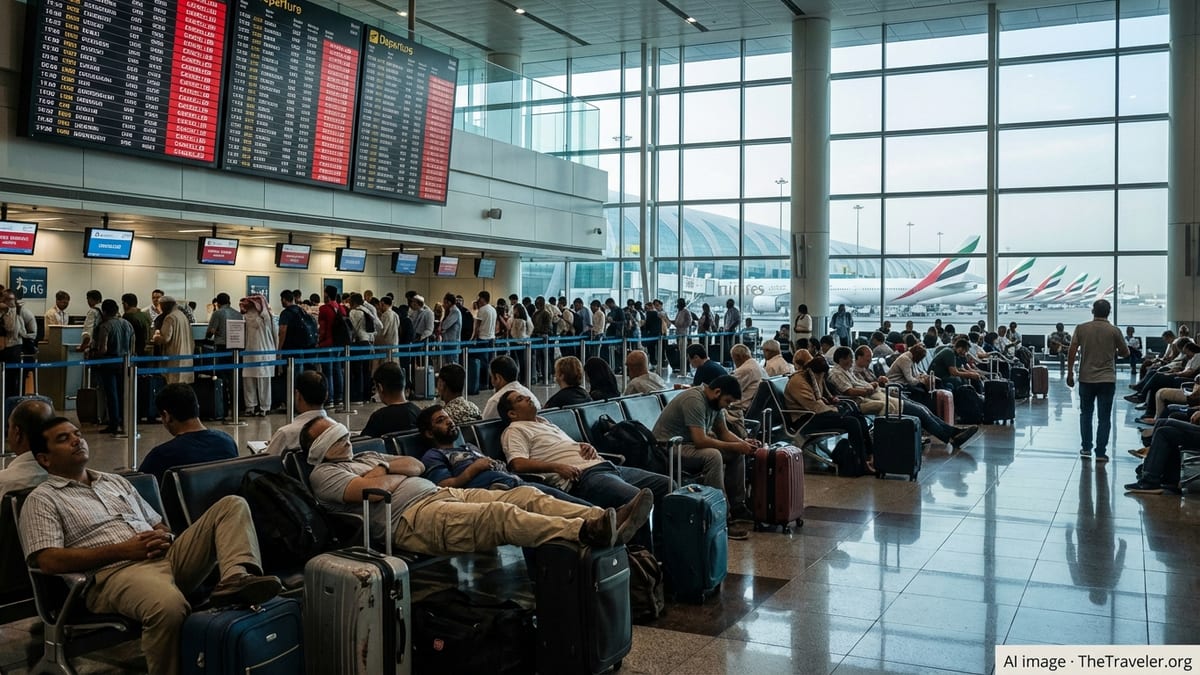
Key Gulf Hubs Go Dark as Skies Close
The crisis escalated after Iran, Israel, Iraq, Qatar, Kuwait, Bahrain, the United Arab Emirates and several other states either fully or partially shut their skies to civilian aircraft, citing acute security risks amid the spiralling confrontation. Live air-traffic maps showed vast stretches of normally dense airspace over the Gulf and Levant almost completely empty, an unprecedented silence in a region that connects Europe, Asia and Africa.
Dubai International, Abu Dhabi’s Zayed International and Doha’s Hamad International Airport, three of the world’s most important long-haul transfer hubs, were either closed outright or operating under severe restrictions. The shutdowns followed US-Israeli strikes on Iranian targets and retaliatory attacks that caused minor damage and injuries at some Gulf airports, according to regional authorities and carriers.
Aviation analytics firm Cirium reported more than 1,800 flights cancelled to and from the Middle East over the weekend, while flight-tracking services recorded tens of thousands of delays worldwide as aircraft were diverted, turned back mid-route or forced into lengthy detours. Industry analysts warned that even a short-lived shutdown would reverberate through flight schedules for days.
Hundreds of Thousands of Travelers Stranded Worldwide
The closures have left an estimated hundreds of thousands of passengers stranded or displaced, from transit lounges in the Gulf to far-flung airports in Europe, Asia and Oceania. Long-haul travelers bound for cities such as Sydney, Bangkok, Johannesburg and Mumbai via Gulf hubs awoke to find their connections cancelled and rebooking options limited.
At major European gateways including London Heathrow, Frankfurt, Paris Charles de Gaulle and Dublin, queues at airline service desks stretched across terminals as passengers scrambled for alternative routings that avoid the affected skies. Some travelers faced layovers of 24 hours or more as carriers struggled to reconfigure networks designed around now-dark Middle Eastern hubs.
In Asia, knock-on disruption rippled through airports from Delhi and Mumbai to Singapore and Jakarta. India’s aviation authorities classified much of the Middle East as a high-risk zone and restricted overflights, further complicating operations between Europe and the Indian subcontinent. Indonesia reported tens of thousands of its citizens stuck in Saudi Arabia and other regional countries, many traveling for religious pilgrimages during Ramadan.
Major Airlines Slash Schedules and Reroute Around the Gulf
Gulf heavyweights Emirates, Etihad and Qatar Airways, which normally carry around 90,000 passengers a day through their hubs, were among the hardest hit, suspending large portions of their networks as home airports closed or airspace access evaporated. Low-cost operators such as Wizz Air and Air Arabia similarly halted flights into the region’s main centers.
The disruption quickly spread beyond regional carriers. Lufthansa Group, Air France-KLM, Turkish Airlines, Finnair, Norwegian and numerous Asian and North American airlines cancelled services to hubs including Dubai, Abu Dhabi, Doha, Tel Aviv, Beirut and Riyadh, while also avoiding the skies over Iran, Iraq, Jordan and other conflict-adjacent states. US carriers suspended routes into Israel and selected Gulf destinations, and many announced they would not overfly the region for at least several days.
Where possible, airlines have begun operating wide detours that skirt closed airspace, sending Europe–Asia flights north over Central Asia or south around Saudi Arabia and the Red Sea. These alternative routings add fuel costs, extend flight times and complicate crew scheduling, raising the prospect of higher fares and tighter capacity even after airspace gradually reopens.
Economic and Operational Shock for Global Aviation
Analysts say the sudden loss of Middle Eastern air corridors delivers a fresh shock to an industry still recalibrating from the pandemic and ongoing restrictions over Russian airspace. With key Gulf hubs offline and several national skies ringfenced as conflict zones, airlines have lost a critical degree of routing flexibility that normally helps absorb weather, technical issues and regional disruptions.
Longer flight paths, elevated fuel burn and increased war-risk insurance premiums are expected to squeeze margins on already thin long-haul routes. Cargo operations, heavily reliant on Gulf super-connectors and overflight rights through Iran and Iraq, are also facing significant disruption, with freight forwarders warning of delays and potential bottlenecks on high-value supply chains linking Asia and Europe.
Airport operators across the Middle East are bracing for immediate revenue losses from landing fees, retail sales and passenger charges, even as they incur extra costs to manage stranded travelers and emergency diversions. Travel and tourism sectors in Gulf states, which rely heavily on seamless air connectivity, face cancellations at hotels and tour operators as visitors abandon or postpone trips amid mounting travel advisories.
Governments Race to Repatriate Citizens and Issue Warnings
Governments worldwide have moved quickly to respond, with foreign ministries issuing urgent travel advisories that warn against non-essential travel to parts of the Middle East, including Iran and Israel, and in some cases advising against transit through Gulf hubs. Several European and Asian states are assessing contingency plans to repatriate citizens if the crisis deepens, though the closed skies and security risks limit military or charter evacuation options.
Diplomatic missions in the region have urged travelers to remain where they are, stay in close contact with airlines and tour operators, and monitor official channels for updates. Embassies are reinforcing consular teams in key locations such as the United Arab Emirates, Qatar and Jordan to assist those stranded, while also tracking citizens stuck in third countries after connections via the Gulf collapsed.
Travel industry groups are calling for clear, coordinated communication from governments and aviation regulators to reduce confusion and prevent airports from becoming overwhelmed. With no firm timetable for a full reopening of regional airspace, airlines and passengers are preparing for a prolonged period of uncertainty, in which route maps, schedules and travel plans may change with little notice.
What Travelers Can Expect in the Coming Days
Aviation experts caution that even if some Middle Eastern skies begin to reopen in phases, full normality will not return quickly. Airlines will need time to reposition aircraft and crews, rebuild schedules and clear backlogs of displaced passengers. Safety assessments by regulators and carriers will dictate how quickly airlines feel comfortable restoring overflights across sensitive regions.
For now, travelers with itineraries touching the Middle East or using the region as a transit bridge between continents are being urged to check the status of their bookings frequently, allow generous buffers for time-sensitive journeys and consider alternative routings that bypass the affected corridor altogether. Flexible rebooking and refund policies are in place at many airlines, but those holding complex or separate tickets may face additional costs or lengthy delays.
Industry observers say the unfolding crisis underscores just how central Middle Eastern airspace has become to the global aviation system. As geopolitical tensions play out over the region’s skies, the world’s travelers are discovering in real time how fragile those connections can be when conflict turns the busiest air highways into no-fly zones overnight.